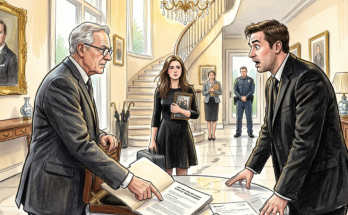
“Escort Her Out.” The Chief Of Staff Pointed At The Door. As Security Took My Arm, A Military Aide Rushed In. “Ma’am, The President Is Waiting For You.”
### Part 1
“Escort her out.”
Graham Voss said it without looking at me.
He stood beneath the high white arches of the state capitol’s executive wing, one hand tucked into his jacket pocket, the other pointing toward the brass-framed doors at the far end of the marble hallway. His tone was almost bored, as if he had asked someone to clear away an empty coffee cup.
Two security officers moved toward me.
Their shoes struck the marble in sharp, hollow clicks.
Click.
Click.
Click.
That sound stayed with me longer than Graham’s words did.
One officer stopped beside me and said quietly, “Ma’am.”
His hand settled above my elbow.
Not violent.
Not even particularly rough.
Somehow that made it worse.
I had worked in that building for four years. I knew the names of the night custodians. I knew which elevator shuddered between floors three and four. I knew that the vending machine near the press office ate dollar bills but accepted quarters. I had written legislation discussed beneath those ceilings, speeches delivered from that podium, policy that affected families Graham would never meet.
And now people I had worked beside for years were suddenly fascinated by the floor.
Nobody spoke.
Nobody asked what was happening.
Near the conference-room entrance, Derek Sloan adjusted his tie.
He had my presentation loaded on the screen behind him.
My charts.
My numbers.
My conclusions.
His name.
I looked at Graham.
“Are you seriously doing this?”
That finally made him turn.
There was satisfaction in his face, but not much emotion. Graham had been chief of staff long enough to know that the most intimidating kind of cruelty was casual cruelty.
“You’ve disrupted an event involving three governors, federal officials, and senior legislative leadership,” he said. “You were told where you belonged today.”
“I was told two hours ago that my name had been removed from the speaker list.”
“Exactly.”
“I built the presentation.”
Derek glanced toward us.
Graham followed my eyes and smiled faintly.
“No, Claire. The governor’s office built the presentation.”
There it was.
Four years condensed into one sentence.
I’m Claire Bennett.
At the time, my official title was senior policy analyst, which sounded more important than it felt. I had a basement office, no assistant, an old desk with one drawer that jammed every humid summer, and a computer monitor whose bottom-right corner had developed a permanent blue shadow.
Derek Sloan had a corner office upstairs.
He also had an uncle who happened to be one of the governor’s most generous political supporters.
Coincidence, naturally.
Graham stepped closer.
“This building is not a place for people who mistake proximity to power for possession of it.”
I felt something inside me become very quiet.
For years I had imagined that if this moment ever came, I would explode.
I didn’t.
I said, “The source files are mine.”
His smile disappeared.
“So are the drafts.”
A few people looked up.
“And I can prove when every one of them was created.”
That was when Graham’s expression changed.
Only slightly.
But I noticed.
Graham Voss was very good at controlling his face.
Fear showed up in him as stillness.
He looked toward the officers.
“Get her out of here.”
The officer beside me tightened his grip.
I could smell floor polish, burnt coffee from the registration table, and the faint metallic scent of the rain that had blown in every time someone opened the exterior doors.
I let them turn me toward the hallway.
I wasn’t going to struggle.
Graham wanted a scene.
More precisely, he wanted a version of the scene he could describe afterward.
Claire became unstable.
Claire disrupted the summit.
Claire had to be removed.
I knew how that machine worked because I had spent years feeding words into it for other people.
So I walked.
Three steps.
Four.
Behind me, Graham was already saying something to one of the event coordinators.
Then the double doors at the far end opened.
A man in a dark military uniform entered with another staff member behind him.
Conversations died almost immediately.
I recognized him from photographs attached to federal scheduling emails.
Colonel Nathan Ward.
Military aide to the President.
He stopped.
His eyes moved past Graham, past the registration tables, past Derek.
Then they landed on me.
The officer still had my arm.
Colonel Ward’s expression sharpened.
He came toward us quickly.
Graham stopped talking.
The entire hallway seemed to narrow around those polished black shoes moving across the marble.
When Colonel Ward reached us, he looked directly at me.
“Ms. Bennett?”
“Yes.”
Relief crossed his face.
“There you are.”
Graham stepped forward.
“Colonel, I can explain—”
Ward didn’t even look at him.
He said the next sentence loudly enough that everyone in the hallway heard it.
“The President is waiting for you.”
The security officer’s fingers immediately loosened around my arm.
For the first time in six years of knowing Graham Voss, I watched him lose control of his face completely.
But the strangest part wasn’t that the President wanted me.
It was the folder Colonel Ward was carrying.
A thick gray folder with a federal seal clipped to the front.
And sticking from the side was a page I recognized instantly.
Because I had written it two years earlier.
Back when I had first begun keeping score.
### Part 2
I didn’t start keeping records because I wanted revenge.
I started because of a speech.
Two years before that hallway, severe spring flooding had torn through the northern counties. Roads disappeared beneath brown water. A retirement community had to be evacuated by fishing boats. I remember photographs of refrigerators floating through kitchens and a red tricycle lodged upside down in a tree.
The governor needed to address the state.
Graham’s office wanted something reassuring.
I thought reassuring was the wrong word.
People who had watched thirty years of their lives wash downriver didn’t need reassurance. They needed someone to acknowledge what had actually happened.
So I stayed late.
At 9:40 p.m., the capitol became a completely different building. The phones stopped ringing. The marble hallways went dim except for pools of yellow-white light beneath the sconces. Somewhere above my basement office, the old pipes ticked as the heating system cooled.
I wrote until nearly two in the morning.
The final line was mine.
The central promise was mine.
The section announcing emergency rural bridge funding was mine.
The governor delivered it the next afternoon.
National outlets quoted several lines.
Staff celebrated upstairs.
I watched from a television mounted above the basement copier.
The next morning, I opened the official archive.
My name was gone from the draft history.
Not merely missing from the public version.
Removed.
The document was credited to “Executive Communications and Senior Leadership.”
I stared at the screen for almost a minute.
Then someone rolled a chair into my doorway.
Sophie Alvarez.
Deputy communications director.
Sophie was ten years older than me, wore sensible shoes because she crossed the capitol about fifteen times a day, and possessed the unnerving ability to know when someone was lying before they finished the sentence.
She held two paper cups.
“Coffee?”
“It smells terrible.”
“That wasn’t my question.”
I took one.
It tasted like burnt cardboard soaked in hot water.
She pointed at my monitor.
“They stripped your name.”
“I noticed.”
“I saw yesterday’s file.”
I said nothing.
“Claire.”
“What?”
“You wrote almost all of it.”
“Eighty percent.”
“Ninety.”
“You’re being generous.”
“I’m being accurate.”
She pulled another chair closer.
“You know Derek told the governor he helped restructure the final section?”
I actually laughed.
Not because it was funny.
Derek had left the office before dinner.
The only contribution he’d made was asking whether the governor should say “communities” instead of “towns.”
“What do you want me to do?” I asked.
“Say something.”
“To Graham?”
“Yes.”
“What do you think happens?”
Sophie leaned back.
“At least he knows you’re paying attention.”
“He already knows.”
That was the problem.
Graham had never overlooked my work accidentally.
People imagine workplace favoritism as laziness. Someone promotes a friend. Someone gives a nephew a better office.
Graham’s version was more sophisticated.
He understood that credit was currency.
He decided who accumulated it.
Derek accumulated a great deal.
I accumulated usefulness.
There’s a difference.
My first year, I had written a rural healthcare proposal that helped keep three clinics open.
Graham praised the “policy team.”
My second year, I developed the legislative framework that got a healthcare access bill through a divided state senate.
Derek appeared beside the governor when it was signed.
My third year, I wrote negotiation language that broke a transportation funding deadlock.
Graham told a newspaper it had been “the result of senior strategic leadership.”
After the flood speech, something changed in me.
Not dramatically.
I didn’t storm upstairs.
I created a folder.
Original Drafts.
Inside it went the flood speech with its creation timestamp.
Then the healthcare bill.
Then the transportation analysis.
Then emails where Graham asked me to develop an argument on Monday and Derek presented that argument on Thursday.
I stored copies outside the state network.
Facts only.
No angry commentary.
No entries saying Graham is stealing from me.
Just:
Draft created.
Draft submitted.
Name removed.
Final version published.
Sophie noticed.
“You’re building a case.”
“No.”
“That looks like a case.”
“It’s a timeline.”
“For what?”
“I don’t know yet.”
She studied me.
Then she nodded.
Two weeks later, she forwarded me an original press-release file Derek had claimed to draft.
No message.
No explanation.
Just the file.
That was Sophie.
Around the same time, something happened outside the capitol that Graham never knew about.
I received an email from a woman named Elena Marlowe.
She worked as a federal policy liaison in Washington.
She had read our healthcare legislation and wanted to understand how we had secured votes from lawmakers who normally refused to support the same lunch order, much less a major bill.
Our first call lasted thirty minutes.
Our second lasted nearly two hours.
Elena didn’t ask who had stood beside the governor during the signing ceremony.
She asked who had drafted Section Twelve.
I had.
She asked who developed the rural hospital coalition.
I had.
She asked who changed the reimbursement formula that brought two skeptical senators onboard.
I had.
There was a pause.
Then she asked, “Were you the principal drafter?”
I looked at the closed basement door.
“Yes.”
“Interesting.”
That single word made my stomach tighten.
“Why?”
“The briefing we received credits someone named Derek Sloan.”
I stared at the wall.
Above my desk was a little crack in the paint shaped like a lightning bolt.
For months I had looked at it without seeing it.
That night I couldn’t look anywhere else.
Elena continued carefully.
“Would you mind sending me the earliest version you have?”
I did.
She thanked me.
Nothing happened.
At least, nothing I could see.
Weeks passed.
Then months.
Every so often, Elena asked another question.
Another source document.
Another drafting history.
She never accused anybody of anything.
Neither did I.
But gradually, our conversations moved beyond what the governor’s office had done.
She began asking what I would do differently at the federal level.
At first I thought she was being polite.
Then she started sending proposed language.
“Thoughts?”
I sent them.
She returned revised versions.
“Better?”
Sometimes yes.
Sometimes no.
Eventually my nights developed a second rhythm.
The capitol by day.
Washington after dark.
Graham kept promoting Derek.
I kept writing.
And somewhere beyond the reach of Graham’s office, people I had never met were quietly learning my name.
Then, eleven months before the summit, Elena sent me an email containing only six words.
Can you join a secure call tonight?
I closed my office door before answering.
I didn’t know it then, but that call was the moment Graham Voss lost control of my career.
He simply wouldn’t discover it until much later.
### Part 3
The secure call began at 8:30 that night.
I took it from my apartment.
I lived on the third floor of an old brick building where the radiators hissed even when they were supposedly off. My upstairs neighbor practiced piano badly on Wednesdays. A grocery store across the street kept its sign illuminated all night, so a red glow slipped through my blinds and stretched across the kitchen wall.
I sat at the table with a legal pad and a glass of water.
Elena appeared first.
Three other names joined.
None were familiar.
Their titles were.
Senior domestic policy.
Intergovernmental affairs.
Legislative strategy.
That was the first moment I realized this wasn’t another courtesy conversation.
A man named Thomas Bell asked me about the healthcare coalition.
Not the public version.
The messy version.
“Who resisted first?”
“County hospital administrators.”
“Why?”
“They thought the reimbursement formula would shift costs onto them.”
“How’d you move them?”
“We didn’t.”
Silence.
I continued.
“We changed the formula.”
Another person leaned closer to her camera.
“Who suggested that?”
“I did.”
“What was the political cost?”
“Less than forcing a bad structure through just to preserve the appearance that our first idea had been right.”
Elena smiled.
The call lasted ninety minutes.
Nobody asked about Graham.
Nobody mentioned Derek.
That made it strangely comfortable.
For the first time in years, I wasn’t defending my right to be in the room.
I was simply in it.
Before the call ended, Thomas said, “We may want to bring you back into this.”
“Happy to help.”
“We would need discretion.”
I nearly smiled.
Discretion was something I had become exceptionally good at.
The work grew slowly.
An email every two weeks.
Then every week.
Sometimes twice a week.
I reviewed coalition structures, compared state-level implementation models, and marked up draft language that later appeared in broader federal policy discussions.
Nothing classified.
Nothing improper.
But important.
I told no one at work except Sophie.
Even then, I waited almost three months.
We were eating sandwiches on a bench behind the capitol, where delivery trucks rattled past and nobody from senior staff ever went because the landscaping wasn’t photogenic.
“I’ve been consulting with a federal group,” I said.
Sophie stopped chewing.
“A federal group.”
“Yes.”
“What kind of federal group?”
“The kind I probably shouldn’t describe loudly.”
She lowered her sandwich.
“You’re serious.”
“I’m serious.”
“How long?”
“Several months.”
“And Graham doesn’t know?”
“No.”
Her mouth slowly curved.
“I’m beginning to understand the folders.”
“The folders existed first.”
“Sure.”
“They did.”
“Claire, I’m not judging you. I’m enjoying this.”
“There is nothing to enjoy.”
“Not yet.”
She was right about that.
At the capitol, things got worse before they got better.
Derek was promoted to senior policy adviser.
The announcement described him as an architect of the administration’s bipartisan healthcare success.
Architect.
I read that word twice.
The man had once asked me whether Medicaid was federal or state because, in his words, he “always mixed that stuff up.”
A week later, Graham called me upstairs.
His office looked out over the capitol lawn.
That view irritated me more than it should have.
I had been in the building longer than several people with windows.
Graham motioned toward the chair across from his desk.
“Derek’s going to be taking more leadership on the infrastructure portfolio.”
I knew what that meant.
“What does that change for me?”
“You’ll support him.”
“I’m already leading the technical work.”
“You’re very good at technical work.”
The compliment was delivered like a cage.
“I’m also the person who developed the strategy.”
Graham leaned back.
“You need to understand something, Claire. Not every talented staffer is meant to be public-facing.”
There was no point asking what that meant.
He would deny whatever I suggested.
So I asked a better question.
“What makes Derek public-facing?”
Graham looked at me for several seconds.
Then he smiled.
“Instinct.”
I almost admired the answer.
Impossible to measure.
Impossible to disprove.
Perfect.
He slid a folder toward me.
“The multi-state infrastructure summit is in four months. Derek will give the closing presentation. I want you to prepare the policy package.”
“You want me to write his presentation.”
“I want you to support the governor.”
Same cage.
Different paint.
I took the folder.
“Anything else?”
His eyes narrowed slightly.
He had expected more resistance.
“No.”
I stood.
At the door he said, “Claire.”
I turned.
“Ambition is useful when it’s managed. Don’t let yours make you difficult.”
I carried that sentence downstairs.
Sophie was waiting near my desk.
“How bad?”
“He wants me to build Derek’s summit presentation.”
She swore under her breath.
I put the folder down.
Then I opened my laptop.
“What are you doing?”
“My job.”
She stared at me.
“That’s it?”
“No.”
I clicked into my personal archive.
“I’m also documenting his.”
The summit project became enormous.
Transportation agencies from multiple states sent raw datasets.
County officials submitted project estimates in incompatible formats.
Federal infrastructure staff requested comparative models.
Derek attended the glamorous meetings.
I did the work.
For three months, my life smelled like printer toner and reheated noodles.
My eyes hurt from spreadsheets.
My shoulders tightened from sleeping badly.
But I built something good.
Not just slides.
A framework showing how neighboring states could pool procurement, coordinate rural corridor improvements, and prevent politically popular urban projects from swallowing every available dollar.
Elena saw an early version.
Her reply arrived ten minutes later.
Who else has this?
I hesitated.
My office.
Another message.
Has it been presented federally?
No.
Her next response took longer.
Please preserve your original files.
I stared at those words.
I already had.
But the request felt different coming from her.
I typed:
Why?
Three dots appeared.
Disappeared.
Appeared again.
Finally:
Because people here are asking who actually developed this.
That night, for the first time, I wondered whether the parallel worlds I had protected so carefully were already beginning to touch.
And whether someone in Washington had started comparing names.
### Part 4
Two weeks before the summit, Derek gave a rehearsal presentation.
The conference room upstairs had freezing air-conditioning, expensive leather chairs, and a long walnut table polished so heavily I could see the ceiling lights reflected in it.
Derek stood beside a screen displaying my opening slide.
Graham sat at the table with senior staff.
I sat against the wall.
That arrangement was not accidental.
Derek clicked forward.
“Our framework focuses on cross-state procurement efficiency.”
He mispronounced the name of one of the counties.
Nobody corrected him.
He continued.
“By consolidating projected allocations, we expect a nineteen percent—”
“Fourteen,” I said.
Derek stopped.
Graham looked at me.
I pointed at the graph.
“Fourteen percent under the conservative model. Nineteen assumes every state enters during phase one.”
Derek glanced at the slide.
“Right. Obviously.”
Obviously.
He clicked forward.
Two slides later, he confused capital expenditure with annual operating expenditure.
Then he quoted a figure from an outdated dataset.
I corrected him again.
After the third correction, Graham closed his notebook.
“Claire.”
“Yes?”
“Could you let Derek finish?”
“If he uses the wrong numbers in front of federal officials—”
“He understands the point.”
The point.
Apparently numbers had become optional in a presentation built almost entirely from numbers.
Derek smirked.
“I think I can handle the room.”
I looked at him.
“Then explain the rural allocation safeguard on slide eighteen.”
His smirk weakened.
Graham’s jaw tightened.
Derek clicked backward.
Slide eighteen appeared.
He read the heading.
“We’ve structured it so rural communities receive protected—”
“How?”
He looked at me.
“What?”
“What mechanism protects the allocation?”
The room was silent.
He couldn’t answer.
I knew he couldn’t.
Because the safeguard was buried in the implementation appendix he hadn’t read.
Graham said, “That’s enough.”
I stood.
“I agree.”
I left.
Sophie caught up with me near the stairwell.
“You were terrifying in there.”
“I asked one question.”
“Exactly.”
I pushed through the stairwell door.
Our footsteps echoed down the concrete steps.
“This is going to get ugly,” she said.
“It’s already ugly.”
“No. Graham is embarrassed now.”
I stopped on the landing.
She was right.
Men like Graham tolerated competence beneath them.
What they couldn’t tolerate was competence that made their chosen people look foolish.
Three days later, I lost access to the summit planning channel.
Nobody warned me.
I clicked the internal page and got a permissions error.
Five minutes later, Graham’s assistant sent me an email.
Your role is shifting to background support. Please route all summit materials through Mr. Sloan.
I read it once.
Then forwarded it to my archive.
Sophie appeared twenty minutes later.
“He’s isolating you.”
“I noticed.”
“They removed you from the speaking prep too.”
I looked up.
“I was on the speaking prep?”
“You were yesterday.”
That was new information.
Apparently someone had initially placed me on a panel.
Someone else had removed me.
I opened the latest credential list.
My name remained under Technical Staff.
For now.
That evening, Elena called.
Her voice sounded different.
More formal.
“We need to discuss next week.”
“The summit?”
“Yes.”
“What about it?”
“There will be senior federal attendance beyond what your office has announced.”
I sat straighter.
“How senior?”
“I can’t give you scheduling information before it’s released.”
“Elena.”
A small pause.
“Claire, are you credentialed for the full event?”
“I think so.”
“You think so?”
“I was this morning.”
She exhaled.
“Bring identification.”
“I always have identification.”
“And keep your phone on.”
Something cold moved through my stomach.
“What aren’t you telling me?”
“Something that’s easier discussed in person.”
“Are you coming?”
“Yes.”
That surprised me.
Elena rarely traveled for state events.
“When?”
“You’ll see me.”
The line went quiet.
Before hanging up, she said, “Whatever happens next week, don’t delete anything.”
I looked at the folders on my laptop.
“Wasn’t planning to.”
The morning of the summit arrived cold and clear after an overnight rain.
The capitol smelled freshly washed.
News vans lined the curb before sunrise.
Inside, catering crews rolled silver coffee urns over protective mats while staff taped directional signs to marble columns.
I arrived at 6:15.
Derek arrived at 7:40 holding an expensive coffee and complaining that somebody had moved his parking space.
His presentation began at three.
Mine, technically.
At 11:05, I was reviewing final transportation numbers when Graham’s assistant appeared at my desk.
She wouldn’t quite meet my eyes.
“Graham wants your badge.”
I thought I had misunderstood.
“My badge?”
“Your summit credential.”
“Why?”
“There’s been a revision.”
She held out her hand.
I removed the laminated credential from my blazer.
“What revision?”
“You’re no longer on the speaker or conference-floor list.”
“I’m not a speaker.”
She said nothing.
That was when I understood.
I had been removed entirely.
“Who made that decision?”
“You’ll have to ask Graham.”
I did.
I found him outside the main conference room with Derek and two junior staffers.
Cameras were being tested behind them.
I walked straight toward him.
“Why was my credential revoked?”
He looked irritated that I had dared to ask where people could hear.
“This is not the time.”
“I built the summit policy package.”
“You supported it.”
“I built it.”
Derek stared at his phone.
Graham lowered his voice.
“Walk away.”
“No.”
That single word changed everything.
His head tilted.
I had spent years accommodating the structure he created.
He mistook that for obedience.
“The entire closing presentation came from my files,” I said. “If you remove me from the event, I want the instruction in writing.”
Three nearby staff members heard that.
Graham noticed.
Then he made his mistake.
He stopped lowering his voice.
“This room is for people who actually represent this administration, Claire. Not people playing dress-up with policy because they read a few briefing packets.”
My cheeks burned.
Not from shame.
From rage.
But beneath it was something colder.
Something almost peaceful.
I said, “The data behind Derek’s presentation is mine.”
Graham’s face hardened.
“So are the drafts.”
His eyes flicked toward the staffers.
“And I can prove it.”
That was the moment he ordered security to remove me.
What Graham didn’t know was that while we were arguing, a motorcade had entered the secure courtyard behind the capitol.
And inside it was someone who had apparently asked one question before entering the building.
“Where is Claire Bennett?”
### Part 5
“The President is waiting for you.”
Colonel Nathan Ward’s words traveled down the marble hallway and seemed to erase every other sound.
Graham recovered first.
Or tried to.
“There’s been some confusion,” he said.
Colonel Ward turned toward him.
“What confusion?”
Graham gestured vaguely toward me.
“Ms. Bennett was leaving.”
“Yes,” Ward said. “With me.”
The security officer removed his hand from my arm completely.
“I apologize, ma’am.”
“You were doing your job.”
I meant it.
He had followed an instruction from the chief of staff.
The problem wasn’t him.
The problem stood six feet away suddenly trying to construct a story faster than reality was dismantling it.
Derek had drifted closer.
His face looked pale beneath the conference-room lighting.
“Colonel,” Graham said, “I wasn’t informed that Ms. Bennett had any role in the federal delegation.”
Ward looked mildly surprised.
“You weren’t?”
There was something devastating about the question.
Not sarcastic.
Not aggressive.
Just genuinely puzzled.
“No.”
Ward opened the gray folder.
“Then perhaps someone should have informed you.”
He removed several pages.
I recognized them immediately.
My healthcare bill drafts.
The first version had my name in the document header.
The final state release did not.
Then came infrastructure framework drafts.
My timestamps.
My tracked revisions.
Emails.
Metadata reports.
Sophie had reached the hallway by then.
Her eyes met mine.
I could tell from her face she hadn’t known this was coming either.
A woman behind Colonel Ward stepped forward.
Elena Marlowe.
She wore a navy coat and carried a leather portfolio.
For almost two years I had known her mostly as a face in a small rectangle on my laptop.
Seeing her beneath the capitol chandeliers felt like watching someone step out of one life and into another.
“Claire.”
“Elena.”
Graham looked between us.
“You two know each other?”
Elena answered.
“For some time.”
Derek finally spoke.
“What exactly is this?”
Elena turned toward him.
“You’re Mr. Sloan?”
“Yes.”
She looked at the presentation screen visible through the open conference-room doors.
Then back at him.
“I’ve read a great deal of your work.”
Derek’s shoulders relaxed by half an inch.
“Thank you.”
Elena added, “Although I’m increasingly uncertain how much of it is yours.”
Nobody moved.
If Graham’s public insult had burned, that sentence felt like ice being poured over the entire hallway.
Elena laid a document on the registration table.
Then another.
The first was a draft of the rural healthcare coalition framework.
Mine.
The second was the final state briefing credited to senior staff.
Then infrastructure.
Then flood recovery language.
Original.
Final.
Original.
Final.
A pattern anyone could understand without an attorney or a forensic analyst.
Derek stepped closer.
“This proves nothing. Policy documents pass through dozens of hands.”
“That’s true,” Elena said.
She flipped another page.
“That is why federal staff reviewed version histories.”
Derek stopped talking.
Graham’s gaze snapped toward me.
I could almost hear the question in his head.
How much did she save?
The answer was simple.
Enough.
But I didn’t say it.
People started gathering.
Not dramatically.
That was what made it worse for Graham.
A legislative aide slowed down.
A reporter near the coffee station looked over.
Two agency directors paused beside the conference-room doors.
Then the governor arrived.
Governor Malcolm Rhodes was not a warm man, but he was observant.
He looked at the security officers.
At me.
At Colonel Ward.
At the papers.
Then at Graham.
“What happened?”
Graham stepped forward.
“Governor, there was a misunderstanding involving Claire and event access.”
I nearly admired him.
Thirty seconds earlier, I had been an insubordinate staffer who needed to be escorted out.
Now I was Claire again.
The governor looked at me.
“Ms. Bennett?”
Before I could answer, Colonel Ward said, “Sir, the President requested Ms. Bennett personally for the policy briefing this afternoon.”
The governor’s eyebrows rose.
“Personally?”
“Yes, sir.”
That word changed the temperature.
The President had not randomly asked for another state employee.
Someone had put my work in front of him.
Someone had explained whose work it actually was.
Governor Rhodes looked toward the papers.
“What am I looking at?”
Elena answered.
“A provenance review.”
Graham’s face tightened.
The governor picked up the first page.
He read.
Turned it over.
Picked up another.
He didn’t need long.
Political leaders may ignore how work is produced until the production becomes politically dangerous. Then their comprehension becomes remarkably fast.
He looked at Graham.
“Did you know about this?”
Graham chose his words.
“I was aware Claire contributed substantially to several projects.”
Contributed.
I felt Sophie move beside me.
The governor asked, “Were you aware final materials routinely removed her attribution?”
“Governor, authorship in an executive office is collaborative—”
“That wasn’t my question.”
Silence.
Derek looked like he wanted to disappear into the wallpaper.
Governor Rhodes glanced toward me again.
“How much of the infrastructure presentation did you develop?”
“All of the analytical framework.”
Derek interrupted.
“That’s not accurate.”
Every head turned.
Of all the available choices, he selected the worst.
He walked toward the registration table.
“I reviewed the framework. I shaped the final strategy.”
I looked at him.
“What did you change?”
His mouth opened.
I waited.
He looked at the papers instead.
I asked, “What does the rural allocation safeguard do?”
The same question from rehearsal.
Derek said nothing.
Governor Rhodes stared at him.
That was enough.
He turned to Graham.
“We will discuss staffing before the end of the day.”
There was no anger in his voice.
Finality sounds quieter than anger.
Colonel Ward checked his watch.
“Ms. Bennett, we need to move.”
I started toward him.
Then Graham said my name.
“Claire.”
I turned.
For one strange second, I thought he might apologize.
Instead he said, “Whatever story they’ve given you, remember who gave you your opportunity here.”
There it was.
Even with his authority collapsing in front of him, Graham needed me to believe I owed him something.
I looked at the basement badge still clipped to my blazer.
“No,” I said.
“You gave me a desk.”
Then I walked away.
The secure briefing room had been prepared upstairs.
I assumed the President wanted to hear about infrastructure.
I was wrong.
When I entered, the first document waiting at my seat wasn’t the summit presentation.
It was a proposal I had written almost three years earlier.
A proposal Graham had told me was “too ambitious to ever leave this building.”
Someone had taken it all the way to Washington.
And now the President wanted to know why it had disappeared.
### Part 6
The room was smaller than I expected.
That’s one of the strange things about power.
From the outside, you imagine enormous rooms, enormous desks, enormous gestures.
Real decisions often happen around ordinary tables beneath fluorescent lights with half-empty water glasses and stacks of paper nobody bothered to align.
The President entered with only a handful of senior advisers.
I’m not going to pretend I wasn’t nervous.
My palms were damp.
My mouth went dry.
For years, Graham had conditioned me to think speaking beyond my assigned role was dangerous.
Now I had been placed at the center of a federal briefing and asked to explain my work.
The President sat across from me.
“I’m told you developed the original rural access model.”
“Yes, sir.”
He tapped the old proposal.
“Why wasn’t it implemented?”
The political answer would have been complicated.
The truthful answer was shorter.
“Chief of Staff Voss killed it.”
“Why?”
“He said it was too ambitious.”
“Was it?”
“At the time? Maybe.”
A few people looked up.
I continued.
“But the problem wasn’t ambition. The problem was that implementing it would require cooperation with officials he didn’t control.”
The President nodded once.
“What would you change now?”
That was the moment something inside me unlocked.
Not because of who was asking.
Because he had asked the right question.
Not who deserved credit.
Not who was responsible for what.
What would you change now?
So I told him.
I explained how the original rural access model could connect with infrastructure investment. How broadband, transportation, emergency care, and hospital staffing were usually treated as separate policy silos even though families living in remote counties experienced them as one problem.
A mother didn’t care which department owned the budget line when an ambulance took forty minutes to reach her child.
A farmer didn’t distinguish broadband policy from healthcare policy when his clinic had moved appointments online.
An elderly couple didn’t care whether a washed-out bridge belonged to transportation or emergency management when that bridge was the route to their nearest hospital.
The President asked questions.
I answered.
Other advisers joined.
Thirty minutes became an hour.
Nobody interrupted to tell me Derek could explain it better.
Nobody asked me to prepare notes for someone else to present.
At one point Elena slid a blank legal pad toward me because I had filled mine.
I realized, with a sensation almost like grief, how accustomed I had become to shrinking.
The briefing ended with the President saying, “I’d like your continued involvement.”
Not Graham’s office.
Mine.
Afterward, Elena and I walked into a quieter side corridor.
My legs suddenly felt weak.
“You okay?” she asked.
“I think so.”
“You look like you just survived a tornado.”
“I may have.”
She laughed.
Then I asked the question that had been bothering me.
“How did that old proposal get here?”
Her expression changed.
“Sophie.”
I stopped.
“What?”
“She sent it.”
“When?”
“Months ago.”
I stared at her.
Sophie had saved more than I knew.
Elena leaned against the wall.
“Claire, you weren’t the only one documenting what happened.”
That shook me more than the President’s invitation.
I had spent years believing I was quietly protecting myself.
Meanwhile, Sophie had been quietly protecting the truth.
“She sent everything?”
“Not everything. Enough to make us curious.”
“Why didn’t she tell me?”
“You’d have tried to stop her.”
Unfortunately, that was probably true.
When I returned downstairs, the summit was still underway.
The atmosphere had changed.
People looked at me now.
Some smiled too eagerly.
Others suddenly remembered we had once worked together.
A senior adviser who had ignored me for three years stopped me near the elevator.
“Claire, incredible news. Always knew you were going places.”
He had once called me Lauren for six consecutive months.
“Thank you.”
I kept walking.
Sophie was waiting by my desk.
I closed the door.
“You sent Elena the rural proposal.”
She winced.
“I was wondering when that would come up.”
“You didn’t tell me.”
“You would’ve said no.”
“That’s what Elena said.”
“She’s smart.”
“Sophie.”
She became serious.
“I watched them erase you for years.”
“That doesn’t mean you get to send my files around.”
“They weren’t confidential. And I sent originals you authored to a policy office already reviewing the same subject.”
I sat down.
She lowered her voice.
“I’m sorry I didn’t tell you. I’m not sorry I did it.”
For several seconds I was angry.
Then tired.
Then something else.
Grateful.
“I wish you’d trusted me enough to ask.”
“I trusted you completely. I didn’t trust you to choose yourself.”
That hurt because it was true.
Before I could answer, someone knocked.
Governor Rhodes.
I had never seen him in the basement.
Neither had anyone else.
The entire hallway had gone unnaturally silent behind him.
“Ms. Bennett.”
“Governor.”
“May I come in?”
Sophie stood.
“I’ll give you two a minute.”
The governor closed the door.
He looked around my office.
The flickering light had finally been replaced, but everything else looked exactly as small as it was.
His gaze rested on the metal filing cabinet.
Then the cheap visitor chair.
Then me.
“I owe you an apology.”
I said nothing.
“I relied too heavily on people I trusted.”
Still nothing.
“I should have known how much of this administration’s policy work was yours.”
That sentence irritated me.
“Why?”
He seemed surprised.
“Excuse me?”
“Why should you have known?”
“Because I’m the governor.”
“Then yes.”
He absorbed that.
I continued.
“People keep telling me Graham hid my work. He did. But those documents crossed a lot of desks. People heard Derek present ideas he couldn’t explain. People saw who was doing the late-night work. Nobody asked because the system was convenient.”
Governor Rhodes looked genuinely uncomfortable.
Good.
“I’m reviewing the staffing structure,” he said.
“I assumed so.”
“There may be an opportunity for you.”
That was interesting.
Six hours earlier, I had been removed from his summit.
Now there was an opportunity.
“What kind?”
He looked directly at me.
“Chief of staff.”
I almost laughed.
Not because the offer was insulting.
Because four years earlier, it would have been everything I thought I wanted.
Now, sitting inside the basement office I had once desperately wanted to escape, I realized something startling.
I didn’t want Graham’s chair.
I wanted out of the kingdom entirely.
### Part 7
Graham resigned three days later.
The official statement said he was leaving to pursue opportunities in the private sector and spend more time considering the next chapter of his career.
Politics has a special language for disasters.
Nobody is fired.
They transition.
Nobody is disgraced.
They pursue new opportunities.
Nobody loses power.
They return to private life.
Sophie read the announcement from my doorway.
“Should we send flowers?”
“No.”
“Fruit basket?”
“No.”
“Sympathy card?”
I looked at her.
She grinned.
“Fine.”
Derek lasted longer.
Technically.
He was reassigned to an internal coordination position with no public portfolio.
His corner office disappeared.
So did the speaking invitations.
Three weeks later, he resigned too.
I never spoke to him again.
People expected me to enjoy that part.
I didn’t.
There was satisfaction, certainly.
But mostly I felt empty.
For years I had imagined justice as a warm thing.
It wasn’t.
Justice was colder.
Cleaner.
A door closing properly after being stuck for a long time.
Governor Rhodes gave me forty-eight hours to consider the chief-of-staff offer.
I needed about forty-eight seconds.
I waited anyway.
When I returned to his office, the lawn outside his windows was bright with early spring sun.
He gestured toward the chair.
“Well?”
“I appreciate the offer.”
His expression already told me he heard what was coming.
“But no.”
“May I ask why?”
I looked at the desk where Graham had sat through hundreds of meetings.
“I spent too long believing advancement meant getting closer to that chair.”
“And now?”
“Now I think I was measuring the wrong distance.”
The governor leaned back.
“Washington?”
“Possibly.”
He nodded slowly.
“I can’t blame you.”
I wondered if that was true.
Then he said something I respected.
“For what it’s worth, you were right downstairs. I should have noticed.”
It didn’t repair anything.
But it was the first apology from anyone in senior leadership that didn’t contain the word if.
Within a month, the federal policy group formalized my consulting role.
Six weeks later, I left the capitol carrying two cardboard boxes.
Four years of my professional life fit inside them.
Books.
A framed photograph of my parents.
A ceramic mug Sophie had given me that said POLICY IS PERSONAL.
A tiny cactus I had somehow kept alive despite forgetting to water it for entire weeks.
The security officer who had once held my arm helped open the exterior door.
“Good luck, Ms. Bennett.”
“Thank you.”
Outside, the afternoon smelled like wet grass.
I walked down the same steps I had climbed on my first day, when I had been twenty-eight, nervous, and convinced good work would automatically be rewarded.
I wished I could tell that younger woman something.
Not that hard work didn’t matter.
It mattered enormously.
But hard work without ownership can become a resource other people mine.
I moved to Washington that summer.
My new office wasn’t glamorous.
That surprised everyone who imagined federal work involved marble columns and polished mahogany.
My first desk was gray laminate.
The air-conditioning hummed too loudly.
The coffee was significantly better.
That was enough.
Elena became my mentor almost by accident.
She never announced herself that way.
She simply did what mentors actually do.
She invited me into rooms.
Then let me speak once I got there.
She criticized my drafts honestly.
She told me when I was being too cautious.
She reminded me that diplomacy and silence were not the same skill.
One afternoon she returned a memo covered in handwritten notes.
At the bottom she had written:
Stop writing as if Graham is still reading over your shoulder.
I stared at that sentence for a long time.
She was right.
Even after leaving, I still softened strong recommendations.
Still wrote “perhaps” when I meant “should.”
Still placed conclusions on page four instead of page one.
Graham had left my career before he left my habits.
Undoing that took longer.
Sophie joined us nine months later.
I hadn’t pressured her.
When a communications strategy position opened, I sent her the link.
Nothing else.
She replied:
Do they have edible coffee?
I wrote:
Mostly.
She applied.
When she arrived on her first morning, she walked past my open door, backed up, and pulled a chair inside without asking.
“Some traditions are sacred,” she said.
I laughed harder than I had in months.
Life got bigger.
Not instantly.
Not magically.
There were still bad meetings.
Still egos.
Still political games.
Power did not become pure because I changed buildings.
The difference was that I had changed.
I asked for attribution.
I corrected the record.
I spoke when my work was mischaracterized.
More importantly, I did the same for people below me.
If a junior analyst wrote the argument, their name stayed on the draft.
If an assistant developed the solution, they presented the solution.
The first time I watched a twenty-five-year-old researcher brief senior officials on work she had actually done, I understood how easy fairness could have been all along.
People like Graham made exploitation look inevitable.
It wasn’t.
A year after I left, his name appeared on my phone.
Not a call.
A message.
I stared at it while rain tapped against my apartment windows.
Claire. Hope you’re well. I’ve followed your work with interest. I’ve been reflecting on our time together and would be glad to reconnect. If you ever need a reference, I’d be happy to provide one.
I read it twice.
Then a third time.
Not because I was angry.
Because I wasn’t.
That surprised me.
Once, I had wanted Graham Voss to understand what he had done.
Now his understanding seemed irrelevant.
I typed a reply.
Thank you for reaching out. I’m doing well and hope you are too. I won’t require a reference, but I appreciate the offer.
My thumb hovered above Send.
Sophie, sitting across from me at dinner, noticed.
“Who is it?”
“Graham.”
Her eyebrows rose.
“What does he want?”
“To reconnect.”
“Oh, absolutely not.”
I smiled.
“I wasn’t planning to.”
“Good.”
I sent the message.
Then I blocked the number.
Not dramatically.
Not angrily.
I simply didn’t want him in my life.
Some doors aren’t meant to be reopened just because the person who slammed them finally discovers what was on the other side.
I thought that was the end of Graham Voss.
It almost was.
Then, three months later, I received a gray envelope from my old state capitol.
Inside was a copy of a document I had never seen before.
A handwritten note from Governor Rhodes was attached.
You deserved to know this existed.
The document was dated eighteen months before the summit.
And at the bottom, beside Graham’s signature, was proof that he had known about Washington’s interest in me long before he ordered me escorted out.
### Part 8
I read the document at my kitchen table.
Then I read it again.
Rain pressed softly against the windows.
My apartment smelled like the tomato soup I had forgotten on the stove, now cooling in a pot behind me.
The document was a staffing memorandum.
Nothing dramatic.
No secret conspiracy.
No criminal scheme.
In some ways, what it revealed was worse because it was so ordinary.
Eighteen months before the summit, a federal intergovernmental office had contacted the governor’s administration asking whether I could participate in a broader policy working group.
The request had gone to Graham.
His response was attached.
Ms. Bennett is a capable technical employee but is not currently positioned for external representation. We recommend routing federal consultation through senior policy adviser Derek Sloan.
I sat completely still.
Eighteen months.
Graham had known.
All that time, I had assumed my Washington work existed outside his awareness.
Apparently, the first invitation had not.
He had tried to reroute it.
To Derek.
The federal office had gone around him.
That explained why Elena’s earliest messages had been cautious.
Why she had contacted me directly.
Why so many requests had avoided the state system.
I called her.
She answered on the fourth ring.
“You got the document.”
“How did you know?”
“Governor Rhodes told me he planned to send it.”
I looked at Graham’s signature.
“Why didn’t you tell me?”
“Because at the time, we couldn’t prove motive.”
“You knew he blocked the invitation.”
“We knew he redirected it.”
“To Derek.”
“Yes.”
“And nobody thought I should know?”
“I thought you should.”
“Then why didn’t you tell me?”
Elena went quiet.
“Because I made a judgment call.”
I waited.
“I thought knowing would make you confront him before you had enough leverage to survive the confrontation.”
That answer made me angry.
Not Graham-angry.
Different.
Because it came from someone I trusted.
“You made that choice for me.”
“Yes.”
“That wasn’t your choice.”
“No.”
The fact that she didn’t defend herself softened something.
She continued.
“I was wrong about that part.”
I rubbed my forehead.
“When did the President’s staff learn?”
“Later. During the infrastructure review.”
“So Graham had been trying to keep me out of federal work for more than a year.”
“Yes.”
“Why?”
“You’d have to ask him.”
“No.”
That answer came instantly.
I never wanted another explanation from Graham.
Because by then, I understood.
Maybe he feared losing control over work he depended on.
Maybe he didn’t want Derek exposed.
Maybe my moving upward threatened the hierarchy he had built.
Maybe he simply couldn’t tolerate someone he had categorized as support becoming impossible to contain.
The motive didn’t matter enough to reopen the door.
I folded the document.
Then I put it into the last folder I ever created about Graham Voss.
Not because I intended to use it.
Because history deserved to be accurate.
Years passed.
The strange thing about life after a defining injustice is how ordinary it eventually becomes.
You think the thing will follow you everywhere.
Then one morning you wake up more concerned about groceries than revenge.
A few years after the summit, I was appointed to lead a national working group on rural infrastructure and healthcare access.
The announcement was small.
No dramatic ceremony.
My parents called.
Sophie brought champagne that cost more than either of us would normally spend.
Elena sent me a one-line message.
About time.
I replied:
Agreed.
By then, I had forgiven her for withholding the Graham memo.
Forgiveness was possible because she had apologized without bargaining for it and changed how she treated me afterward.
That distinction mattered.
Forgiveness without change is just permission wearing nicer clothes.
Graham never apologized.
Not really.
His message about reconnecting contained reflection without responsibility.
He hoped I was well.
He offered a reference.
He never said:
I erased your work.
I blocked your opportunity.
I humiliated you publicly.
I was wrong.
So I felt no obligation to offer him peace he had never bothered to earn.
Years later, a young analyst named Rachel Kim came into my office.
She was brilliant, quiet, and visibly furious.
She carried a printed briefing.
“What happened?”
She placed it on my desk.
A director in another division had presented her research that morning without crediting her.
I looked at the document.
Then at her.
“Did you write this?”
“Yes.”
“Can you prove it?”
Her expression shifted.
“Yes.”
“Good.”
She seemed almost disappointed by how calm I sounded.
“What do I do?”
I remembered Sophie pulling a chair beside my basement desk.
I remembered Elena asking for original files.
I remembered Graham pointing toward those doors.
I remembered the security officer’s hand above my elbow.
“First,” I said, “we correct the record.”
Rachel blinked.
“Just like that?”
“Just like that.”
“What if he gets angry?”
“He might.”
“What if he says I’m difficult?”
“He might do that too.”
She swallowed.
I leaned forward.
“Being professional does not require participating in your own disappearance.”
Something in her face changed.
We corrected the attribution that afternoon.
Not secretly.
Not vindictively.
I asked the director to revise the distribution and include Rachel as principal analyst.
He resisted.
I insisted.
The world did not collapse.
Nobody needed to keep secret folders for two years.
Nobody had to be escorted from a building.
That was the victory Graham would never understand.
My greatest revenge was not getting a bigger title than his.
It was building a workplace where someone like him could not do what he had done to me.
Sometimes people ask whether I’m grateful it happened.
I’m not.
Pain does not deserve gratitude merely because we survived it.
I learned from those years.
That is different.
I learned that talent does not protect you from exploitation.
Documentation matters.
Attribution matters.
Allies matter.
Quiet people may be keeping much better records than powerful people realize.
And patience is not weakness when you know exactly what you’re waiting for.
But I also learned something harder.
There comes a point when proving yourself to people committed to misunderstanding you becomes a waste of your life.
I spent years hoping Graham would finally look at me and admit what I was capable of.
By the time he did, his opinion had become worthless.
That may have been the most important promotion I ever received.
Not the federal title.
Not the national working group.
Freedom from needing his approval.
I still occasionally visit the state capitol.
The first time I returned for an intergovernmental meeting, I walked through the same marble hallway where security had once taken my arm.
The floor had been polished.
The chandeliers were the same.
The registration table stood almost exactly where it had during the summit.
For a second, memory arrived so vividly that I heard those footsteps again.
Click.
Click.
Click.
Then another sound replaced them.
“Ms. Bennett?”
A young staffer hurried toward me.
“The governor’s team is ready for your briefing.”
Different governor.
Different staff.
Different life.
I looked toward the double doors at the end of the hallway.
Years earlier, Graham Voss had pointed at them and ordered me out because he believed the building belonged to people like him.
He thought power meant deciding who got through which door.
I understand it differently now.
Real power is knowing that one locked door does not define the size of your world.
Sometimes the person pushing you out believes they are ending your story.
Sometimes they are simply forcing you toward the entrance of a much larger one.
I followed the staffer down the hallway.
Nobody escorted me.
Nobody needed to.
And when those double doors opened this time, I walked through them under my own name.
THE END!