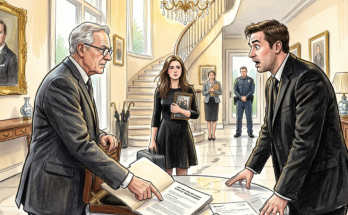
While I Fought For My Life On The Battlefield, The Medic Called My Mom. She Hung Up: “Don’t Ruin Our Party Mood.” Then They Posted A Photo On My Deck: “Finally, A Day Without The War Drama.” They Thought I Was Dying. But I Woke Up, Made One Call, And Sold Something They Thought Was Theirs. Who’s Dramatic Now?
### Part 1
The first thing I remember after waking up was the sound of a monitor beside my head.
Beep.
Pause.
Beep.
Pause.
The rhythm was so steady it almost made the room feel peaceful, which was strange because nothing about my body felt peaceful.
My mouth was dry enough that my tongue stuck to the roof of it. A cold sheet covered me from the waist down, and fluorescent lights reflected off the polished floor of the overseas military hospital like strips of ice.
For several seconds, I couldn’t remember why I was there.
Then the memories came back in pieces.
The brutal heat.
The weight of my medical pack pulling against my shoulders.
The strange weakness spreading through my legs.
Someone shouting my name.
The ground rushing up.
After that, nothing.
A nurse noticed my eyes were open and came quickly to my bedside.
“Easy, Lieutenant. Don’t try to sit up.”
“My unit?”
“They’re safe.”
Her answer came so quickly that I realized she’d probably been told that would be my first question.
“How long?”
“Almost two days.”
Two days.
I closed my eyes.
Even breathing felt like work.
The nurse checked one of the screens beside me, adjusted the blanket, then said, “Your system took a serious hit. The doctors were worried for a while.”
“Did anyone call my family?”
Something changed in her face.
Not much.
Just enough.
“Yes.”
That single word told me more than I wanted to know.
“My mother?”
She hesitated.
“Your emergency contact was notified.”
I knew immediately something had happened.
My mother had a talent for making every room uncomfortable without ever raising her voice. She could turn a compliment into an insult so elegantly that other people sometimes smiled before realizing what she had done.
For thirty-two years, she had treated every problem I experienced as a performance.
When I broke my wrist at eleven, she told the emergency-room nurse I had “a low tolerance for discomfort.”
When I cried after my grandfather died, she told relatives I was “making grief about myself.”
When I enlisted, she asked how long it would take before I came home because military life was “too demanding for someone so emotional.”
Some families have nicknames.
Mine gave me a diagnosis.
Drama.
That was the word.
If my younger brother Owen wrecked a car, he was “going through a difficult phase.”
If I disagreed with Dad at dinner, I was “starting drama.”
If Owen borrowed money and didn’t repay it, he needed support.
If I asked why the rules were different for me, I was jealous.
Eventually, I stopped asking.
Joining the military was the first decision I made without trying to imagine what my parents would think.
Becoming a medic was the second.
Buying the lake house was the third.
That house mattered to me in ways they never understood.
It sat beside a quiet stretch of blue water surrounded by pines, with a long wooden deck and windows that turned gold every evening when the sun dropped behind the ridge.
I bought it at thirty after years of deployments, overtime, saving, and saying no to almost everything I didn’t need.
No family money.
No co-signer.
No inheritance.
Just me.
The day I showed my parents the house, Mom walked slowly across the deck, looked at the water, and said, “It seems like a lot of house for one person.”
I laughed because I assumed she was joking.
She wasn’t.
Dad opened the refrigerator without asking.
Owen immediately wanted to know whether he could use the place for weekends.
I told them no.
Not because I hated them.
Because for once, I wanted something that belonged completely to me.
Before my current deployment, I had been even clearer.
“The house is closed while I’m gone.”
Mom had stared at me across my kitchen island.
“To your own parents?”
“To everyone.”
She smiled.
That tight little smile she used whenever she believed I would eventually give in.
“You’ve become very territorial.”
“I’ve become very specific.”
The spare keys went into the locked safe in my office.
Nobody had permission to enter.
Nobody.
Back in the ICU, the nurse stepped away to speak to someone in the hall.
My phone was lying on the small table beside the bed.
I reached for it.
The movement sent exhaustion through my entire arm, but I managed to pull it close.
No missed calls from Mom.
None from Dad.
Nothing from Owen.
I stared at the empty notification screen until something cold settled in my chest.
Then a social media alert appeared.
My mother had posted a new photo.
For reasons I still can’t explain, I opened it.
The image loaded slowly on the weak hospital connection.
First I saw blue sky.
Then champagne glasses.
Then my father.
My brother.
My mother.
And behind them, unmistakable in the afternoon sunlight, was the wooden railing of my lake house.
There were at least a dozen people on my deck.
Someone had hung decorations from my pergola.
A cooler sat beside my outdoor fireplace.
My parents were smiling like they owned the place.
My thumb trembled as I scrolled down.
Then I read the caption.
“Sunny skies, good wine, and the family that actually matters. Finally, a day free of the war drama.”
For a long moment, I heard nothing.
Not the monitor.
Not the footsteps outside.
Not even my own breathing.
They weren’t just ignoring the fact that I had nearly died.
They were celebrating inside the one place I had explicitly forbidden them to enter.
And somehow, while I had been unconscious, they had gotten the keys.
That was when a second question hit me.
If they had gotten into the safe, what else had they touched?
### Part 2
I didn’t call my mother.
That surprised even me.
The younger version of me would have.
Twenty-two-year-old me would have called screaming.
Twenty-five-year-old me would have demanded an explanation.
Twenty-eight-year-old me might even have apologized halfway through the argument just to make the yelling stop.
Thirty-two-year-old me took screenshots.
Every photograph.
Every caption.
Every comment.
Every smiling face standing on property that belonged solely to me.
My mother’s friends had filled the post with compliments.
“What a gorgeous place!”
“Your lake house is incredible!”
“You deserve this getaway!”
Mom had responded to one woman with, “We’re finally learning to enjoy what we’ve worked for.”
I read that sentence three times.
What we’ve worked for.
Something inside me became very still.
The nurse returned carrying water.
“You okay?”
I turned the screen toward her.
She glanced at the photograph, then looked at me.
“Is that your house?”
“Yes.”
“Are they supposed to be there?”
“No.”
Her eyebrows lifted.
“That seems like a problem.”
“It is.”
I took a sip of water.
Then I asked, “Can you find Sergeant Reed?”
Sergeant Jonah Reed was my unit supervisor and one of the calmest people I had ever met. He had been present when I collapsed, and according to the nurse, he was still nearby handling administrative paperwork.
He arrived twenty minutes later.
Jonah was a broad-shouldered man in his forties who somehow looked permanently tired and permanently alert at the same time.
The moment he entered, he studied my face.
“You look better.”
“You look like you haven’t slept.”
“That’s because I haven’t.”
He pulled a chair beside the bed.
“You scared everyone.”
“What happened?”
His expression became serious.
“You went down fast. Your body was already stressed from the heat, and there was an infection nobody knew about. By the time we got you inside, you weren’t responding.”
I looked at the monitor.
“They called my mother.”
Jonah went quiet.
“What did she say?”
He rubbed his jaw.
“You don’t need that right now.”
“What did she say?”
He exhaled.
“I called because protocol required it.”
“And?”
“She thought I was exaggerating.”
I actually laughed.
It hurt.
Not physically.
Somewhere deeper.
“Of course she did.”
“Evelyn—”
“What exactly did she say?”
He looked reluctant, which told me it was worse than I expected.
“She said not to ruin their party mood. She said you always exaggerate everything.”
My fingers tightened around the blanket.
“Then?”
“She hung up.”
“Did you call again?”
“I tried.”
He looked at me carefully.
“The number wouldn’t go through.”
She had blocked him.
I turned my face toward the window.
Beyond the glass, evening sunlight burned orange against a dusty sky.
For years, I had defended my parents by changing the vocabulary.
Cruel became complicated.
Dismissive became old-fashioned.
Favoritism became misunderstanding.
Manipulation became concern.
But there are moments when language stops protecting people.
My mother had been told her daughter was unconscious in a military medical emergency.
She had responded by complaining about her party.
Not even that destroyed me as much as the timing.
Her party.
At my house.
“Did she know where you were calling from?” I asked.
“Yes.”
“Did you tell her it was serious?”
“Repeatedly.”
I nodded.
Something was ending inside me.
Not dramatically.
Not loudly.
More like a door closing.
I handed Jonah my phone.
He studied the picture.
“That’s your place?”
“Apparently it’s my family’s resort now.”
He frowned at the caption.
“That was posted after the call.”
“Exactly.”
He looked at me.
“What are you going to do?”
That was when I remembered the voicemail.
Six months earlier, a real estate attorney named Daniel Mercer had contacted me about a buyer interested in my lake property.
I wasn’t trying to sell.
The buyer didn’t care.
He had apparently been looking for waterfront acreage in that particular area and had already made two generous offers.
I rejected both.
Daniel told me if I ever changed my mind, the offer would probably remain available.
At the time, I thought he was wasting his breath.
Now I searched my contacts.
His name was still there.
Jonah noticed.
“Attorney?”
“Real estate.”
His eyes narrowed.
“You’re thinking about selling?”
“I’m thinking about removing the board beneath their feet while they’re still standing on it.”
For the first time since he entered the room, Jonah smiled.
“Now you sound like yourself.”
I hit call.
Daniel answered on the fourth ring.
“Evelyn?”
“Hi, Daniel.”
“You sound terrible.”
“Overseas hospital.”
There was a pause.
“That explains it.”
“Is your client still interested in the lake property?”
Another pause.
Longer this time.
“Yes.”
“Cash?”
“Yes.”
“How quickly?”
“If the title is clean and you’re serious? Very quickly.”
“It’s clean.”
I looked again at my mother’s photograph.
In the background, Owen was standing beside my grill wearing one of my old college sweatshirts.
He hadn’t even packed enough clothes.
He had gone through my closet.
I felt something colder than anger.
“Daniel, I need another favor.”
“What kind?”
“I need to know exactly how fast a buyer can take lawful possession after closing.”
His voice sharpened.
“Is somebody occupying the property?”
“Yes.”
“Tenant?”
“No.”
“Authorized guest?”
“No.”
I looked at the caption one more time.
“Family.”
Daniel sighed.
“That’s usually worse.”
Then he said something that completely changed what I thought I was dealing with.
“Evelyn, before we discuss a sale, you need to answer one question.”
“What?”
“Did you ever give your parents permission to receive mail at that address?”
My heart sank.
“No.”
“Then we may have a bigger problem than a party.”
### Part 3
Daniel asked me to check my home security account.
That should have been easy.
It wasn’t.
My lake house had exterior cameras and a smart lock, mostly because deployments kept me away for months at a time. I rarely checked them unless weather alerts came through.
I opened the security app.
Password incorrect.
I typed it again.
Incorrect.
I stared at the screen.
“That’s impossible.”
Jonah leaned closer.
“What?”
“My password changed.”
Daniel was still on speaker.
“When did you last access the account?”
“Maybe three weeks ago.”
“Can you recover it through email?”
I tried.
The recovery message came through immediately.
I reset the password and logged in.
Then I felt the temperature of the room disappear.
The smart lock history showed entries beginning almost seven weeks earlier.
Not today.
Not yesterday.
Seven weeks.
Someone had been entering my house while I was overseas.
Again.
And again.
And again.
The first entry occurred at 8:13 on a Saturday morning.
The code used was labeled OWNER BACKUP.
Only two physical backup keys existed.
Both had been inside my safe.
I opened the camera archive.
Several weeks of footage were missing.
Not all of it.
Just enough.
Daniel said, “Can anyone else control your account?”
“No.”
“Could someone have gotten physical access to your computer before deployment?”
“My parents visited.”
I remembered Mom standing near my office doorway while I packed medical supplies.
Dad carrying boxes from my garage.
Owen asking where I kept my passport because he claimed he was curious about deployment documentation.
At the time, all of it had seemed annoying rather than suspicious.
Now every memory had edges.
I pulled up the oldest surviving clip.
My father appeared on the driveway.
He wasn’t sneaking.
That was what disturbed me most.
He walked toward the front door carrying groceries as casually as if he had lived there for years.
Mom followed him.
Owen arrived twenty minutes later.
The next clip showed Dad bringing a folding table inside.
Another showed Mom opening the garage.
Another showed two people I didn’t recognize arriving with overnight bags.
Jonah muttered, “They’ve been using it.”
Daniel asked, “Do you have any financial accounts tied to that address?”
“Utilities. Insurance. Property tax.”
“Anything else?”
“No.”
“Then why did you react when I asked about mail?”
I turned toward the phone.
“Because I suddenly remembered something.”
Three months before deployment, my father had asked whether he could send an insurance document to my house because he was having “mail problems.”
I said no.
He laughed.
I had forgotten about it.
Maybe he hadn’t.
“Daniel, what are you worried they’re trying to establish?”
“Right now? Nothing specific. I’m trying not to jump ahead.”
“Jump.”
He paused.
“If someone receives mail at a property, keeps possessions there, and can demonstrate repeated access, they sometimes try to create the appearance that they have occupancy rights.”
“That house is mine.”
“I know.”
“The deed is mine.”
“I know.”
“They can’t just take it.”
“Not lawfully.”
I hated the way he said that.
Not lawfully.
People who respect rules hear those words and feel reassured.
People raised by boundary-breakers hear them differently.
“What do I need to do?”
“First, preserve everything. Screenshots. Access logs. Video. Messages. Second, don’t contact them yet.”
That was difficult.
My phone was already full of evidence.
My mother had uploaded another picture.
This one showed my father standing beside the lake with a group of men.
The caption said, “Retirement is looking better every day.”
Retirement?
I enlarged the photo.
Behind them sat two patio chairs I didn’t own.
Then I noticed something beside the sliding door.
A small ceramic planter.
Painted blue.
Mom’s.
She had owned it for years.
She was moving belongings into my house.
My stomach tightened.
This wasn’t one impulsive family party.
They had been settling in.
Daniel broke the silence.
“I’ll pull the title and county records immediately.”
“Tonight?”
“Yes.”
“Can you still reach your buyer?”
“Yes.”
“Then call him.”
“You’re sure?”
I looked around the ICU.
A clear plastic cup sat beside my bed.
A folded military blanket rested across my legs.
Every object in that sterile room seemed temporary.
For years, the lake house had been the opposite.
It was the one physical place where I believed I had control.
Now my parents had contaminated that too.
“I’m sure.”
Daniel asked, “Even if we can remove them without selling?”
That question hurt more than I expected.
I pictured quiet mornings on the deck.
Coffee.
Fog over the water.
The old pine beside the dock.
My books beside the fireplace.
I loved that house.
But something had changed.
If I kept it, I knew what would happen.
Every floorboard would carry the memory of them deciding my boundaries didn’t matter.
Every room would feel like a place I had to defend.
“I don’t want to spend the next ten years guarding something I bought for peace.”
Daniel understood.
“Okay.”
We discussed the buyer.
He had previously offered substantially above comparable sales because he wanted the acreage and dock access.
The offer still stood.
Daniel believed he could structure an accelerated closing if the buyer remained motivated.
There would still be legal details.
Verification.
Electronic signatures.
Title review.
But the buyer was ready.
Then Daniel said, “I’m sending you something.”
My phone buzzed.
A county-record image opened.
It showed an inquiry connected to my address.
My father’s name appeared on it.
I stared at the date.
It had been filed twelve days after my deployment began.
“What is this?”
Daniel’s voice became very quiet.
“Your father contacted the county assessor’s office.”
“Why?”
“We’ll have to confirm.”
“For what?”
“To ask how ownership transfers between family members are documented.”
The monitor beside me continued its steady rhythm.
Beep.
Pause.
Beep.
Pause.
My family hadn’t merely been using my house.
At least one of them had been researching how property changes hands.
### Part 4
By morning, I knew more.
Not everything.
Enough.
Daniel had stayed up pulling records and sending messages to the county clerk’s office.
Nothing had actually been transferred.
No forged deed had been recorded.
No ownership claim existed.
That was the good news.
The bad news was that my father had apparently been asking questions.
A lot of them.
How to add a family member to a deed.
What documentation was required.
Whether powers of attorney could be used when the owner was overseas.
How property could be transferred if the owner was unavailable.
The questions themselves weren’t illegal.
But combined with everything else, they made my skin crawl.
“They didn’t have power of attorney,” I told Daniel.
“Correct.”
“I never signed anything.”
“Correct.”
“So they couldn’t have transferred ownership.”
“Correct.”
“Then what were they doing?”
“That’s the part I can’t answer.”
Neither could I.
Not yet.
There was another possibility.
Maybe Dad had convinced himself I would eventually “share” the property.
Maybe Mom thought family ownership was inevitable.
Maybe Owen had been promised the house.
My parents had always confused wanting something with having a right to it.
When I was sixteen, Mom gave Owen my old laptop because he wanted one.
When I complained, she said, “You weren’t using it every second.”
When I was twenty-three, Dad volunteered me to lend Owen several thousand dollars.
When I refused, Dad called me selfish.
When I bought my lake house, Mom’s first reaction wasn’t pride.
It was calculation.
“It’s a bit much for someone like you.”
I hadn’t understood those words at the time.
Now I did.
Someone like you.
She didn’t believe I was supposed to have more than Owen.
That imbalance violated the natural order of our family.
At noon, Daniel called again.
“The buyer is in.”
“How fast?”
“He can move immediately.”
“And possession?”
“That needs careful wording. Your parents aren’t tenants. They have no lease, no rental agreement, and according to what you’ve shown me, no permission. But removal procedures depend on local enforcement and exactly what they claim when confronted.”
“Meaning?”
“If they leave when ordered, simple. If they fabricate an occupancy claim, less simple.”
“They will.”
“You sound certain.”
“I grew up with them.”
That afternoon, I called my neighbor.
His name was Frank Delaney, a retired electrician who lived two houses down and treated lake gossip like a public service.
He answered immediately.
“Evelyn? Aren’t you overseas?”
“I am.”
“You okay?”
“Getting there.”
“What’s happening at my house?”
Silence.
Then he said, “I was wondering about that.”
“How long have my parents been there?”
“On and off? Couple months, maybe.”
My jaw tightened.
“Did they tell you they had permission?”
“Your dad said you wanted them keeping an eye on things.”
Of course he did.
“Frank, did they ever say anything else?”
Another pause.
“One thing was odd.”
“What?”
“Your mother introduced herself to some people at the marina as the owner.”
My fingers went numb.
“Are you sure?”
“She said something like, ‘We finally have the place the way we want it.’ I assumed you’d transferred it.”
“No.”
“Oh.”
Frank sounded genuinely disturbed.
“They changed anything?”
“Well…”
That word.
I hated it already.
“Tell me.”
“They moved furniture. Repainted one guest room. Your brother had some kind of gathering there last month.”
I closed my eyes.
“Anything else?”
“I saw a locksmith.”
My eyes opened.
“When?”
“Maybe three weeks ago.”
That explained the smart lock.
They hadn’t simply found my keys.
They had altered access to my house.
I thanked Frank and ended the call.
Then I sat completely still.
For years, my parents had accused me of overreacting whenever I noticed their behavior.
Now, lying in an ICU thousands of miles away, I understood why the label had been so useful to them.
If they could convince everyone I was dramatic, then any objection I raised could be dismissed before anyone examined the facts.
My mother didn’t need to prove I was wrong.
She only needed to remind people who I supposedly was.
Sensitive.
Difficult.
Dramatic.
Daniel called with final documents shortly after sunset.
I reviewed every page carefully.
I asked questions.
I made him explain the possession language twice.
Then I signed.
The lake house was sold.
Not theoretically.
Not pending some distant closing date.
The transfer process was underway immediately.
My sanctuary had become an asset.
An asset my family could no longer treat as inherited territory.
The buyer’s representatives contacted local authorities with documentation showing the pending possession change and unauthorized occupants.
But before anybody reached the property, I received a message from Owen.
It was the first communication from my family since my collapse.
No concern.
No question about my health.
Just six words.
Mom says stop being weird about the house.
I stared at it.
Then another message appeared.
We’re having people over this weekend.
I almost laughed.
Instead, I typed three words.
Enjoy the party.
I didn’t send them.
I deleted the draft.
Because the next person to speak to my family wasn’t going to be me.
And by then, the house wouldn’t be mine anymore.
### Part 5
The first call came at 6:47 the next morning.
Dad.
I watched the phone vibrate.
I didn’t answer.
A voicemail appeared.
Then another call.
Mom.
Then Owen.
Then Dad again.
For people who believed I created unnecessary drama, they seemed extremely committed to reaching me.
The nurse brought breakfast while my phone kept buzzing against the tray table.
“You going to answer that?”
“No.”
“Family?”
“Technically.”
She gave me a look that suggested she had heard enough stories during night shifts to understand exactly what technically meant.
By 7:15, I had eleven missed calls.
At 7:22, Mom finally left a voicemail.
“Evelyn, call me immediately. There are officers here and some attorney is claiming your house has been sold. Your father is furious. This is completely inappropriate.”
Completely inappropriate.
I laughed.
The nurse looked over.
“Good news?”
“Depends who you ask.”
Another voicemail arrived.
This time from Owen.
“What the hell are you doing? Mom’s crying. Dad says you’ve gone completely unstable. There are people telling us we have to leave.”
I listened twice.
Not because I enjoyed it.
Because the language fascinated me.
Not once did he ask why I had sold the house.
Not once did he mention that they had entered without permission.
Not once did he acknowledge my hospitalization.
The only emergency in Owen’s mind was that consequences had arrived at the front door.
Around eight, Daniel called.
“They’re refusing to leave voluntarily.”
“Of course.”
“Your father is claiming you authorized their occupancy.”
“False.”
“We have your written messages from before deployment stating the property was off-limits.”
“Good.”
“He’s also claiming he manages the house while you’re overseas.”
“Also false.”
“Security records help us.”
“What about the locksmith?”
“We’re documenting that.”
I heard papers moving on his end.
“The buyer is willing to be patient enough to handle this correctly. Nobody wants an avoidable dispute. But your parents don’t have the leverage they think they do.”
“What are they doing now?”
“Arguing.”
“That sounds right.”
Apparently, two sheriff’s deputies had arrived along with a representative for the new owner.
They were shown the documentation.
My parents were informed they had no lease.
No ownership.
No written permission.
No lawful authorization to control the property.
They were given a short window to remove personal belongings and leave voluntarily before the matter escalated.
That was when Mom called again.
I answered.
Not because I wanted a conversation.
Because I wanted to hear what she would say when every excuse had run out.
“Evelyn!”
Her voice exploded through the speaker.
In the background, I heard doors slamming.
Someone was talking loudly.
Dad, probably.
“Where are you?”
Mom actually scoffed.
“What kind of question is that?”
“A simple one.”
“We’re at the lake house, obviously, dealing with the nightmare you created.”
I looked around the ICU.
“I’m in a hospital.”
Silence.
Just one beat.
Then she said, “Yes, well, your work is always chaotic.”
There it was.
No concern.
No pause.
No “Are you okay?”
She went straight back to herself.
“You sold the house without telling us.”
“I didn’t know I needed your permission.”
“We’re family.”
“You broke into it.”
“We did not break in.”
“How did you get the keys?”
Another pause.
“Your father found them.”
“In my locked office?”
“You’re twisting everything.”
“How did he open the safe?”
Mom exhaled sharply.
“We needed access because somebody had to maintain the property while you were gone.”
“I hired a caretaker.”
“He wasn’t family.”
Exactly.
That was the problem.
“Did you change the locks?”
“We upgraded them.”
“Did you tell the locksmith you owned the house?”
Silence.
“Did you receive mail there?”
Another silence.
“Did Dad ask the county how family property transfers work?”
Her voice changed.
Not much.
But enough.
“What have you been told?”
There it was.
The first crack.
Not denial.
Fear.
I sat a little straighter.
“What was Dad planning?”
“Nothing.”
“Then why are you nervous?”
“I’m not nervous.”
Behind her, I heard my father shout, “Give me the phone.”
Mom lowered her voice.
“You are humiliating us in front of people.”
I looked at my hand.
There was a small adhesive mark where an IV had been removed.
Two days earlier, my mother had been told I might not make it.
Her greatest concern now was embarrassment.
“You posted photographs from my property while I was unconscious.”
“We didn’t know that.”
“You were told.”
“That man was being dramatic.”
I almost admired her commitment.
Even now.
Even with proof.
Reality itself had to be wrong if admitting it meant admitting I mattered.
“You said you wanted a day free of drama,” I told her.
Her breathing became sharp.
“Don’t be childish.”
“I’m giving you something better.”
“What?”
“The rest of your life.”
Then Dad’s voice filled the background.
“Tell her she can’t do this! That house was supposed to stay in the family!”
I froze.
Supposed to.
Not hoped.
Not maybe.
Supposed to.
Mom tried to cover the phone.
Too late.
I had heard him.
“Mom.”
“What?”
“What does Dad mean, ‘supposed to stay in the family’?”
Nobody answered.
Then the line went dead.
### Part 6
That sentence bothered me for three days.
The house was supposed to stay in the family.
It followed me from the ICU to the step-down ward.
It followed me through medical checks.
It followed me while Jonah brought me coffee that tasted like burnt cardboard and updated me on my unit.
My physical recovery was moving in the right direction.
My understanding of my family was moving somewhere darker.
Daniel continued gathering documents in case my parents created further problems.
That was how we found the letter.
It wasn’t addressed to me.
It was a scanned copy of a letter Dad had sent to an insurance broker.
The house address appeared at the top.
Daniel forwarded it with a short note.
Call me.
I did.
“What am I looking at?”
“Your father appears to have been exploring insurance options connected to the property.”
“He can’t insure a house he doesn’t own.”
“Correct.”
“So why?”
“He may have been trying to understand whether he could be listed as an interested party or household member.”
I read the document again.
Nothing had been completed.
No fraud had occurred through that particular inquiry.
But the pattern was obvious now.
Dad had been creating a paper trail.
Mail.
Repeated occupancy.
Maintenance claims.
Lock changes.
Insurance questions.
Ownership-transfer questions.
It wasn’t enough to take the house.
Maybe it was never going to be enough.
But my parents had clearly been preparing to blur the boundaries.
“Why?” I asked.
Daniel didn’t answer.
He couldn’t.
Owen did.
Not intentionally.
He emailed me that night.
The subject line was: You’ve ruined everything.
The message was long, angry, and self-righteous.
He accused me of punishing Mom.
Humiliating Dad.
Making the family look unstable.
Destroying “a long-term plan.”
That phrase stopped me.
I called him.
He answered immediately.
“So you finally decided to act like an adult?”
“What long-term plan?”
Silence.
“What?”
“You wrote that I destroyed a long-term plan.”
“I was angry.”
“What plan?”
“Forget it.”
“No.”
“You always do this.”
“Do what?”
“Interrogate people.”
I nearly smiled.
Apparently asking direct questions was now interrogation.
“What plan, Owen?”
He groaned.
“Dad was going to explain eventually.”
“Explain what?”
“That the lake house made more sense for me.”
I didn’t speak.
Owen kept going because people like my brother often mistake silence for permission.
“You’re never there. You’re constantly deploying. I’m trying to build an actual life here.”
An actual life.
My service didn’t qualify.
My years of work didn’t qualify.
My mortgage payments didn’t qualify.
His desire did.
“You thought I was giving you my house?”
“Not immediately.”
“What does that mean?”
“Mom said you’d probably realize eventually that owning a place like that doesn’t make sense with your career.”
“And then?”
“And then we’d work something out.”
“We?”
“Family.”
I let the word hang.
“Did Dad tell you the house would be yours?”
Another pause.
“Not officially.”
There it was.
I closed my eyes.
“What did he tell you?”
“He said once you got tired of military life, there would be options.”
“What options?”
“I don’t remember exactly.”
“Try.”
Owen snapped.
“You’re making this sound sinister.”
“I’m asking what Dad said.”
“He said eventually we might restructure things.”
Restructure.
That sounded exactly like my father.
He used financial language whenever he wanted theft to sound responsible.
“Was that why he contacted the county?”
“I don’t know.”
“Was that why Mom was receiving mail at my house?”
“I don’t know.”
“Was that why they changed my locks?”
“I said I don’t know!”
Finally, some emotion.
Then Owen said the one thing that made everything clear.
“You don’t even have kids, Evelyn. What did you need that whole place for?”
I stared at the wall.
There it was.
The family equation.
He mattered more because his future counted.
Mine was temporary.
He deserved the lake house because eventually he might have children.
I was simply holding it until they decided where it belonged.
“Owen.”
“What?”
“Did you know I was in intensive care?”
Silence.
“Mom said you were sick.”
“Did you know someone from my unit called her because I was unconscious?”
Another silence.
“She said they were exaggerating.”
“And you believed her?”
“You’re talking to me now, aren’t you?”
That answer killed something permanently.
Not anger.
Hope.
All my life, some small part of me had believed Owen might eventually grow up and see what our parents had done.
He had seen.
He simply benefited from it.
“I need you to understand something,” I said.
“What?”
“You didn’t lose my lake house.”
He scoffed.
“Obviously.”
“You never had it.”
“Fine.”
“And you never had me either.”
His voice changed.
“What’s that supposed to mean?”
“It means this is the last conversation we’re having for a very long time.”
“Evelyn, don’t be ridiculous.”
There was that word again.
Different vocabulary.
Same purpose.
“Goodbye, Owen.”
I ended the call.
Then I blocked him.
The next morning, Daniel sent another message.
The sale had fully closed.
The money was in escrow pending final settlement processing.
My parents were out.
The buyer had taken possession.
The house was gone.
For the first time in weeks, I thought the worst might actually be behind me.
Then a nurse handed me an envelope.
“It came through your command office.”
There was no return name.
But I recognized the handwriting immediately.
My father’s.
Inside was a single sheet of paper.
And the first line read:
“You have no idea what you’ve cost this family.”
### Part 7
I almost threw the letter away.
Instead, I read it.
Not because Dad deserved my attention.
Because I wanted to know whether there was anything left I needed to protect myself from.
The letter began exactly as I expected.
He accused me of being impulsive.
Vindictive.
Immature.
He said families should solve problems privately.
He said selling the house while overseas was “emotionally unstable behavior.”
He mentioned nothing about breaking into it.
Nothing about changing the locks.
Nothing about ignoring my medical emergency.
Then I reached the middle.
That was where the tone changed.
Dad wrote that he and Mom had been “developing a family property plan.”
According to him, Owen needed long-term stability.
Because I traveled frequently, Dad believed the lake house was “underutilized.”
He had intended to discuss transferring partial ownership after my deployment.
Not because he had the authority.
Because he assumed he could pressure me until I agreed.
That was the great secret.
No brilliant criminal scheme.
No forged deed hidden in a vault.
Something more ordinary.
Entitlement.
My parents had convinced themselves my property was already negotiable because my ownership mattered less than Owen’s wants.
Dad’s research hadn’t been preparation for some elaborate theft.
It had been preparation for coercion.
He wanted to understand the mechanics so he could present the transfer as a nearly finished plan.
Mom had been moving belongings in to normalize their presence.
Owen had been encouraged to imagine the house as his future home.
By the time I returned, I would have walked into a family decision disguised as a conversation.
I could already hear them.
“Why are you making this difficult?”
“It makes more sense this way.”
“You’re barely here.”
“Think about your brother.”
“Family property should benefit the family.”
And if I resisted?
Drama.
That word would do the rest.
I folded the letter.
For the first time, I didn’t feel angry.
I felt free.
Jonah came by that afternoon.
“You look different.”
“I finally understand it.”
“Understand what?”
“They never thought they were stealing.”
He sat down.
“That better?”
“Worse, actually.”
I handed him the letter.
He read silently.
When he finished, he returned it.
“That’s impressive.”
“What is?”
“How many words he used without saying ‘I was wrong.’”
I laughed.
A real laugh this time.
“That may be the family motto.”
Two weeks later, I was cleared to begin the long process of returning home.
Not directly to duty.
Not immediately to normal life.
Recovery had its own schedule.
For someone who had spent years forcing my body through exhaustion, accepting that was harder than I expected.
But there was something comforting about following a plan that belonged only to me.
The house money settled.
The amount looked strange sitting in my account.
The lake house had sold for significantly more than I paid.
Financially, it was a win.
Emotionally, it felt complicated.
I had lost a place I loved.
But I had sold it voluntarily.
That distinction mattered.
My parents had not taken it.
I had chosen to let it go rather than allow them to turn it into a battlefield.
When I finally returned to the United States, nobody from my family came to the airport.
I hadn’t told them the date.
Jonah had returned a few days earlier and picked me up.
As we drove away, I watched familiar roads pass beyond the window.
“You know where you’re going?” he asked.
“Hotel first.”
“And after?”
“I’m looking at property.”
He glanced at me.
“Another lake?”
“No.”
“Mountain?”
“No.”
“Desert?”
“I’ve had enough heat.”
He laughed.
I looked toward the horizon.
“Coast.”
Three weeks later, I found it.
A small cedar cottage several states away from my parents.
Nothing flashy.
No massive deck.
No oversized kitchen.
Just weathered shingles, white-framed windows, and a narrow path leading through dune grass toward the water.
When I opened the back door for the first time, I smelled salt.
The ocean was louder than the lake.
Restless.
Constant.
Alive.
I bought the cottage.
Cash.
No debt.
No co-signer.
No family involvement.
The first night there, I sat on the back steps wrapped in a blanket while the wind moved through the grass.
My phone buzzed.
Unknown number.
I almost ignored it.
Then I saw the preview.
Please, Evelyn. This has gone far enough.
Mom.
She had found another number.
Below that message came another.
Your father’s health has been terrible from all the stress. Owen is devastated. We need to heal as a family.
I stared at the words.
Then another message arrived.
I know mistakes were made.
Not “I made mistakes.”
Mistakes were made.
Passive voice.
My mother’s final refuge.
And then:
We forgive you for what happened with the house.
I laughed so hard I had to put the phone down.
### Part 8
I didn’t answer Mom that night.
Or the next morning.
Or the day after that.
A week later, she mailed a letter to my old apartment.
It was forwarded.
Dad emailed Daniel twice demanding my new address.
Daniel refused.
Owen sent a message through a cousin telling me I was “destroying the family over property.”
That might have worked on me once.
Not anymore.
Because it had never been about property.
The lake house was only where the truth became impossible to ignore.
Three months after returning home, I met my parents one final time.
Not at my cottage.
They still didn’t know where I lived.
I chose a quiet restaurant halfway between our cities.
Public.
Neutral.
Easy to leave.
Mom arrived wearing a cream sweater and the wounded expression she reserved for funerals and social embarrassment.
Dad looked older.
Owen didn’t come.
Fine by me.
Mom reached across the table immediately.
I moved my hand.
Her face tightened.
“We’re here because I’m willing to listen,” I said.
Dad frowned.
“That’s a strange way to speak to your parents.”
I almost stood up right then.
Instead, I waited.
Mom began.
“We know there were misunderstandings.”
“No.”
Her mouth tightened.
“Evelyn—”
“There were decisions.”
Dad leaned back.
“You’re still making accusations.”
“You entered my home without permission.”
“We were maintaining it.”
“You changed the locks.”
“For security.”
“You moved your belongings inside.”
“Because we were staying there.”
“You told people you owned it.”
Mom shook her head.
“That was casual conversation.”
“You researched transferring ownership.”
Dad’s face hardened.
“That was financial planning.”
“You encouraged Owen to believe it would become his.”
Neither answered.
I continued.
“When Jonah called to say I was unconscious, Mom hung up.”
Her eyes shifted.
“I didn’t understand the seriousness.”
“He told you.”
“The connection was bad.”
“He called again.”
She looked down.
“You blocked him.”
Silence.
There are times when winning an argument feels satisfying.
This wasn’t one of them.
There was no victory in proving your parents had failed you.
Only clarity.
Mom finally whispered, “I was overwhelmed.”
“With what?”
She looked at me.
“The party.”
I nodded.
That was all I needed.
Dad leaned forward.
“So what do you want from us?”
I thought about it.
Once, I wanted an apology.
Then I wanted acknowledgment.
Then consequences.
Now?
“I don’t want anything.”
Mom’s face changed.
Fear.
Real fear.
Anger would have been easier for her.
Anger meant attachment.
“I’m not asking you to understand me anymore,” I said. “I’m not asking you to treat me equally. I’m not asking you to admit what you did. I came here because I wanted to tell you clearly that I’m done participating.”
Mom’s eyes filled.
“We’re your family.”
“Yes.”
“Does that mean nothing?”
“It means I gave you more chances than I would have given anyone else.”
Dad looked furious.
“You’ll regret this when we’re gone.”
Maybe he expected that sentence to hit the old guilt switch.
It didn’t.
“I might grieve someday,” I said. “But grief isn’t the same as regret.”
Mom started crying quietly.
A younger version of me would have reached across the table.
I didn’t.
Not because I enjoyed watching her cry.
Because every time I had cried, she had called it drama.
I wasn’t going to confuse her tears with accountability.
She whispered, “Can you ever forgive us?”
I considered the question carefully.
“Maybe.”
Her eyes lifted.
“But forgiveness wouldn’t change anything.”
“What does that mean?”
“It means I might eventually stop feeling angry. I might eventually remember good things without immediately remembering the bad ones. But forgiveness doesn’t mean access.”
Mom stared at me.
“You’d really cut us off forever?”
“I’m not making promises about forever.”
I stood.
“I’m just choosing peace today.”
Dad shook his head.
“This is unbelievable.”
I smiled slightly.
“No. It’s actually very simple.”
Then I left.
Outside, late-afternoon sunlight reflected off car windshields.
I sat behind the wheel for several minutes before starting the engine.
I expected guilt.
It never came.
Six months later, I returned to duty in a different assignment closer to home.
I still worked in military medicine, but I stopped volunteering for every impossible schedule just to prove I could handle it.
I learned to rest.
That turned out to be harder than surviving chaos.
My cottage slowly became mine.
I painted the kitchen.
Built shelves.
Bought two oversized chairs for the back porch.
Jonah visited occasionally.
So did friends from my unit.
No one entered without asking.
No one treated my home like communal property.
No one mocked me for caring about boundaries.
Owen tried contacting me twice over the next year.
The first time, he wanted money.
The second, he said Mom was having “a hard time.”
I didn’t respond to either.
My parents occasionally sent holiday cards.
I stopped opening them.
People sometimes ask whether selling the lake house was an overreaction.
Maybe that question would bother me if I still measured my life through other people’s comfort.
I don’t.
The house was wood, glass, stone, and shoreline.
Beautiful, yes.
But replaceable.
My self-respect wasn’t.
The afternoon I nearly died, my parents sat on my deck drinking champagne and celebrating a day without my “drama.”
For years, that memory made me angry.
Now it almost makes me smile.
Because they finally got exactly what they asked for.
A life free from the daughter they considered too difficult.
No emergency calls.
No arguments.
No requests for understanding.
No uncomfortable reminders that I had built something without them.
They wanted peace without me.
I gave it to them permanently.
And every morning now, when I open the back door of my cottage and hear the ocean beyond the dune grass, I remember something I should have learned years earlier.
Sometimes the most powerful thing you can say to people who keep crossing your boundaries isn’t “Please stop.”
It isn’t even “You hurt me.”
It’s closing the door they assumed would always remain open.
Then building a life so peaceful that you never feel tempted to unlock it again.
THE END!