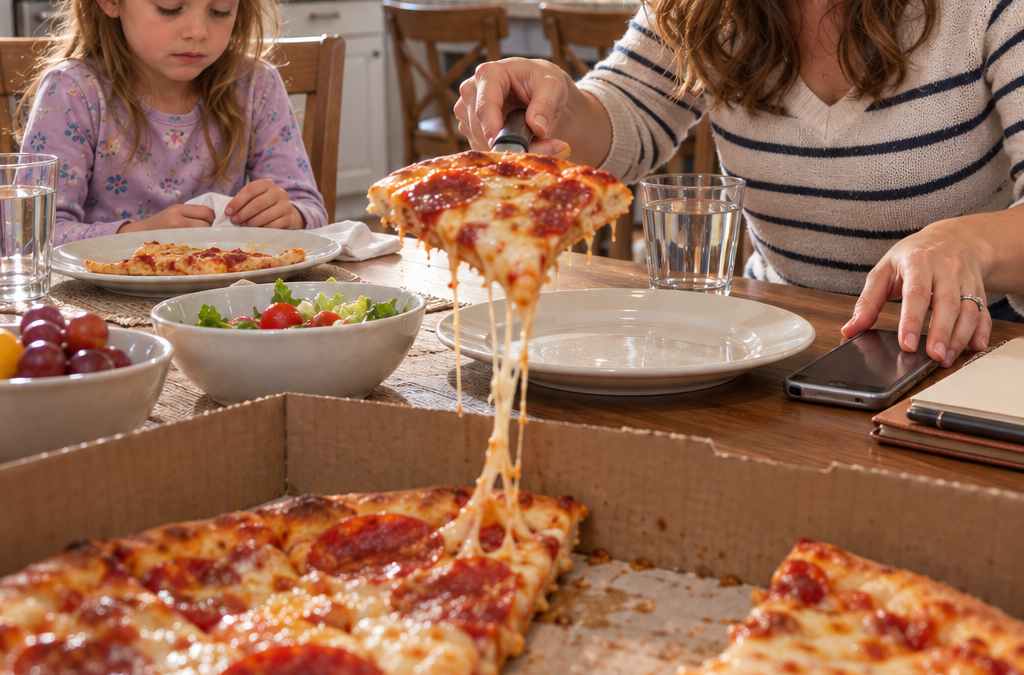
My 6-year-old daughter had already finished one slice of pizza when she leaned toward me and whispered, “Mom, am I allowed to eat twice here?” At first, I thought she was joking. Then I saw the way she kept glancing toward the kitchen doorway, as if someone might appear and punish her for being hungry. I didn’t call my ex-husband. I didn’t confront his wife. I waited until morning, wrote down exactly what my daughter had said, and made 3 phone calls that would change every custody arrangement we had.
### Part 1
Friday nights with my daughter had always been intentionally ordinary. My name is Claire Morgan, I was 38 years old then, and after nearly 15 years in the Army, ordinary had become something I valued more than people might expect. I spent my weekdays around schedules, reports, deadlines, and people trained to hide discomfort behind professional faces, so when my 6-year-old daughter Mia came home to me every other weekend, I wanted our house to feel soft around the edges.
That Friday, she climbed into my SUV outside Nathan’s townhouse carrying a purple backpack that looked almost as large as she did. She buckled herself in and immediately announced that she wanted cheese pizza, despite the fact that she had spent the previous year insisting pepperoni was “the only serious pizza.” I pretended to be offended, and for the first 20 minutes of the drive, nothing about her seemed unusual.
Nathan and I had been divorced for a little more than 2 years. We hadn’t destroyed each other in court or screamed across parking lots during custody exchanges; our marriage had simply become a system of responsibilities without much affection left inside it. About a year after the divorce, he married Brooke, a woman who seemed polished, efficient, and almost aggressively organized.
I had never particularly liked the idea of another woman helping raise my daughter, but I had also refused to become the jealous ex-wife everyone expected me to be. Brooke remembered school theme days, kept extra sunscreen in her car, and once drove 40 minutes back to Mia’s school because Mia had forgotten a stuffed rabbit she needed for show-and-tell. When Mia spoke positively about her, I swallowed whatever complicated feelings came up and reminded myself that children benefited from having more adults who cared about them.
That Friday evening, Mia changed into pajamas before 7 and sat at our kitchen table while I opened the pizza box between us. She finished one slice faster than usual, drank some milk, and stared at the remaining pieces. I slid the box slightly toward her and asked, “Want another one?”
She did not reach for it. Instead, she folded her hands in her lap and asked quietly, “Am I allowed to eat twice at your house?”
I remember the refrigerator humming behind me. I remember a car passing outside with music loud enough that the bass trembled faintly through the window, and I remember feeling as though every sound in my kitchen had suddenly become too sharp. “What do you mean, sweetheart?”
“If I already ate dinner once,” she said, still staring at the pizza, “can I eat again?”
“Of course you can. If you’re still hungry, you can have more.”
Mia looked toward the doorway leading into the hall. It was such a strange movement that I followed her gaze, half expecting to see someone standing there. Nobody was.
Then she whispered, “Brooke says hungry girls learn self-control faster.”
My first instinct was not graceful. I wanted to grab my phone, call Nathan, and demand to know exactly what had been happening inside his house while I had been carefully minding my own business. Years in uniform had taught me, however, that the first explanation available was not always the right one, and that anger could make people damage information before they understood it.
More importantly, Mia was 6. She did not need an investigator sitting across from her; she needed her mother.
I kept my voice light. “Did Brooke tell you that?”
Mia nodded.
“What does she mean by it?”
“I don’t know.”
I pushed the pizza box closer. “You can have another slice.”
“Really?”
“Really.”
She reached for one, but slowly enough that my stomach tightened. This was a child who used to steal strawberries from the cutting board while I made breakfast and grin when I pretended not to notice. Now she was studying my expression before touching food.
While she ate, I changed the subject. Mia told me her teacher had moved her seat because she and her friend Ava talked too much, that a boy in her class could make a whistle sound through the gap where his front tooth had fallen out, and that she had decided she wanted either a hamster or a pony for Christmas. I acted interested in the logistical differences between those 2 requests while privately trying not to look at how quickly she finished the second slice.
Ten minutes later, she brought it up again on her own.
“At Daddy’s house, dinner is one time.”
I placed my glass down carefully. “What does that mean?”
“If you’re hungry after dinner, breakfast is next.”
“Every night?”
She shrugged. “When Brooke says.”
“And what does Daddy say?”
“Daddy works.”
Nathan managed commercial construction projects and often came home late. He occasionally spent nights near job sites around Richmond, Charlottesville, or Fredericksburg, so the answer could have meant almost anything. I forced myself not to fill in the blanks for her.
“What happened the last time you were hungry after dinner?”
Mia peeled a little piece of crust apart between her fingers. “I got crackers.”
“Okay.”
“Brooke said I stole them.”
The word made something cold move through me.
“What happened then?”
“She took them away.”
“Was Daddy there?”
“No. He was at his hotel.”
That detail caught my attention because Nathan had been away for work on Tuesday. He had mentioned it during our custody exchange without any concern whatsoever.
Mia looked up. “If I tell you stuff, you’ll make Daddy mad again.”
I kept both hands flat against the table. “Did someone tell you not to tell me?”
She hesitated before answering. “Brooke says house rules stay inside the house.”
For several seconds, I could hear my pulse. Then I reached across the table and touched the back of Mia’s hand.
“You can tell me anything that makes you scared, uncomfortable, or hungry. You will never get in trouble with me for telling the truth.”
Her eyes became shiny, but she did not cry. “Okay.”
That night, I tucked Mia into the room she had helped decorate with paper stars and planets. I kissed her forehead, switched on the little night-light near her bookshelf, and had nearly reached the doorway when she called me back. Her fingers were gripping the top of her blanket.
“Mom?”
“Yeah?”
“Can I keep crackers in my room?”
I turned around. “Why?”
“Just in case.”
“Just in case of what?”
She looked embarrassed.
“In case I wake up hungry.”
Some anger arrives like an explosion. Mine arrived as silence.
I went downstairs, filled a small container with crackers, brought it back, and placed it beside her bed without asking another question. Then I sat beside her until her breathing became slow and even.
When I returned to the kitchen, the pizza box was still open.
One slice remained.
I stared at it for a long time before closing the lid, because by then I understood one thing with absolute certainty.
This was no longer about pizza.
### Part 2
At 6:14 the next morning, I woke to the sound of a cabinet closing downstairs. Mia was usually a cheerful sleeper who considered anything before 7:30 an insult, so I put on my robe and went looking for her. I found her standing barefoot beside the kitchen counter, still wearing her pajamas, with the cracker container tucked under one arm and a granola bar in her other hand.
She froze when she saw me.
“Good morning,” I said.
“Morning.”
“What are you doing?”
“Nothing.”
The answer came too fast. I glanced at the granola bar.
“Are you hungry?”
She nodded.
“Then eat it.”
Mia stared at me for several seconds. I could see her waiting for a condition, a warning, or some invisible second half of the sentence. When none came, she carefully opened the wrapper.
I made scrambled eggs and toast and sliced strawberries while she sat at the kitchen island. When she came over to watch me cook, she reached automatically toward the cutting board, then stopped her hand in midair. “Can I have one?”
I nearly dropped the knife.
“You don’t have to ask me for strawberries.”
Her expression told me she wasn’t sure whether that was a permanent rule or a temporary kindness. She took one, ate it, and backed away from the counter.
After breakfast, I found the empty granola bar wrapper inside her backpack. Beside it was another unopened bar she had apparently saved. I left both exactly where they were.
I had spent too many years watching people decide what they believed first and collect evidence second. I refused to do that with my own child. One strange weekend could have innocent explanations, and children Mia’s age could misunderstand rules, mix together conversations, or describe events without the context adults assumed was obvious.
So I did not interrogate her. We went to the library, where she chose 2 books about horses and another about planets, and afterward we stopped at the grocery store to buy apples, bread, milk, and cereal. Mia seemed relaxed until we reached the snack aisle.
She stared at a display of crackers. “Mom?”
“Hmm?”
“Can snacks make your body bad?”
I turned toward her. “Why are you asking?”
She shrugged.
“Did somebody tell you that?”
“Brooke says snacks make your body bad if you don’t control yourself.”
I crouched beside the shopping cart so we were at eye level. “Did she tell you your body was bad?”
Mia tugged at the bottom of her sweatshirt. “She says I have to learn before I get older.”
“Learn what?”
“Control.”
I hated the word immediately, but I did not show it.
“What happens when Brooke thinks you didn’t have control?”
Mia studied the pattern on the grocery-store floor. “She gets disappointed.”
“What does disappointed look like?”
“She makes me stand on the scale.”
My fingers tightened around the cart handle.
“What scale?”
“The one in her bathroom.”
“What happens after you stand on it?”
“She writes the number down.”
That was enough. I stood, placed a box of the crackers Mia had been looking at into the cart, and asked whether she wanted tomato soup or chicken soup with grilled cheese for lunch. She picked tomato.
Back home, while Mia colored at the kitchen table, I stepped into the hallway and opened the notes app on my phone. I wrote the date and recorded only the statements I could remember clearly: “Hungry girls learn self-control faster.” “House rules stay inside the house.” “She makes me stand on the scale.” “She writes the number down.”
I deliberately avoided adding words such as abuse, starvation, or punishment. Those were conclusions, and I did not yet know what conclusion was justified.
Then I put my phone away.
I did not want Mia’s memory of the weekend to become her mother constantly taking notes while staring at her like something terrible had happened. We built a blanket fort in the living room, watched an animated movie about a talking dog, and around 4 she asked for apple slices with peanut butter.
I put a full plate in front of her.
She ate quickly.
“Slow down,” I said automatically. “There’s plenty.”
Her hand stopped halfway to her mouth. “Sorry.”
“You don’t have to apologize.”
A few minutes later, she pointed at the remaining apples. “Do I have to finish all of them?”
“No.”
“Even though I asked for them?”
“Even then.”
She looked more confused by that answer than she had by anything else I had said.
Later, I asked a question that seemed ordinary enough. “Are there foods you don’t like at Dad’s?”
“Green beans.”
I smiled. “Reasonable.”
“Brooke makes me sit at the table.”
“Until you finish?”
Mia nodded.
“What happens if you don’t?”
“I don’t get anything else.”
Standing alone, that rule would not have frightened me. Parents all over America had arguments with children over vegetables and dessert, and I was not interested in turning every strict household rule into something sinister. But I was beginning to see that the issue was not one rule.
It was the collection of them.
Then Mia said, “Last Tuesday I got crackers by myself.”
I already knew where this was going, but I let her talk.
“I was hungry, so I got them from the pantry.”
“And Brooke saw you?”
Mia nodded. “She said I stole food.”
“What happened?”
“She took them. Then she said no snacks anymore.”
“For the whole night?”
“I don’t know. Maybe a lot of days.”
“Did you tell Daddy when he came home?”
Mia shook her head.
“Why not?”
“Brooke said Daddy already has enough problems.”
I stood and told Mia I needed to move clothes into the dryer. In the laundry room, I closed the door, put both palms against the washing machine, and counted slowly to 10.
I was not angry because Brooke had stricter dinner rules than I did. I was angry because my daughter had apparently been taught that hunger was a disciplinary problem, that asking for food could be called stealing, and that telling her father would make his life harder.
When I returned, Mia was drawing a purple horse with wings.
I sat beside her. “You didn’t do anything wrong by talking to me.”
She kept coloring. “Okay.”
“And you never have to keep a secret about something that makes you afraid or hungry.”
Her crayon stopped.
“Even if Daddy gets mad?”
“Even then.”
Mia looked up. “Are you mad at Daddy?”
That question hurt more than anything else she had said.
“I’m worried about you,” I answered. “That’s what matters.”
That evening, after she went to bed, I logged into the patient portal for her pediatrician. At Mia’s previous checkup, the doctor had noted that her growth curve had shifted and recommended monitoring it at the next visit. At the time, neither the doctor nor I had treated it as an emergency.
Children changed. Appetites changed. Bodies grew at different rates.
But I stared at that note until the screen blurred.
Then I closed the laptop.
I was not a pediatrician, a social worker, or a family-law judge. I was a mother sitting alone at a kitchen table, and the most dangerous thing I could do now was convince myself that my fear qualified me to do everyone else’s job.
Sunday morning, I made a decision.
I would not call Brooke.
I would not give Nathan advance warning.
I would make 3 different calls instead.
### Part 3
My first call was to Mia’s pediatrician’s office. Because it was Sunday, the answering service transferred me to an on-call nurse, and I explained the situation as carefully as possible. I said my 6-year-old was describing food restrictions, weighing at home, fear about asking for additional food, and anxiety around snacks.
The nurse asked practical questions. Was Mia alert? Yes. Drinking normally? Yes. Complaining of dizziness, pain, vomiting, or weakness? No.
I repeated the doctor’s previous note about Mia’s growth pattern. The nurse arranged a prompt appointment and told me what symptoms would justify immediate medical attention before then. She never told me what had happened inside Nathan’s home because she could not possibly know.
That restraint helped me.
My second call went to Dana Cross, the attorney who had represented me during my divorce. I expected voicemail, but she answered after the fourth ring. “Claire, it’s Sunday morning, so either somebody won the lottery or something has gone wrong.”
“I wish it were the lottery.”
I told her everything.
Dana did not interrupt until I finished. Then she asked the question I had been afraid she would ask.
“Have you confronted Nathan or Brooke?”
“No.”
“Good.”
The relief in her voice surprised me.
“I want to.”
“I know. Don’t.”
Dana explained that I should preserve Mia’s spontaneous statements, avoid repeated questioning, and follow professional guidance rather than trying to build my own case. She reminded me that asking the same questions over and over could confuse a young child and make an already difficult situation worse.
“What about sending her back?” I asked.
“That depends on what develops and what the appropriate professionals advise. We have a custody order, Claire. We don’t rewrite it ourselves because we’re scared.”
That was not what the angry part of me wanted to hear. It was exactly what the responsible part needed.
Dana promised to review the custody order Monday morning and determine what emergency or temporary options might be available if the circumstances supported them. Before hanging up, she added, “And one more thing.”
“What?”
“Your Army career does not give you special authority here.”
“I know.”
“Good. Then stay in your lane. Be Mia’s mother. Let everyone else do their jobs.”
My third call was the hardest.
Based on Mia’s statements and the guidance I had received, I contacted the appropriate Virginia child welfare reporting service and described my concerns. Saying them aloud to a stranger made them sound more real than they had in my own kitchen.
The person on the line asked whether Mia had reported being physically struck. No.
Did I know exactly how often food had been withheld? No.
Was she currently safe with me? Yes.
Had she described losing access to food as a consequence for getting food without permission? Yes.
I repeated Mia’s actual words whenever possible. I did not embellish them, because I did not need to.
When the call ended, I looked at the clock.
Three phone calls.
No screaming. No threats. No dramatic voicemail telling Brooke she had made the worst mistake of her life.
Just 3 calls to people who knew more than I did.
A few minutes later, Mia wandered into the kitchen wearing socks that did not match. “Can I have cereal?”
It was almost 11.
“Sure.”
“Even though lunch is soon?”
“Yes.”
She poured herself a small bowl, added barely enough milk to cover the bottom, and ate at the table. When she finished, she immediately carried the bowl toward the sink.
“You can leave that,” I said.
“I have to wash it.”
“You can if you want. You don’t have to.”
She looked at me like I had changed another rule without warning.
My phone rang at 11:23.
Nathan.
I let it ring twice before answering.
“Hey,” he said. “Why isn’t Mia answering her tablet?”
“She hasn’t been using it much.”
A pause. “Everything okay?”
I looked toward the living room, where Mia had curled up on the rug in front of a cartoon.
“She’s safe.”
Nathan’s tone changed. “What does that mean?”
“It means we need to discuss some things she told me.”
“What things?”
“Food.”
Silence.
“What about food?”
“She says Brooke limits when she’s allowed to eat, weighs her, writes down her weight, and has taken snacks away after Mia got food herself. She also says she’s been told house rules stay inside the house.”
Nathan responded instantly. “That doesn’t sound right.”
“I agree.”
“No, Claire. I mean that doesn’t sound like Brooke.”
There it was.
Not, “Is Mia okay?”
Not, “What exactly did she say?”
Brooke.
“I’ve contacted her doctor, my attorney, and the proper child welfare service,” I said.
The line went quiet.
“You called child services?”
“I reported what Mia told me.”
“Jesus, Claire.”
“Don’t make the phone call the problem.”
“You should have called me first.”
“I’m calling you now.”
“After reporting us.”
“I didn’t report a theory. I reported statements.”
I heard a door close on his end.
“Brooke is going to lose her mind.”
I almost laughed, except nothing was funny. “That is not my priority.”
“Claire, you’re making this into something it isn’t.”
“I don’t know what it is yet. That’s exactly why I called people whose job is to determine that.”
For a moment, Nathan had no answer.
Then he said, “Brooke has rules. Mia is picky sometimes. She sneaks snacks.”
Every muscle in my shoulders tightened.
“How do you know she sneaks snacks?”
Nathan hesitated.
“What?”
“You just said she sneaks snacks.”
“Brooke mentioned it.”
“When?”
“I don’t know. A couple weeks ago.”
“So you knew there was an issue about Mia getting food.”
“That’s not what I said.”
“No. It isn’t.”
I ended the conversation before it became an argument.
Thirty seconds later, my phone buzzed.
A message from Brooke.
I don’t know what Mia told you, but she’s been having behavior problems. Please don’t reward this.
I read it twice.
Not: Is Mia okay?
Not: What did she say?
Not even: Can we talk?
Brooke already knew what subject had caused the problem, even though I had never spoken to her.
I took a screenshot and forwarded it to Dana.
Then another message appeared.
Children need consistency between households.
I did not answer.
For the first time all weekend, I felt something settle inside me.
Until that moment, I had been afraid I was assembling unrelated details into a story because fear had gotten ahead of facts.
But Brooke’s message told me something important.
She already knew which details Mia might have told me.
### Part 4
By Monday morning, Brooke had sent 6 messages. They moved from defensive to accusatory with almost mathematical efficiency: Mia had never missed meals, I misunderstood discipline, Mia played one household against the other, I spoiled her, and Brooke only wanted to teach her healthy habits. The final message arrived at 6:41 a.m.
You are turning normal parenting into a crisis because you never accepted me.
I screenshotted all of them.
Then I made Mia breakfast.
At the pediatrician’s office, Mia sat on the paper-covered examination table wearing purple leggings and a yellow sweater while her sneakers swung several inches above the floor. Looking at her there, I had to remind myself again that fear could distort ordinary details if I let it. I did not want a doctor to confirm my anger; I wanted the doctor to evaluate my daughter.
That was exactly what happened. The pediatrician reviewed Mia’s history, examined her, documented the concerns, and listened when Mia volunteered information. She made no theatrical declarations and gave me no dramatic sentence I could repeat in court.
I respected her more for it.
After the appointment, I drove Mia to school. Before getting out, she looked toward me.
“Am I going to Daddy’s today?”
“Not today.”
“Is Daddy mad?”
“That’s grown-up stuff.”
“Because I told?”
My throat tightened. “No. You never have to fix grown-up feelings by keeping secrets.”
Mia nodded, but she did not look convinced.
Around noon, Dana called. She had reviewed the custody order and explained what legal steps could be requested while the child welfare and medical concerns were assessed. There would be paperwork, standards, evidence, notice, and review.
No magic judge would appear because I was angry enough.
Strangely, that made me feel better.
At 2:17, Nathan called while I sat in my car outside my office.
“We need to talk.”
“I have 10 minutes.”
“Brooke says you’re trying to take Mia away from us.”
“I’m trying to make sure Mia is safe.”
“She is safe.”
“Then the facts will support that.”
He became quiet.
Finally he said, “Brooke does not starve Mia.”
“I never used the word starve.”
“You’re implying it.”
“No. I’m repeating what Mia said.”
Nathan sighed. “You know how kids are.”
“How are they?”
“They exaggerate.”
“She’s 6.”
“Exactly. Six-year-olds misunderstand things.”
“They absolutely can.”
That stopped him.
“So you agree with me?”
“I agree she’s 6, which is why I’m not asking her to investigate your house. I’m asking adults with training to evaluate what she described.”
I heard a woman’s voice in the background.
Brooke.
“Put me on speaker,” she said.
“Don’t,” I told Nathan.
Too late.
“Claire,” Brooke said sharply, “children need boundaries.”
“Not doing this with you.”
“Mia asks for food constantly. If you let a child eat whatever she wants every time she wants it, you create unhealthy habits.”
“She asked me if she was allowed to eat twice.”
“She gets 3 meals a day.”
“That wasn’t my question.”
“She knows how to manipulate you.”
I looked down at my hand wrapped around the phone.
“Do you weigh her?”
Silence.
Then Brooke gave a short laugh. “Seriously?”
“Do you weigh Mia?”
“We own a scale.”
“Do you put her on it?”
“She likes standing on it.”
“Do you write the number down?”
The pause lasted longer this time.
“I track health information.”
“For a 6-year-old?”
“Somebody has to teach her healthy habits before she develops problems.”
“Did her doctor ask you to track her weight?”
Brooke’s voice hardened. “You don’t get to interrogate me.”
“You’re right.”
That seemed to confuse her.
“I’m following professional guidance. I don’t need to interrogate you.”
She scoffed. “From who? Your Army friends?”
“No. Mia’s doctor, my attorney, and civilian child welfare professionals.”
Nobody spoke for several seconds.
Then Brooke said, “You are insane.”
Nathan muttered, “Brooke.”
“No, she needs to hear this. Claire has hated me from the beginning because Mia loves me.”
There it was—the argument she wanted.
Jealous ex-wife.
Replacement mother.
Territorial biological parent.
Anything except the actual question.
“This has nothing to do with whether Mia loves you,” I said.
“Of course it does.”
“It has to do with whether she feels afraid to ask for food while she’s in your care.”
Brooke began speaking over me.
I ended the call.
My hands shook afterward. Restraint was exhausting in a way anger never was.
That evening, Dana called for an update. I told her about Brooke admitting she recorded Mia’s weight and repeated as accurately as I could what had been said. Dana instructed me to write down the time and sequence without editorializing.
“I already did.”
“Good.”
Over the following 3 days, Nathan’s tone changed.
At first, I assumed Dana or somebody from the child welfare process had frightened him. Then, Thursday evening, he called and sounded like a different man.
“Claire.”
“What?”
“I went through my messages with Brooke.”
I sat down.
“And?”
“There’s something I need to show you.”
“What?”
“A message from a few months ago.”
My stomach tightened. “What did it say?”
Nathan inhaled slowly.
“She told me exactly what she was doing.”
I waited.
His voice cracked on the next sentence.
“And I told her to handle it.”
### Part 5
Nathan came to my house Friday morning carrying his phone and a paper cup of coffee he never touched. Mia was already at school because I had made one condition very clear: whatever conversation we were about to have would happen nowhere near our daughter. He sat across from me at the same kitchen table where Mia had asked whether she was allowed to eat twice.
“Show me,” I said.
Nathan unlocked his phone. “I already sent screenshots to my attorney.”
“Good.”
He looked surprised.
Maybe he expected me to accuse him of protecting himself. Part of me certainly believed he was, but by then, apologies mattered less to me than preserving what actually existed.
He opened a message exchange from nearly 3 months earlier.
Brooke had written: Mia went into the pantry after dinner again. I’m done rewarding it. No extra snacks for the rest of the week. Maybe being hungry will finally teach her to listen.
Nathan’s reply sat directly below it.
I’m in Richmond until Thursday. Handle it however you think is best.
I read both messages twice.
Then I placed his phone on the table.
“You knew.”
“I knew Brooke was frustrated about snacks.”
“She used the word hungry.”
“I didn’t read it the way you’re reading it.”
“How did you read it?”
Nathan dragged both hands over his face. “As Brooke being strict.”
“She said she was going to use hunger to teach obedience.”
“I know what it says now.”
“It said the same thing 3 months ago.”
He lowered his eyes.
The anger I had spent a week controlling finally found somewhere to land.
“You keep saying you didn’t know everything. Maybe that’s true. But not knowing everything is not the same as knowing nothing.”
“I know.”
“No, Nathan. I need you to hear me. You were her father in that house. Brooke didn’t need you to personally take food out of Mia’s hand. She needed you to keep looking away.”
He flinched but did not argue.
That mattered more than I expected.
Nathan showed me additional messages. None looked like a villain confessing to some elaborate plan; most were ordinary enough that a distracted parent could dismiss them if he wanted to. Mia was difficult at dinner. Mia asked for snacks again. Mia needed firmer limits. Mia kept asking when she was going back to Mom’s house.
Nathan’s responses were worse because they were so short.
Okay.
Deal with it.
I’ll talk to her.
A thumbs-up icon.
“You handed parenting over to Brooke,” I said.
“I trusted my wife.”
“You stopped checking.”
Nathan stared at the table.
“Yes.”
For a moment, neither of us spoke.
Then he said, “I called Mia’s school counselor.”
My head came up. “You questioned Mia?”
“No. I promised I wouldn’t. I asked the counselor whether they had noticed any changes.”
“And?”
Nathan’s jaw tightened.
“Mia has been asking what time lunch is.”
I felt cold.
“How often?”
“Enough that her teacher noticed.”
Nathan looked toward the window. “She asks in the morning. Sometimes more than once.”
Another tiny detail.
Meaningless by itself.
Terrifying beside everything else.
“I should have seen it,” he said.
“Yes.”
He looked at me as though he had expected comfort.
I did not give him any.
“I thought Brooke was stricter than us,” he continued. “I thought that might actually be good. I thought Mia needed structure.”
“She’s 6, Nathan.”
“I know.”
“She was scared to take a second slice of pizza in my kitchen.”
His eyes filled.
That finally silenced me.
I was still furious with him, but I could see that the sentence had reached somewhere the legal language and accusations had not. Nathan had spent years thinking of himself as the reasonable parent, the provider, the man who kept things calm.
Now he was facing the possibility that his version of calm had simply been absence.
His phone buzzed on the table.
Brooke.
He turned it facedown.
“She knows I’m here.”
“Why?”
“I told her.”
“Why would you do that?”
“Because I’m tired of lying to avoid fights.”
That answer surprised me.
“She asked whether I gave you the messages.”
“And?”
“I said yes.”
My phone buzzed next.
Brooke.
Congratulations. You finally got Nathan to betray his own wife.
Another message arrived before I could lock the screen.
You know Mia is healthy. Discipline is not abuse.
I screenshotted both messages.
Nathan watched me forward them to Dana.
“You’re really not going to answer?”
“No.”
“How?”
“Practice.”
He gave a humorless laugh.
“What happens now?” he asked.
“The process continues.”
“And me?”
I looked directly at him.
“You start being Mia’s father instead of asking everybody else what version of you would feel least guilty.”
He nodded slowly.
When Nathan reached the front door, he stopped.
“Claire.”
“What?”
“I’m sorry.”
There had been a time when I imagined those words from him after our divorce. In some versions, I forgave everything. In others, I delivered a perfect speech that left him devastated.
Reality was simpler.
“Be sorry to Mia,” I said. “And don’t make her comfort you because you feel bad.”
Nathan swallowed. “I won’t.”
After he left, I stood beside the window and watched him remain inside his truck for almost 5 minutes.
The following weeks moved slower than television would have prepared anyone for. There were interviews, records, meetings, attorney calls, scheduling issues, and temporary arrangements. Nathan cooperated.
Brooke became less careful.
Her texts shifted from angry to defensive and finally to almost pleading. She insisted that she had been teaching nutrition, that Nathan had agreed with her methods, and that nobody understood how difficult Mia could be around food.
On one point, she was correct.
Nathan had agreed.
I refused to let him rewrite himself as a completely innocent man who had been tricked by a terrible wife. The messages would not allow it anyway.
Three weeks after that first pizza night, Dana called.
“We have a hearing date.”
I sat straighter.
Then she said, “Don’t expect a movie, Claire. There probably won’t be one dramatic moment where everything suddenly becomes obvious.”
“I don’t need one.”
Across the living room, Mia was building a wooden castle.
Twenty minutes earlier, she had taken an apple from the fruit bowl without asking permission.
That felt bigger than any courtroom speech.
Still, the hearing mattered.
For weeks, Brooke had controlled the explanation.
Soon, she would have to explain her own words somewhere my anger had no authority at all.
### Part 6
The hearing took place on a cold Tuesday morning under a flat gray Virginia sky. I wore a navy civilian suit instead of my uniform because Dana had made something clear weeks earlier: I was not walking into court as an Army officer. I was walking in as Mia’s mother.
Dana met me outside the courtroom holding a thick folder.
“Answer exactly what you’re asked,” she reminded me.
“I know.”
“I know you know. I’m reminding you because you’re angry.”
“Fair.”
Nathan arrived alone and sat several chairs away. He looked exhausted.
Brooke appeared 10 minutes later with her attorney. She wore a cream-colored coat and carried herself exactly as she always had during school events—back straight, chin slightly raised, expression composed.
Our eyes met.
She gave me a tiny smile.
I did not return it.
The hearing itself was almost painfully ordinary. Nobody screamed. Nobody slammed photographs onto a table. The judge reviewed filings while attorneys walked through records, statements, medical documentation, communications, and the developing child welfare information.
That normality made the situation feel more serious, not less.
Mia’s doctor had documented concerns without claiming she could reconstruct everything that had happened. The child welfare documentation described what had been reported and what had been learned through the appropriate process. Dana never suggested that one appointment or one statement automatically proved every accusation.
Then the messages were introduced.
The atmosphere changed.
Brooke’s attorney argued that her words reflected a strict philosophy about food, not an intention to harm Mia. Dana did not call Brooke cruel or unstable. She simply worked through Brooke’s own language.
No extra snacks for the rest of the week.
Maybe being hungry will finally teach her to listen.
Then came the weighing.
Brooke explained that she considered weight part of health and believed children should learn good habits early. Dana asked whether Mia’s pediatrician had requested home weigh-ins.
“No.”
“Any pediatric specialist?”
“No.”
“A registered dietitian?”
“No.”
“Any medical professional?”
Brooke shifted in her seat. “No.”
“Then whose recommendation were you following?”
“My judgment as a parent.”
“You are not Mia’s parent,” Dana said calmly. “You were acting as a caregiver in her father’s household.”
Brooke’s expression changed.
Only slightly.
But I saw it.
Nathan’s testimony was harder for me.
He admitted receiving Brooke’s messages. He admitted responding. He admitted that he had known she intended to remove access to snacks after Mia got food without permission.
Nobody allowed him to become a hero simply because he had eventually cooperated.
“Why didn’t you investigate further?” he was asked.
Nathan stared down at his hands.
“I trusted the adult.”
There was a long pause.
Then he added, “I should have checked on the child.”
I looked away.
The sentence hurt because it was so painfully simple.
When it was my turn, Dana had already warned me not to make a speech. I described the Friday night, Mia’s hesitation, the second slice of pizza, the crackers beside her bed, the granola bar she had saved, the scale, and the statements about hunger.
Then I admitted what I did not know.
I could not say how many times Mia had been hungry.
I could not testify about Brooke’s thoughts.
I could not claim I had witnessed events I had not seen.
Brooke’s attorney stood.
“Ms. Morgan, did you dislike Brooke before this situation?”
“No.”
“You had no discomfort with another woman helping raise your daughter?”
“I had normal discomfort. That doesn’t mean I believed she was dangerous.”
“Would you describe yourself as protective?”
“Yes.”
“Highly protective?”
“I suppose.”
“Isn’t it possible that protectiveness influenced your interpretation?”
“Yes.”
He paused as though he had expected resistance.
“You admit that?”
“Of course. I’m Mia’s mother. That’s why I contacted people qualified to evaluate what she said instead of deciding the facts myself.”
Dana did not smile, but I saw her look down for a moment.
Later, the judge asked what outcome I wanted.
That was the question I had rehearsed a hundred times in my head.
I could have said I wanted Brooke out of Mia’s life forever.
Part of me did.
I could have talked about consequences or betrayal or how furious I was with Nathan.
Instead, I looked at the judge.
“I want my daughter to feel safe saying she’s hungry in her own home.”
Nobody moved.
“I want her to understand that food is not something she has to earn by being obedient. And I want the adults responsible for her to understand that she should never be afraid to tell me what happens when I’m not there.”
That was all.
The judge did not deliver some cinematic speech. Temporary protective conditions were issued while the larger matters continued to be reviewed. Brooke would not be responsible for Mia’s unsupervised care.
Nathan’s parenting time would continue only under conditions established through the proper process.
Nobody was dragged away.
Nobody lost everything in 60 seconds.
It was not revenge.
Outside the courtroom, Nathan approached me.
“I’ll follow everything.”
“You’d better.”
“I mean it.”
“I know.”
Near the elevators, Brooke stood beside her attorney.
For weeks, she had baited me through texts. She wanted anger, accusations, insults, anything that could support her story that I was an unstable ex-wife using Mia as a weapon.
I had given her nothing.
No threats.
No social-media posts.
No screaming match.
Just records, professional evaluations, her messages, and 3 phone calls made on a Sunday morning.
Brooke looked directly at me.
The smile she had worn before the hearing was gone.
I expected that to feel satisfying.
It did not.
There was nothing satisfying about needing lawyers, doctors, social workers, and a judge to make a 6-year-old comfortable around dinner.
Dana touched my elbow as we walked toward the exit. “You okay?”
I considered lying.
“No.”
Then I looked through the glass doors toward the parking lot.
“But Mia will be.”
That afternoon, I picked her up from school.
She climbed into the back seat of my SUV and immediately asked, “Can we get pizza tonight?”
For the first time in weeks, I smiled without forcing it.
“Absolutely.”
Mia buckled her seat belt.
“Can I have 2 pieces?”
I looked at her in the rearview mirror.
“You can have however many you’re hungry for.”
She stared at me for a second.
Then she smiled.
But she still asked one more question.
“Even if somebody gets mad?”
And that was when I realized the hearing had settled only the legal question.
The harder work was just beginning.
### Part 7
For the next several months, I learned that safety and recovery were not the same thing. A court order could establish boundaries around Brooke, but no judge could reach into Mia’s mind and remove the little rules she had learned to carry with her. Those rules appeared in places I did not expect.
She asked whether bananas counted as snacks.
She apologized after taking a second helping of pasta.
Once, after dropping half a cookie on the floor, she cried because she thought asking for another would be “wasting food twice.”
Each time, I wanted to tell her Brooke had been wrong about everything.
Instead, professionals taught me to do something harder.
Keep food neutral.
Keep the house predictable.
Do not make every snack a therapy session.
Mia needed to experience normal life more than she needed me constantly reminding her that abnormal things had happened.
Nathan had work to do too.
For a while, Mia was cautious with him. She still loved him, but children could love someone and stop trusting them at the same time.
To his credit, Nathan eventually understood that saying, “I’m your dad,” was not a substitute for rebuilding what he had neglected.
He started small.
He showed up on time.
He listened when Mia complained.
He stopped immediately defending his intentions whenever she mentioned something painful.
Several months after the hearing, the 3 of us attended a family counseling session. Mia sat at a low table drawing flowers while Nathan sat across from her, visibly trying not to force conversation.
Without looking up, Mia said, “Daddy?”
“Yeah?”
“You didn’t believe me.”
I watched his face.
The old Nathan would have said he did not know.
He would have explained that Brooke had hidden things.
He would have described his work schedule or said adults sometimes misunderstood each other.
This time, he did none of those things.
“You’re right.”
Mia continued coloring.
“I should have listened better.”
“Okay.”
That was it.
No hug.
No music.
No miraculous forgiveness.
Just a child holding a purple crayon and a father accepting responsibility without making the child responsible for relieving his guilt.
I respected Nathan more in that moment than I had in years.
That did not mean I forgave him completely.
It certainly did not mean I wanted him back.
Our marriage had ended for reasons that existed long before Brooke, and I had no interest in confusing responsible co-parenting with romantic redemption. Some relationships were meant to improve without being restored.
Brooke, meanwhile, eventually stopped contacting me directly. Communication went through the appropriate channels whenever necessary. Nathan’s marriage to her deteriorated under the weight of everything that had happened, but I made a deliberate choice not to follow the details.
I did not ask whether they fought.
I did not ask whether he blamed her.
I did not need photographs of Brooke suffering to prove that Mia had deserved protection.
The more attention I gave Brooke, the more space she continued to occupy inside my home without physically being there.
I wanted that space back.
One Sunday afternoon, Nathan brought Mia home carrying a small paper bakery bag.
“What’s that?” I asked.
“Cookies.”
Nathan stood behind her.
“She chose them.”
Mia grinned. “Daddy let me eat one before lunch.”
I raised an eyebrow at him. “Reckless parenting.”
Nathan almost smiled. “I’m experimenting with danger.”
Mia laughed.
So did I.
The sound surprised all 3 of us.
It did not erase anything. Forgiveness was not an eraser, and reconciliation did not require pretending wounds had never existed.
Sometimes progress simply meant people stopped defending who they had been and started becoming more useful versions of themselves.
That evening, Mia and I ordered pizza.
For a while, I had considered avoiding it. I thought the smell of melted cheese and baked crust might always drag me back to the Friday night that had changed everything.
Then I realized I did not want to surrender pizza to a bad memory.
So we kept ordering it.
We sat at the same kitchen table.
Mia finished her first slice while explaining an argument happening between 2 girls in her class over who owned a glittery pencil.
Then she reached into the box.
No pause.
No question.
No glance toward the doorway.
She simply took a second slice.
I felt tears rise so suddenly that I lowered my face toward my drink.
Mia did not notice.
That was the beautiful part.
She was too busy talking.
After the second slice, she hopped down from her chair.
“Mom, can I have strawberries too?”
“Of course.”
She opened the refrigerator herself.
Months earlier, she had stood beside the same counter and asked permission to touch a strawberry.
Now she pulled the container from the shelf, washed 4 of them, and returned to the table without looking over her shoulder once.
That was when I understood what victory looked like.
It was not Brooke leaving the courthouse without her confident smile.
It was not Nathan admitting his failure.
It was not a judge signing an order.
It was a child opening a refrigerator without fear.
I had spent most of my adult life believing protection required strength, authority, planning, and decisive action. The Army had reinforced all of those instincts.
Mia taught me something different.
Sometimes protecting somebody begins with being quiet enough to notice when an ordinary sentence is not ordinary at all.
And I would soon learn that there was still one more thing Mia had been afraid to tell me.
### Part 8
The final piece surfaced almost 6 months after the first pizza night, and by then I had stopped expecting new revelations. Mia had grown more relaxed around food, school was going well, and our home had returned to the kind of chaos I had once taken for granted. Shoes appeared in the hallway for no logical reason, crayons migrated into kitchen drawers, and strawberries disappeared faster than I could buy them.
One Saturday morning, we were making pancakes when Mia pulled a folded piece of paper from the pocket of her pajamas.
“I forgot I had this.”
“What is it?”
She handed it to me.
The paper had been folded so many times that the creases were beginning to tear. I opened it expecting a drawing.
Instead, I found rows of numbers written in an adult hand.
Dates.
Weights.
Small marks beside some of them.
I felt the familiar cold sensation return.
“Where did you get this?”
“Brooke gave it to me.”
“When?”
“A long time ago.”
“Why?”
Mia poured chocolate chips into the pancake batter. “She said I was supposed to remember my good numbers.”
I made myself breathe.
“Did she tell you what a good number was?”
Mia shrugged. “Smaller.”
I looked again at the paper.
Then I folded it carefully.
“You’re not in trouble.”
“I know.”
The fact that she said it so easily almost made me cry.
Six months earlier, she would have watched my face before answering. Now she turned back to the pancakes like the piece of paper was just another forgotten thing she no longer needed.
I contacted Dana and followed the same rule I had followed from the beginning.
No dramatic confrontation.
No message to Brooke.
No interpretation beyond what Mia had actually said.
The paper became part of the existing record where appropriate, but by then I no longer felt the urge to use every new detail as a weapon. Brooke’s role in Mia’s life had already been restricted, the legal process had continued, and the professionals involved had enough information to do their jobs.
More importantly, Mia was doing hers.
She was being 6.
Then 7.
At her seventh birthday party, she ate cake, left half the frosting on her plate, asked for chips 15 minutes later, and spent nearly an hour running through a sprinkler with 4 classmates.
Nobody weighed her.
Nobody wrote anything down.
Nobody told her she had failed a test of self-control.
Nathan attended the party.
He stayed long enough to help clean up and short enough not to turn the afternoon into some performance of divorced-parent harmony.
Before leaving, he approached me near the garage.
“She looks happy.”
“She is.”
He nodded.
“Claire, I know I’ve said this before, but I’m sorry.”
“I know.”
“I don’t expect you to forgive me.”
I looked at him.
“I don’t know whether I ever will completely.”
He absorbed that without arguing.
“But I’m glad you stopped asking Mia to carry your guilt.”
Nathan looked toward the backyard, where Mia was shrieking because somebody had sprayed her with a garden hose.
“I almost lost her trust.”
“Yes.”
“I might never get all of it back.”
“That’s possible.”
He nodded again.
The conversation ended there.
That was the relationship we eventually built: honest enough to work and limited enough to stay healthy.
There was no romantic reunion.
No suggestion that our family had secretly belonged together all along.
Nathan and I had already proven we were better parents apart than spouses together.
Brooke eventually disappeared from the center of our lives entirely. I heard pieces of information through the legal process and through Nathan when something directly affected Mia, but I did not follow her personal life. Whether she believed she had been misunderstood no longer mattered to me.
Some people imagine closure as the moment the person who hurt you finally admits everything.
I stopped needing that.
Brooke could tell herself whatever story allowed her to sleep.
My responsibility was not to control her story.
It was to make sure Mia no longer had to live inside it.
Almost a year after that first Friday night, Mia and I were sitting at the kitchen table eating pizza again. She was telling me about a classmate who claimed the tooth fairy paid $20 if a tooth came out during school hours because “school teeth are more valuable.”
“Twenty dollars?” I said.
“That’s what Harper said.”
“Harper needs a financial adviser.”
Mia giggled and reached for another slice.
I watched her hand.
No hesitation.
She did not count what she had already eaten.
She did not search my face for permission.
She simply took it.
Then she pointed toward the refrigerator.
“Are there strawberries?”
“Probably.”
She jumped down and opened the door.
I thought about the strange path that had brought us there.
One whispered question.
A hidden granola bar.
A container of crackers beside a bed.
A scale.
A father who had mistaken absence for trust.
A stepmother who had wrapped control in the language of health.
And 3 phone calls.
For a long time, I believed those phone calls were the moment I protected my daughter.
Eventually, I realized I was wrong.
Protection started earlier.
It started when Mia asked, “Am I allowed to eat twice?” and I resisted the urge to dismiss the question as childish nonsense.
Children rarely describe frightening situations using the words adults expect. They may not say, “Something unhealthy is happening in my other home.”
They might ask whether they are allowed another slice of pizza.
They might hide a snack.
They might suddenly become nervous about a routine that never used to bother them.
One unusual behavior does not prove a terrible explanation. Children misunderstand things, families have different rules, and parents can scare themselves by jumping to conclusions.
But listening costs nothing.
Listening without interrogating matters.
And when something genuinely concerning emerges, there are professionals whose job is to help families figure out what a frightened parent cannot responsibly determine alone.
That was the lesson I carried forward.
Not that every strange sentence was evidence.
Not that instinct was always correct.
But that love sometimes required enough humility to say, “I don’t know what this means yet, but I’m not going to ignore it.”
Mia returned to the table with strawberries.
She ate 2.
Then another.
Then she pushed the bowl away because she was full.
A year earlier, every one of those tiny choices would have carried fear.
Now they meant nothing.
Exactly as they should.
“Mom?”
“What?”
“Can we make popcorn later?”
I smiled.
“If you want.”
“Even after pizza?”
I waited.
For half a second, my heart stopped.
Then Mia rolled her eyes dramatically.
“I’m kidding.”
I laughed so hard I had to cover my face.
She laughed too.
That was when I knew we were going to be all right.
The question that had once frightened her had finally become something she could joke about.
She reached for one last strawberry.
I did not say a word.
I just smiled.
THE END!