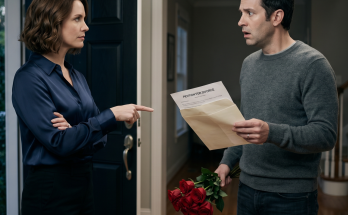
My Husband Found Out I Was Pregnant And Said: “Not My Child,” And Kicked Me Out. But A Lawyer Called Me: “Your First Husband From The 2010s Left You His Entire Fortune — $77 Million, But Conditional…”
Part 1
People say you can feel a marriage dying.
They make it sound poetic, like your bones start humming a warning before your life catches fire. Maybe that is true for some women. For me, the warnings came dressed as ordinary things.
A garage light left on.
Cash missing from the joint account.
My husband turning his phone facedown when I walked into the room.
For six years, I was Megan Harper, Derek Harper’s wife. We lived in a quiet suburb north of Atlanta, in a four-bedroom house with white shutters, trimmed hedges, and neighbors who waved like we were all starring in a commercial for clean living. I was an architect at a midsized firm downtown. Derek managed commercial real estate. We hosted dinner parties. We remembered birthdays. We looked stable.
Paper lies.
The first time I caught Derek taking a call in the garage, it was raining. I remember the sound clearly, water ticking against the gutters while I stood in the kitchen with a folder of blueprints under my arm. His voice came through the mudroom door, low and careful.
“No, not yet,” he said. “I need more time.”
I opened the door.
He spun around so fast his shoulder hit the shelf behind him. A box of old Christmas lights fell and cracked against the concrete.
He smiled too late.
“Client problem,” he said.
I wanted to believe him, so I did.
That was my mistake. Not the first one, but maybe the cleanest. The one I can point to now and say, there. That was where the floor started sloping.
Over the next few months, Derek became polished in a way that made him feel less like my husband and more like a man rehearsing for court. He asked where I was going, but not because he cared. He asked what time I would be home, but not because he missed me. He asked about Thomas.
Thomas Caldwell was my first husband. We married young, divorced quietly, and went our separate ways without smashed plates or dramatic speeches. He moved to Portland and built a software company. I stayed in Georgia and built houses on paper before they became real.
I hadn’t spoken to Thomas in more than ten years.
So when Derek asked, “Whatever happened to that tech guy you married?” I laughed.
“Thomas? No idea.”
He stirred his coffee without drinking it.
“He ever contact you?”
“No.”
“Not even once?”
I looked up from my laptop. “Why are you asking?”
He shrugged. “Just curious.”
Derek was many things. Curious was rarely one of them.
The morning I found out I was pregnant, Atlanta was bright and cold. I sat in my car outside the clinic with both hands on the steering wheel, staring at the ultrasound photo like it was written in a language I almost understood. Eight weeks. A heartbeat. A small, impossible flicker on a screen.
I bought a tiny white onesie on the way home. It said future architect across the front in crooked blue letters. I tucked the ultrasound photo under tissue paper and placed it in a silver gift bag.
Derek was in the kitchen when I came in, wearing his work shirt with the sleeves rolled up. The house smelled like lemon cleaner and the chicken he had reheated but not eaten.
“I got you something,” I said.
He looked annoyed before he looked curious.
I set the bag on the island.
He pulled out the onesie first. His face did not change. Then he found the ultrasound photo.
For one second, the whole room went silent in a way that felt unnatural, like even the refrigerator had stopped humming.
Then he set both items down carefully.
“That’s not my child,” he said.
I laughed because my brain needed him to be joking.
He wasn’t.
“Derek.”
“I know enough.”
“What are you talking about?”
His eyes were flat. Not angry. Not hurt. Decided.
“I want you out tonight.”
I gripped the edge of the island. The marble felt freezing under my fingers.
“This is your baby.”
“No,” he said. “It isn’t. And I’m not raising another man’s kid.”
By nine o’clock, I was sitting in my car in a Kroger parking lot two miles from my house, the silver gift bag on the passenger seat and my winter coat pulled tight around my stomach.
The onesie had fallen halfway out of the tissue paper.
I kept staring at it while one question circled my mind like a dog that would not lie down.
What kind of man hears his wife is pregnant and immediately knows exactly what accusation to make?
I did not have the answer yet. But in the cold dark of that parking lot, I began to understand that Derek had not reacted.
He had moved.
### Part 2
Sleeping in a car is nothing like movies make it look.
There is no graceful curling up under a soft blanket. There is only the hard angle of the seat belt buckle against your hip, the fog on the inside of the windshield, and the strange humiliation of trying not to look homeless while realizing you are, at least for the night.
I kept the heater running until I worried about gas. Then I turned it off and sat in the dark with my hands tucked into my sleeves.
Normal life passed twenty feet away. A woman loaded paper towels into her trunk. A teenager in a red hoodie pushed a cart with one squeaky wheel. A father argued with a little boy about cereal.
I was eight weeks pregnant, locked out of my own house, and I had $412 in my personal checking account.
Most of my savings had been moved into our joint account over the last two years because Derek said it made bills simpler. My laptop was in the house. My passport. My birth certificate. My project files. The hard drive with my architectural designs.
All inside.
All behind a door Derek had decided I no longer deserved to open.
Around midnight, I opened my banking app.
The joint account still showed a balance of a little over $31,000.
I took screenshots. I don’t know why. Instinct, maybe. My father had been an engineer. He raised me to believe that if something cracked, you documented the crack before anyone patched over it and lied.
Then I searched Thomas Caldwell.
At first, nothing new appeared. Old business profiles. A photo of him at some tech conference in a blue blazer. A LinkedIn page he hadn’t updated in years.
Then I found the acquisition article.
His software company had sold three years earlier to a private firm. The amount was undisclosed. I knew enough about business to know that “undisclosed” sometimes meant small, but sometimes meant large enough that everyone involved preferred silence.
I stared at the screen.
Derek had asked about Thomas three times.
Not once. Not casually.
Three times.
“Did he ever contact you?”
“Do you know where he lives now?”
“Did you two stay friendly after the divorce?”
At the time, I thought he was jealous. Now, sitting under the sick yellow glow of a grocery store parking lot light, I felt something colder than jealousy settle into place.
Derek had been looking for something.
By five in the morning, the sky had turned the color of dirty wool. I drove to a diner off Peachtree, one of those twenty-four-hour places with silver napkin dispensers and coffee strong enough to strip paint. I ordered eggs and toast. I ate none of it.
The waitress called me honey and filled my cup three times.
I used the back of a receipt to make a list.
First: lawyer.
Second: documents.
Third: doctor.
Fourth: Thomas.
The lawyer came first because fear makes you stupid if you let it drive.
I knew a family attorney named Claire Sutton from a networking event. She had once asked me to look at plans for her office renovation. I still had her number.
At 7:06 a.m., I sent her a text.
Claire, this is Megan Harper. I need urgent legal advice. My husband kicked me out last night after I told him I’m pregnant. He may be moving money.
Her reply came eleven minutes later.
Come at 8:45. Don’t call him. Don’t text him. Screenshot everything.
That was the first time since Derek’s kitchen that I breathed all the way in.
Claire’s office was in Buckhead, on the fourteenth floor of a glass building that smelled like polished stone and expensive coffee. I walked in wearing yesterday’s clothes, with drugstore toothpaste still sharp in my mouth and my hair twisted into a knot I hadn’t looked at in a mirror.
Claire did not ask if I was okay.
She knew I wasn’t.
She set a yellow legal pad on the table and said, “Start at the beginning. Don’t protect him.”
So I didn’t.
I told her about the pregnancy. The accusation. The garage calls. The cash withdrawals. The questions about Thomas.
Claire wrote quickly, her face calm in a way that made me feel less likely to fall apart.
When I finished, she slid her phone across the table.
“Check the joint account now.”
I logged in.
The balance was $43.18.
For a moment, I thought the app had glitched.
Then I saw the transfers. Three of them. All made between 9:47 and 10:12 the night before.
Less than an hour after Derek threw me out.
The money had gone into an account I did not recognize.
Claire’s pen stopped moving.
“That,” she said, “was not panic. That was execution.”
My stomach turned, slow and heavy.
Because if Derek had emptied the account that fast, then he had already known what he planned to do before I ever handed him that silver gift bag.
And if he had known, the pregnancy was not the reason.
It was only the excuse.
### Part 3
Claire moved like a woman who had seen too many men confuse marriage with ownership.
By ten-thirty that morning, she had copied my screenshots, drafted a letter to the bank, and explained in a voice so level it kept me from shaking that Derek could not legally lock me out of a house with my name on the mortgage.
“He may try,” she said. “That is different from having the right.”
Her office window looked down over traffic sliding through Buckhead like metal beads on a string. The sun was too bright. I remember hating that. It felt rude for the world to look so clear while my life was smeared beyond recognition.
Claire tapped her pen against the legal pad.
“Now tell me exactly why Thomas matters.”
I told her everything I knew, which was almost nothing.
Thomas Caldwell. First husband. Married when I was twenty-four. Divorced when I was twenty-eight. No children. No drama. Portland. Software company. Sold company. Silence.
Claire listened.
“Did Derek know Thomas had money?”
“I didn’t know Thomas had money.”
“But Derek was asking.”
“Yes.”
“How long?”
“Two months. Maybe three.”
Her eyes narrowed slightly.
“Then he found something. Or he thought he did.”
The words landed with a little click inside me.
Claire gave me instructions. New email account. Not one Derek knew. Save every text, every call log, every bank record. Do not speak to Derek alone. Do not accept any offer. Do not go back to the house without notice and preferably not without an officer present.
“And Megan,” she said as I stood to leave, “call someone from Thomas’s family.”
I almost said no.
Not because I didn’t want answers, but because calling the family of a man I had once loved and had not contacted in a decade felt like knocking on a door I had no right to touch.
Still, in the parking garage, I found Thomas’s sister Rachel on Facebook. Same kind eyes. Same dark hair, now threaded with gray.
I sent a message.
Rachel, this is Megan. I’m sorry to contact you suddenly. I need to ask about Thomas and possibly his estate. I hope you’re well.
I expected silence.
She called forty minutes later.
“Megan?” Her voice was soft, cautious. “How did you not know?”
The parking garage seemed to tilt.
“Know what?”
There was a pause long enough for me to hear a car horn somewhere below.
“Thomas died in September.”
I closed my eyes.
A stroke, she said. He was forty-seven. It had been sudden. Quiet. The funeral was small.
“He never remarried,” Rachel added. “He talked about you sometimes. Not in a strange way. Just… warmly.”
My throat tightened.
“I’m sorry,” I said, and meant it in a way that surprised me.
Rachel exhaled.
“His attorneys have been trying to find you.”
A cold line ran from the base of my skull down my back.
“What attorneys?”
“Gordon Reeves in Portland. Megan, I don’t know details, but Thomas left instructions. Your name came up.”
I wrote the number on the back of Claire’s folder with a hand that had stopped feeling like mine.
When Gordon Reeves answered, he sounded professional, careful, and relieved.
“Mrs. Harper,” he said, using the name I had not carried when Thomas knew me. “I’m very glad you called.”
“I was told Thomas’s estate may involve me.”
“It does.”
“How much are we talking about?”
Silence.
Not confusion. Measurement.
Then he said, “Approximately seventy-seven million dollars.”
The number did not make sense at first.
Seventy-seven million belonged to lottery billboards, not to women sitting in parking garages wearing yesterday’s blouse with a granola bar in their purse.
I pressed my palm to the steering wheel.
“There is a condition,” Gordon said.
Of course there was.
My laugh came out small and dry.
“What condition?”
“You must appear in person at our Portland office within sixty days of formal notification to verify your identity and sign beneficiary documents. Thomas wrote it that way to prevent fraudulent claims. The condition is procedural, but firm.”
I looked at the concrete wall in front of me. Level Three. Blue paint peeling near the elevator.
“Has anyone else asked about this?” I said.
Gordon hesitated.
“The terms of the trust are not public. But the existence of certain estate structures can sometimes be inferred if someone knows where to look.”
“Someone did know where to look.”
Another pause.
“Mrs. Harper,” he said carefully, “are you in danger?”
I thought of Derek’s face over the kitchen island. I thought of the emptied bank account. I thought of the way he had stepped back when I reached for him, as if my pregnancy were something dirty.
“I don’t know yet,” I said.
And that was the worst part.
Because for the first time, I understood Derek had not thrown me out because he believed I betrayed him.
He threw me out because he believed I was about to become powerful.
### Part 4
I did not fly to Portland immediately.
That would have been the dramatic thing, and real life rarely rewards drama.
First, Claire filed for emergency relief over the joint account transfers. Then she sent a formal notice to Derek’s attorney, a man named Stuart Pell, stating that I would be entering the marital home to retrieve personal property and that any attempt to interfere would be documented.
She also told me to get medical insurance in my own name.
“You are pregnant,” she said. “Your body is not a loose end.”
That sentence broke me more than anything Derek had said.
I cried in Claire’s bathroom with one hand over my mouth so her assistant wouldn’t hear. The soap smelled like lavender. The mirror was too honest. My face looked pale and older, but my eyes did not look empty.
That mattered.
Two days later, I returned to the house with a sheriff’s deputy and a cardboard list.
Derek opened the door.
He was freshly shaved. Of course he was. Men like Derek always believe looking calm is the same as being innocent.
His eyes dropped to my stomach for half a second, then away.
“Megan,” he said.
I did not answer.
The deputy stood behind me, bored but watchful.
The house smelled exactly the same: lemon polish, coffee, the faint cedar scent from the entry table drawer where Derek kept winter gloves. That hurt more than I expected. Betrayal should change the smell of a place. It should turn the walls black or make the floor reject your feet.
Instead, my home looked like my home.
A blue mug sat in the sink. My gray scarf hung on the chair where I had left it. The silver gift bag was gone.
Linda Harper sat at the kitchen table.
Derek’s mother was seventy-one, small and neat, with white hair cut into a precise bob. She wore pearls on a Thursday morning and had the kind of gentle voice people mistook for kindness.
She watched me carry boxes from the study.
“My laptop,” I said to Derek.
He looked at the deputy, then walked to the hall closet and handed it over.
“My passport. Birth certificate. Social Security card.”
“They’re in the safe,” he said.
“Open it.”
His jaw tightened.
Linda stirred her tea though there was no sugar in it.
The safe was in our bedroom closet. While Derek opened it, I stood in the doorway and refused to look at the bed.
That was where we had slept side by side for six years. That was where he had kissed my shoulder on Sunday mornings. That was where I had once imagined placing a bassinet.
Now it looked like evidence.
I packed everything I could prove was mine. Work files. External drives. Jewelry from my grandmother. A photo of my father. Three sweaters. My winter boots.
As I carried the last box out, Linda spoke.
“You’re making all of this much harder than it needs to be.”
I stopped.
Her voice was mild. Almost sad.
I turned to her. “You knew.”
Derek’s hand tightened on the doorframe.
Linda blinked once. “Knew what, dear?”
The deputy looked up.
I smiled then. Not because anything was funny, but because I finally saw the outline of the room I was really standing in.
Not a house.
A stage.
Derek was not the only actor.
“I’ll let my attorney ask that,” I said.
Linda’s face did not change, but her eyes sharpened.
Three days later, I flew to Portland.
The city was wet and gray, the air smelling of rain and roasted coffee. Gordon Reeves’s office occupied the top floor of a brick building in the Pearl District. His conference room had tall windows and a view of rooftops shining with water.
He was in his sixties, with silver glasses and the careful posture of a man who had spent his life guarding other people’s secrets.
He showed me Thomas’s signature.
Seeing it hurt.
Not romantically. Not like lost love. More like finding an old door in a house you thought had been demolished.
Thomas had left me the majority of his estate. Seventy-seven million in trust assets, released in stages. Eight million within thirty days. The rest over eighteen months as holdings were liquidated.
“Why?” I asked.
Gordon folded his hands.
“He wrote a letter for you.”
He slid an envelope across the table.
My name was on it in Thomas’s handwriting.
Megan.
Inside were three pages.
I read only the first line before my eyes blurred.
You were the only person who loved me before I became useful.
I pressed the paper flat with trembling fingers.
By the time I finished, the rain had thickened against the windows.
Thomas had not wanted me back. He had not written like a man asking for forgiveness or romance. He wrote like someone taking inventory at the end of his life. He said I had been honest with him when leaving would have been easier to make cruel. He said he trusted me to build something good.
Then came the line that made my blood cool.
If anyone comes near you because of this money, assume they have already shown you who they are.
I folded the letter slowly.
Derek had shown me.
And Linda, I was beginning to understand, had shown me even more.
### Part 5
The first threat came the morning after I returned from Portland.
I was staying with my friend Jess in her apartment near Midtown. Jess and I had met in graduate school and bonded over bad vending machine coffee, impossible deadlines, and our shared belief that most ugly buildings were the result of cowardice.
When I called her from Claire’s office, she didn’t ask for details.
She said, “Come over. I’ll make the bed.”
That was Jess.
Her apartment smelled like basil, old books, and the orange candle she burned when stressed. The spare room was small, but the sheets were clean, and for the first time in days, I slept lying down.
At 8:13 the next morning, my phone rang.
Unknown number.
I almost ignored it, but something made me answer.
A man’s voice said, “Megan Harper?”
“Yes.”
“You don’t know me, but I’m a friend of Derek’s.”
My hand tightened around the mug I was holding.
“I thought you should understand something,” he continued. “People who turn private family matters into legal attacks sometimes find that their professional lives become complicated.”
I set the mug down carefully.
“Is that right?”
“You’re an architect. Licensed. Licenses can be challenged. Employers can receive complaints. Clients can hear things.”
His voice was smooth, almost bored.
I walked into Jess’s hallway and turned on the recorder on my old tablet.
“What is your name?” I asked.
A pause.
“I’m offering friendly advice.”
“I’m recording this call.”
The line went dead.
For a few seconds, all I heard was the hum of Jess’s refrigerator and the traffic outside.
Then I called Claire.
She listened without interrupting.
“Good,” she said when I finished.
“Good?”
“He’s scared enough to get sloppy.”
By noon, Claire had contacted my employer, documented the threat, and filed notice with Derek’s attorney. By Monday, she had submitted a harassment motion.
Derek’s response came through Stuart Pell, not directly.
He denied knowing anything about the call.
Of course he did.
But the call had done something useful. It had confirmed that Derek was no longer trying only to end a marriage. He was trying to control the story.
That became clearer when the settlement offer arrived.
It came in a thick PDF with polite legal language and poison folded between every paragraph. Derek would agree not to contest the divorce. He would “generously” waive any claim to Thomas’s estate. He would return a portion of the joint funds.
In exchange, I would accept less than my fair share of marital assets, withdraw the harassment motion, and sign a nondisclosure agreement preventing me from discussing the circumstances of our separation with anyone.
I read it twice at Jess’s kitchen table.
Rain tapped the window. Jess was making pasta, moving around behind me with quiet, furious energy.
“He wants to buy your silence,” she said.
“Yes.”
“Are you tempted?”
I looked at the number on the page.
I was.
Anyone who says money can’t tempt you when you’re pregnant, exhausted, and sleeping in someone else’s spare room has never watched their life burn down while checking their bank balance.
For about forty minutes, I imagined signing.
I imagined quiet. A new house. A doctor. No court. No more Derek. No more Linda. No more waking at three in the morning with my heart hammering because I dreamed I was back in that kitchen holding an ultrasound photo like evidence in a trial I had not known I was entering.
Then I read the NDA again.
Not allowed to discuss the circumstances of the separation.
That meant I could not say he accused me falsely.
I could not say he emptied the account.
I could not say he knew about Thomas.
I could not say someone threatened my professional license.
He did not want peace.
He wanted a locked room.
I called Claire.
“No,” I said.
“I agree,” she replied.
“No counteroffer.”
A small silence.
Then Claire said, “You’re sure?”
I looked at Thomas’s letter lying beside the settlement offer.
Assume they have already shown you who they are.
“Yes,” I said. “I’m sure.”
Three days later, I called Rachel Caldwell.
I asked one careful question.
“Did anyone contact you after Thomas died asking about his estate?”
Rachel went quiet.
“Yes,” she said slowly. “A woman. She said she was a journalist writing about tech acquisitions.”
My pulse shifted.
“When?”
“November. Maybe early December.”
“What did she ask?”
“Whether Thomas left money to anyone outside the family.”
I closed my eyes.
“Did you get her number?”
“I may still have it.”
She found it while I waited, listening to paper rustle on the other end of the line.
When she read the area code, my whole body went still.
Atlanta.
And when Claire subpoenaed the phone records two weeks later, that number traced back to Linda Harper.
Derek had thrown me out.
But Linda had found the match.
### Part 6
Linda came to Jess’s apartment on a Sunday morning carrying cookies.
That was the sort of woman Linda was. She could walk into a war with a Tupperware container and make half the room believe she was there to help.
She called Jess’s number at ten, which I had never given her. That alone told me enough.
“Could I speak with Megan?” she asked.
Jess held the phone out like it had something rotten on it.
I took it.
“What do you want, Linda?”
Her sigh was soft and practiced.
“Just to talk. Please.”
I almost said no.
Then I thought of Claire’s voice: People reveal themselves when they think they are persuading you.
“Eleven,” I said. “Jess will be here.”
“I had hoped we might speak privately.”
“No.”
She arrived at 10:58 wearing a cream cardigan and pearl earrings. The cookies were oatmeal raisin, Derek’s favorite, not mine. She set them on the coffee table and looked around Jess’s living room with her sweet little smile.
Cataloging.
The secondhand sofa. The stack of architecture books. My prenatal vitamins beside a glass of water. My suitcase near the hallway.
She saw all of it.
“I want to apologize,” she said.
I sat across from her with my phone recording beside my thigh.
“For what?”
“For Derek’s reaction.”
“Reaction.”
“He panicked.”
I said nothing.
Linda leaned forward. Her perfume smelled like powder and white flowers, the same scent that used to linger in my dining room after Christmas dinners.
“He has been under terrible pressure. Business pressure. Emotional pressure. Then you surprised him with news he wasn’t ready to process.”
I almost laughed.
“You mean the baby.”
“Of course.”
“The baby he said wasn’t his.”
Pain flickered across her face. It looked convincing. That was the frightening thing about Linda. I think she could make herself feel whatever expression she needed.
“He was wrong to say that.”
“Yes.”
“But wrong words said in fear don’t have to end a family.”
There it was.
Not apology. Strategy.
“A baby needs a father,” Linda said. “A complete family. You of all people should understand what broken homes do.”
My father died when I was nineteen. My mother raised me alone after that. Linda knew exactly where to press.
I smiled.
“My broken home had more love in it than your complete one.”
Her expression cooled by one degree.
“Megan.”
“Who called Rachel Caldwell?”
Silence.
It lasted less than a second, but I saw it. The tiny fracture in her performance.
“I don’t know what you mean.”
“Yes, you do.”
“I’m here to talk about my grandchild.”
“No,” I said. “You’re here because Derek wants me to sign an NDA.”
Her hands folded in her lap.
“That agreement would protect everyone.”
“From the truth?”
“From unnecessary ugliness.”
I looked at the cookies on the table.
“You pretended to be a journalist.”
Linda’s face remained still.
“You called Thomas’s sister and asked whether he left money to anyone outside his family.”
Her smile disappeared.
Not slowly.
Gone.
The room changed when she stopped pretending. It was like watching a lamp click off and realizing the thing in the corner had been watching you the whole time.
“You have no idea what you’re doing,” she said.
Jess shifted behind me, but I raised one hand slightly.
“I know exactly what I’m doing.”
“You are pregnant, living in a spare room, fighting a family with resources you don’t understand.”
“I understand enough.”
“No,” Linda said softly. “You understand paperwork. You understand buildings. You do not understand people like us.”
For the first time, she sounded like herself.
Not grandmother. Not peacemaker.
Operator.
I stood.
“This conversation is over.”
She rose too, smoothing her cardigan.
At the door, she turned back.
“Derek is willing to forgive you.”
The words hit me so strangely that for a moment I could only stare.
“Forgive me?”
“For making this so public. For involving attorneys. For humiliating him.”
Something inside me became very quiet.
“Tell Derek,” I said, “that late forgiveness from a man who tried to bury me is garbage. I don’t want it. I don’t need it. And I will never trade my silence for his comfort.”
Linda’s eyes narrowed.
“You’re making an enemy.”
“I already had one,” I said. “Now I know her name.”
After she left, my knees weakened. Jess locked the door, then turned and hugged me without saying a word.
My phone was still recording.
When Claire listened to it later, she said only one word.
“Perfect.”
But that night, when I lay in Jess’s spare room with one hand on my stomach, I understood something that made sleep impossible.
Linda had not come to negotiate.
She had come to measure how much damage I could survive.
### Part 7
Discovery is a polite legal word for turning over rocks.
What crawled out from under Derek’s rocks was ugly, but not surprising.
Claire requested bank records, phone logs, emails, work laptop search history, communications with Stuart Pell, and anything related to Thomas Caldwell or his estate. Derek’s side objected to almost everything. The judge overruled most of it.
The first useful thing came from Derek’s work laptop.
He had searched Thomas Caldwell’s name eleven months before he threw me out.
Not once. Repeatedly.
Thomas Caldwell acquisition.
Thomas Caldwell estate.
Thomas Caldwell Portland trust attorney.
Spousal rights inheritance Georgia divorce.
I read the printed search history in Claire’s office while rain slid down the window in crooked lines.
My husband had researched whether he could touch money I did not even know existed.
The second useful thing came from Linda’s phone records.
A seventeen-minute call to Rachel Caldwell in November.
Eleven calls between Linda and Derek in the seventy-two hours before he threw me out.
Six calls the night he emptied the joint account.
The third useful thing was an email.
Derek had sent it to Stuart Pell four days before the pregnancy announcement.
Need situation resolved before Portland attorneys make contact with M.
M.
Me.
I sat with that email for a long time.
There are sentences that change your past. You read them, and suddenly every memory rearranges itself around them.
Derek watching me over dinner.
Derek asking if Thomas ever contacted me.
Derek suggesting I put more savings into the joint account.
Derek saying we should wait another year before having children, then acting relaxed when we stopped preventing pregnancy.
He had not been drifting away.
He had been positioning furniture before setting a fire.
Claire watched my face.
“You don’t have to be strong in here,” she said.
“I’m not being strong.”
“What are you being?”
“Accurate.”
That was the only thing I trusted by then.
Accuracy.
Dates. Times. Transfers. Calls. Documents. Not feelings, because feelings could be denied. Not memories, because memories could be called dramatic. But records had weight.
A transfer at 9:47 p.m.
A call at 10:03 p.m.
An email four days before.
A phone record in November.
The truth had a skeleton, and Claire was assembling it one bone at a time.
Meanwhile, Derek changed tactics.
He stopped denying everything emotionally and began presenting himself as confused.
Through Stuart Pell, he suggested that he had been “misled by concerns regarding marital fidelity.” He claimed he moved the joint money to “protect shared assets.” He said his questions about Thomas were “ordinary curiosity.”
Ordinary curiosity does not search revocable trust structures at midnight.
Claire’s mouth tightened when she read his statement.
“He’s preparing to look foolish instead of malicious.”
“Will it work?”
“Not with the email.”
The deposition was scheduled for a Tuesday in March.
The night before, I barely slept. Not because I feared Derek yelling. Derek would never yell in a deposition. He would wear a good suit and a clean expression. He would say he didn’t recall. He would make betrayal sound like a misunderstanding with paperwork.
At 3:18 a.m., I sat at Jess’s kitchen table eating saltine crackers because nausea had become my loyal enemy.
Jess came out in pajama pants and found me staring at nothing.
“You okay?”
“No.”
She sat across from me.
“You want advice or company?”
“Company.”
So we sat in silence while the refrigerator hummed and the city outside made its soft night noises.
After a while, she said, “Tomorrow, don’t look for remorse.”
I turned to her.
“You won’t find it,” she said. “Look for fear. Fear tells the truth faster.”
The next morning, I wore a navy dress that still fit if I did not breathe too deeply. Claire met me in the lobby with a folder under one arm and coffee in the other.
“How are you?” she asked.
“Accurate.”
She smiled faintly.
“Good.”
Derek was already in the conference room when we entered.
Gray suit. Blue tie. Wedding ring still on.
For one wild second, I remembered him dancing barefoot with me in our kitchen three years earlier while pasta boiled over on the stove. I remembered loving him. I remembered being loved, or thinking I was.
Then he looked at my stomach and looked away.
The memory died cleanly.
Claire opened her folder.
And Derek began to learn what happens when the woman you tried to erase kept receipts.
### Part 8
For the first forty minutes, Derek performed beautifully.
He said “I don’t recall” with the smoothness of a man who had practiced in a mirror. He kept his hands folded. He nodded respectfully when Claire asked questions. He looked wounded but reasonable.
Stuart Pell sat beside him, expensive watch flashing under the conference room lights.
I sat across the table with a bottle of water I had not opened.
The court reporter typed steadily. Tiny keys clicking. Truth becoming transcript.
Claire began gently.
“When did you first become aware of Thomas Caldwell’s death?”
“I’m not sure.”
“Before or after September?”
“I don’t recall.”
“Before or after you asked your wife whether Mr. Caldwell had contacted her?”
“I don’t recall asking that.”
Claire slid over a printed text message.
It was from Derek to Linda.
She says no contact. Need other way to verify.
Derek read it.
His jaw moved once.
“Do you recall now?” Claire asked.
Stuart objected.
Claire let him.
Then she moved to the searches.
Then the phone records.
Then the joint account.
With each document, Derek became a little less polished. Not visibly to a stranger, maybe. But I knew him. I knew the small signs. The way his thumb pressed into his palm. The way he stopped blinking when cornered. The way he looked at Stuart before answering, like a child checking whether the stove was hot.
Then Claire placed the email on the table.
Need situation resolved before Portland attorneys make contact with M.
“Mr. Harper,” she said, “who is M?”
“I don’t recall.”
“You don’t recall who you referred to by initial in an email to your divorce attorney four days before expelling your pregnant wife from the marital home?”
Stuart objected again.
Claire waited.
Derek’s face had gone pale beneath his careful tan.
“I was under stress,” he said.
“That was not my question.”
“I don’t remember.”
Claire leaned back.
“Were you aware, before February 14th, that your wife was a named beneficiary in Thomas Caldwell’s trust?”
Derek looked at Stuart.
Stuart put a hand near, but not on, Derek’s arm.
The room held its breath.
“I had heard possibilities,” Derek said.
“From whom?”
“I don’t recall.”
“From your mother?”
“I don’t recall.”
“Did your mother call Rachel Caldwell pretending to be a journalist?”
His eyes snapped up.
There it was.
Fear.
Jess had been right.
“I don’t know anything about that.”
Claire slid over Linda’s phone record.
“Do you recognize this number?”
“No.”
“It appears eleven times in your call history in the seventy-two hours before you removed your wife from the home. Would seeing the full record refresh your memory?”
Derek said nothing.
The court reporter’s keys paused.
That silence felt better than any confession.
Not because I needed him to admit the truth. I didn’t. The truth was already sitting on the table in black ink. But I wanted to see him understand that I was no longer alone in a parking lot.
He looked at me then.
For the first time since the kitchen.
Not at my stomach. At me.
There was no apology in his face. No love. No grief.
Only calculation collapsing.
I held his gaze.
I thought I would feel rage, but I didn’t. Rage requires heat, and whatever I felt was colder than that.
It was clarity.
Claire continued for another hour. By the end, Derek’s “I don’t recall” had started sounding less like a shield and more like a leak.
When it was over, Stuart packed his papers too quickly.
Derek stood.
For one second, I thought he might speak to me.
He didn’t.
In the elevator, Claire stood beside me in silence until the doors closed.
“He’ll settle,” she said.
“I know.”
“Possibly soon.”
“I know.”
She glanced at me.
“You’re very calm.”
“No,” I said. “I’m just done being surprised.”
Outside, Atlanta looked newly washed from morning rain. The pavement shone. Cars hissed through puddles. A delivery driver laughed into his phone near the curb.
Life kept going. That had seemed cruel at first. Now it felt like permission.
My phone buzzed as Claire and I reached the parking deck.
Unknown number.
Then a text appeared.
You should ask what Thomas really knew about you.
There was an attachment.
A photo of an old envelope addressed to Thomas in my handwriting.
I stopped walking.
Because I had never sent Thomas a letter after our divorce.
Not one.
### Part 9
The envelope in the photo was cream-colored, bent at one corner, with my old name written across the front.
Megan Caldwell.
My hand shook before I could stop it.
Claire noticed immediately.
“What is it?”
I showed her.
Her face changed in that controlled way lawyers have when something is either very useful or very bad.
“Do you recognize it?”
“No.”
“Could it be your handwriting?”
“It looks like mine.”
“When was the photo sent?”
“Just now.”
Claire took my phone.
“Do not respond.”
The message had come from another unknown number. The image was cropped tight, no background except a strip of wood grain beneath the envelope.
Claire forwarded it to herself and Gordon Reeves.
By evening, Gordon called.
His voice had lost its polished calm.
“That envelope is from Thomas’s personal effects,” he said.
I sat on Jess’s sofa, one hand over my stomach.
“How would Derek have a photo of it?”
“He shouldn’t.”
“What is inside?”
A pause.
“I don’t know. It was sealed when cataloged.”
“When?”
“After Thomas died. Before the estate inventory was finalized.”
“Who had access?”
“Only my office, the estate administrator, and family representatives.”
Rachel.
Linda had called Rachel. But Rachel would not have sent Linda anything. I knew that without needing proof.
Gordon continued carefully.
“I’ll review the inventory logs. Megan, until we know more, assume someone is trying to create doubt around Thomas’s intentions.”
“Why?”
“Because if Derek cannot reach the money legally, he may try to make you afraid of accepting it.”
That night, I dreamed of Thomas.
Not as he was in photos from Portland, older and softened by rain. I dreamed of him at thirty-one, standing barefoot in our first apartment, trying to assemble a cheap bookshelf while pretending he did not need instructions.
We had not been a tragic love story. That mattered.
People always want divorce to mean hatred or failure. Sometimes it means two people were honest before they became cruel. Thomas and I loved each other badly but parted kindly. I had not wanted his money because there had been no money then. I had wanted him to come home before midnight. I had wanted him to stop treating every conversation like a problem to solve.
In the morning, Gordon called again.
“The envelope was found.”
“And?”
“It contains a letter.”
“From me?”
“No,” he said. “To you.”
I went still.
“But the outside—”
“Thomas reused an old envelope. Your handwriting is on it because it appears to be from a birthday card you sent during your marriage. He kept it.”
I looked across Jess’s kitchen at the weak sunlight on the counter.
“What does the letter say?”
“I can scan it, but I think you should hear the important part now.”
Paper rustled.
Gordon read carefully, paraphrasing more than quoting, because he was that kind of attorney even with dead men’s words.
Thomas had written that if anyone challenged my inheritance, the old envelope was proof of why he trusted me. Inside it, he had kept a note from our marriage. Not romantic. Just a small card I had once written during a hard year.
I believe in the man you are becoming, but I won’t disappear so you can become him.
I remembered writing that.
I remembered the night.
Thomas had been building his company from our apartment, sleeping three hours, forgetting meals, forgetting me. I had left the card beside his coffee before going to work. At the time, I thought it might save us.
It didn’t.
But he kept it.
My eyes filled.
Gordon’s voice softened.
“He wrote that you were the first person who ever told him love should not require self-erasure.”
I covered my mouth.
Derek’s text had been meant to scare me. Instead, it handed me back a piece of myself I had forgotten.
Claire traced the source of the photo within a week.
Not perfectly. Not enough for criminal certainty. But enough for court.
The estate administrator’s assistant had received a request from someone claiming to be from Gordon’s office, asking for catalog images. The request had been sent from an email address one letter off from Gordon’s domain.
A fake.
The IP trail led to a business center in Atlanta.
Derek’s company leased space in that building.
When Claire filed it, Stuart Pell requested an immediate settlement conference.
This time, there was no NDA.
But there was one more weapon Derek had left.
Paternity.
He filed a statement claiming he still had “reasonable doubts” about the baby and wanted any custody, support, or settlement terms delayed until after birth.
When Claire told me, I was sitting in my car outside the OB clinic, holding a new ultrasound photo.
The baby had one tiny hand raised near her face, as if already tired of everyone.
I laughed.
Then I cried.
Then I said, “Test now.”
Twelve weeks was enough for a prenatal DNA test.
Derek agreed because refusing would make him look worse.
The result came back on a Friday afternoon.
Probability of paternity: 99.9999%.
Derek was the father.
He had always been the father.
I read the result once, twice, three times.
There was no joy in being proven truthful by a lab report. Only a heavy sadness that my child’s first public record involving her father was proof against his lie.
That night, Derek called from a blocked number.
I answered because Claire had told me not to, and because sometimes even accurate women make human choices.
He breathed once.
“Megan,” he said. “We need to talk.”
His voice sounded different.
Smaller.
And for one dangerous second, I heard the man I used to love.
### Part 10
I should have hung up.
Instead, I stood in Jess’s kitchen with the phone pressed to my ear and let Derek speak.
“I made mistakes,” he said.
Mistakes.
Such a small word for deliberate destruction.
I looked at the bowl of lemons on Jess’s counter. One had a soft brown spot near the stem.
“You accused me of cheating.”
“I was scared.”
“You emptied our account.”
“I thought you were going to leave with everything.”
“I was pregnant and sleeping in a car.”
Silence.
Then he said, “I didn’t know that.”
That made me laugh, once.
“You kicked me out at night in February. Where did you think I went, Derek? The Ritz?”
He inhaled sharply.
“I want to fix this.”
“No.”
“We’re having a daughter.”
The word daughter hit me in the ribs. We had just learned from the bloodwork. A girl.
He knew because the result had gone through attorneys.
“You don’t get to use her as a bridge back to me.”
“She deserves a family.”
“She has one.”
“With you in Jess’s spare room?”
There he was.
Not sorry.
Just searching for leverage.
My voice went cold.
“Do not call me again.”
“Megan, wait.”
I hung up.
The next morning, Claire filed the paternity result and requested sanctions for Derek’s false accusation. Stuart Pell stopped sounding confident in emails.
Still, Derek tried one final angle.
He claimed my temporary living situation proved instability. He suggested that I was emotionally reactive, financially secretive, and unprepared for motherhood. He did not mention that I was temporarily living with Jess because he had thrown me out and drained the joint account.
Claire’s response was surgical.
She included the bank transfers. The emergency order. The paternity test. The harassment complaint. Linda’s recorded visit. The fake estate email trail. Jess’s sworn statement describing the night I arrived with one suitcase, no laptop, and no access to marital funds.
Jess wrote exactly like she spoke.
Megan was exhausted, frightened, and focused on protecting her unborn child. She did not act irrationally. She made lists.
When I read that line, I cried harder than I had over Derek.
She made lists.
Sometimes love is not poetry. Sometimes love is someone seeing the small way you survive and writing it down for a judge.
The settlement came eleven days later.
Derek relinquished any claim to Thomas’s estate forever. He returned the $31,000 plus interest. I received sixty percent of marital assets because of documented dissipation and bad faith. The house would be sold, and my share would be paid directly into an account only I controlled. Derek would cover a portion of my legal fees. The NDA was gone.
Most importantly, the paternity result entered the record.
I wanted that there.
Not because I needed the world to know Derek was my child’s father, but because I wanted the lie pinned down where it could not crawl.
The final meeting happened in a neutral conference room downtown.
Derek looked thinner. His suit hung differently at the shoulders. For the first time, his wedding ring was gone.
He signed first.
I watched his pen move.
There was no satisfaction in it. Not the bright kind people imagine. It was quieter. More like locking a door and realizing you are on the correct side of it.
Afterward, he asked for five minutes alone.
Claire said, “No.”
I said, “It’s fine.”
She gave me a look.
“I’ll stand by the door,” I said.
Derek and I moved to the hallway near a window overlooking the street. Cars flashed below. Someone on the sidewalk carried a bouquet of yellow flowers wrapped in brown paper.
Derek looked at my stomach.
“I panicked,” he said.
“No. You planned.”
His mouth tightened.
“I listened to bad advice.”
“Your mother?”
He looked away.
That was answer enough.
“She thought we needed to protect the family.”
“From me?”
“From uncertainty.”
I shook my head.
“No. From my worth.”
The words surprised both of us.
He rubbed a hand over his face.
“We could still co-parent well.”
“Yes,” I said. “For her sake, we will.”
His eyes lifted quickly.
“Maybe with time—”
“No.”
“You don’t know what I was going to say.”
“I do.”
The hallway smelled faintly of carpet cleaner and coffee. The light through the window was pale and clean.
“I will not forgive you back into my life,” I said. “I will not turn late regret into romance. I will not raise my daughter in a house where love is used as a trapdoor.”
His face crumpled for half a second.
Then pride pulled it back together.
“You’re different now.”
“No,” I said. “I’m not. You just miscalculated what I could survive.”
I walked back to Claire.
My hands did not shake.
Outside, my daughter moved inside me, one small flutter beneath my ribs.
Not a kick yet.
More like a knock.
I’m here.
I touched my stomach.
“So am I,” I whispered.
### Part 11
The first disbursement from Thomas’s estate arrived on a Wednesday morning in April.
Eight million dollars.
The notification appeared while I was eating toast at Jess’s kitchen table, wearing maternity leggings and one of her old college sweatshirts.
I stared at the number for so long the toast went cold.
Money like that does not feel real when it arrives as digits. It feels like a clerical error. Like someone moved the decimal too far and will call soon to apologize.
I called Gordon.
“It’s real,” he said gently.
Then I called Rachel.
She cried.
Not loudly. Just one soft break in her voice when she said, “Thomas would be glad.”
I believed her.
I used some of the money to secure a small house in Decatur with good light, old hardwood floors, and a backyard that needed work. The first time I walked through it, the rooms were empty except for dust and a dead moth on the windowsill, but I knew.
Architects are trained to see what can hold.
This house could.
Jess helped me move. She labeled boxes with aggressive clarity.
Kitchen — actually useful.
Baby — tiny socks, terrifying.
Derek trauma documents — do not lose or burn yet.
I laughed for the first time in weeks.
My mother came from Savannah and stayed three days. She cleaned cabinets, stocked the freezer, and cried quietly in the nursery when she thought I could not hear.
The nursery walls were pale green. I chose the color because it looked different throughout the day. Morning made it soft. Afternoon made it bright. Evening made it almost silver.
I built my daughter’s crib myself at seven months pregnant, sitting on the floor with an Allen wrench, swollen ankles, and unreasonable determination.
When I finished, I sat back and said, “There.”
The room smelled like new wood and paint.
For the first time, the future did not smell like smoke.
Derek attended prenatal appointments when required and behaved politely in the stiff way of men under legal supervision. He asked about the baby’s heartbeat. He brought bottled water once. He did not ask about me.
That was fine.
Linda tried to send a gift.
A hand-knit blanket, cream-colored, wrapped in tissue paper, with a card that said, For my granddaughter. May she always know family.
I returned it unopened through Claire.
Derek emailed that I was being cruel.
I replied through the parenting app Claire insisted we use.
Boundaries are not cruelty.
He did not answer.
Ellie was born on a Tuesday in July after seventeen hours of labor that made me briefly understand why old myths described women as warriors. Jess was in the room. My mother was in the chair by the window, praying under her breath. Derek waited outside until after the delivery because that was the boundary I chose.
When Ellie cried, the sound was thin and furious.
The nurse placed her on my chest, slippery and warm, and the world narrowed to the weight of her.
Seven pounds, four ounces.
Dark eyes.
Long fingers.
Angry little mouth.
“Hi,” I whispered. “I’m your mom.”
She stopped crying for exactly three seconds, as if considering whether this arrangement was acceptable.
Then she screamed again.
Jess cried. My mother cried. I cried.
Derek came in later. He stood beside the bed looking terrified in a way I almost respected. Not terrified of me. Not of court. Of Ellie.
Good, I thought.
Some things should humble you.
He touched her foot with one finger.
“She’s beautiful,” he said.
“Yes,” I replied.
He looked at me then, and I saw grief move across his face. Maybe real. Maybe late. Maybe both.
It changed nothing.
There are apologies that arrive after the house has burned, carrying a cup of water.
I did not need his water.
I had built somewhere else to live.
### Part 12
Ellie is eight months old now.
As I write this, she is sitting in a bouncer beside my desk, studying her own feet with the seriousness of a judge reviewing evidence. She has Derek’s dark eyes, my stubborn chin, and a scream that could strip paint from a porch railing.
We live in the Decatur house with the good light.
The garden is still mostly weeds, but I’m learning. Every Saturday morning, I put Ellie in a carrier and walk the yard, telling her the names of things I can identify and making up names for the ones I can’t.
“That,” I tell her, pointing to an ugly shrub near the fence, “is either a very determined plant or a mistake with roots.”
She usually drools in response.
My architecture practice has seven clients now. My name is on the door. Harper Design Studio. I thought about changing the last name, but decided not to rush. A name can carry damage, but it can also carry proof.
I am still here.
Derek’s business shrank after the settlement. He had to liquidate holdings at a bad time. People heard pieces of what happened, because I signed nothing that required silence. I did not run a campaign against him. I did not need to. Truth has a way of finding vents.
He sees Ellie according to the schedule.
He is careful. Prepared. Sometimes painfully formal. He sends photos through the parenting app when she is with him. Her asleep in a striped onesie. Her grabbing his tie. Her glaring at mashed peas.
I do not forgive him.
I cooperate.
Those are different things.
Linda has never met Ellie.
She has requested it twice through Derek. Both times, I said no. Perhaps one day, when Ellie is old enough to speak clearly and tell me what happens in a room, I will reconsider. Maybe not.
People love to pressure women toward forgiveness because it makes everyone else more comfortable. They call it healing when what they mean is silence. They call it grace when what they mean is access.
I have no interest in making Linda comfortable.
Rachel visited in the spring. She brought photographs of Thomas from the years I did not know him. Thomas on a dock in Oregon wearing a yellow rain jacket. Thomas hiking beside a waterfall. Thomas laughing at something outside the frame.
He looked peaceful.
That helped.
Rachel held Ellie and cried a little.
“He would have loved this,” she said.
I touched Ellie’s soft hair.
“I think he wanted something good to come from what he built.”
Rachel nodded.
“He said you were structurally honest.”
I laughed through tears.
“That sounds like Thomas.”
But I understood what he meant.
Structural honesty is not softness. It is not politeness. It is not staying quiet so the room can remain pretty.
It is knowing what holds weight and what only pretends to.
My marriage to Derek looked beautiful from the street. White shutters. Trimmed hedges. Dinner parties. Matching holiday cards.
But inside, the load-bearing walls were rotten.
The night he threw me out, I thought I had lost everything.
I had lost the illusion.
That is different.
The truth gave me back my life, but not gently. It dragged me through a parking lot, a diner booth, a lawyer’s office, a deposition table, and a hospital room. It made me look at every person around me and ask, Do you hold, or do you only decorate?
Jess held.
Claire held.
My mother held.
Rachel held.
Thomas, in his strange late way, held.
Derek did not.
Linda did not.
And I did.
That is the part I want Ellie to know someday.
Not that her father failed me. Not that her grandmother tried to use love like a leash. Those truths matter, but they are not the center.
The center is this:
When someone tries to make you small, they are usually afraid you will discover your size.
Derek counted on my fear.
Linda counted on my isolation.
They were both wrong.
I knew how to read a structure. I knew how to document a crack. I knew how to leave a building before it collapsed and still carry out the blueprints for something better.
So no, I did not forgive my husband and go back.
I did not turn late regret into a love story.
I built a door with my own name on it.
Then I carried my daughter through.
THE END!
Disclaimer: Our stories are inspired by real-life events but are carefully rewritten for entertainment. Any resemblance to actual people or situations is purely coincidental.