“You don’t owe us anything today, Linda, and honestly, you haven’t for a very long time,” the manager said, gently pushing my hand away.
I just stood there staring because my brain genuinely stopped working for a second.
I had my small brass coin purse open, the one Harold bought me at the flea market in Ohio decades ago. It has that little double-clinking clasp. I always keep exactly fifteen dollars in it for my Tuesday lunch.
I am seventy-four years old. Ever since my husband, Harold, passed away six years ago, I have eaten lunch at the same Cracker Barrel off Route 31 in Kokomo, Indiana, every single Tuesday. Same booth. Same chicken and dumpling meal. It always comes out to twelve dollars and forty-nine cents.
It is my one routine. It is the only time I really leave the house except for groceries and church.
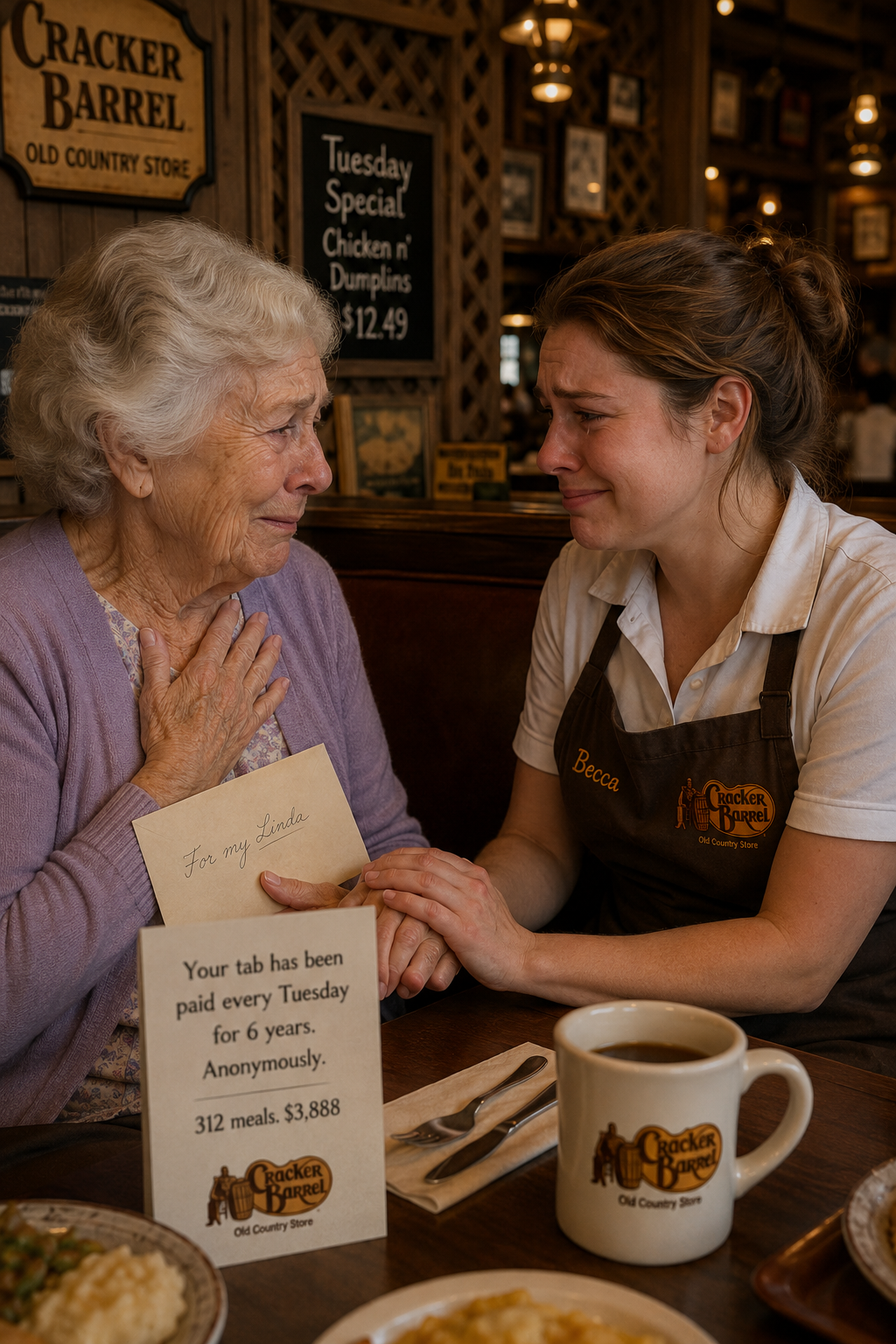
But that afternoon, Greg, the manager, looked at me with this strange, soft expression. He told me my tab had been paid every single week for six years. Anonymously. That was three hundred and twelve meals. When I did the math in my head, it came out to nearly four thousand dollars. Somebody had been covering my lunch since the very first week I sat in that booth alone.
I asked Greg who did it. I demanded to know. He just shook his head and walked back toward his office. But when I went back to my booth, our regular waitress, Becca, was standing there. Her eyes were completely red. She was holding a small white envelope. I recognized the messy blue ink on the front immediately. It was Harold’s handwriting.
I need to back up for a second because this won’t make sense unless you know how Harold was. We were married for forty-eight years. We lived in a small, white siding ranch house on the edge of town. Harold was a machinist at the Chrysler plant, and I worked part-time at the school district office sorting paper charts. We did not have a lot of money. We drove old Buicks until the rust ate the doors, and we clipped coupons every Sunday evening.
We had our routines. Tuesdays were always our diner day. Even when the plant was on strike, even when my knees started acting up in the winter, we went. We always sat in the corner booth near the stone fireplace. Harold would order the catfish, and I would get the dumplings. He always used to tease me about how I kept my money in that little brass coin purse. He said the click of the clasp was the loudest sound in the state of Indiana.
Then he got sick. It happened so fast. One month he was complaining about a dull ache in his side, and three months later, the doctor in Indianapolis told us there was nothing left to do.
Pancreatic cancer is a thief. It took his strength, his appetite, and eventually, his voice. But it never took his mind. In those final weeks at home, he spent a lot of time writing in a yellow legal pad, tearing pages off and hiding them in his desk. I thought he was just sorting out the house insurance and the pension details.
After the funeral, I was entirely lost. The house was too quiet. The silence in the living room felt like a physical weight pressing down on my chest.
I didn’t want to cook. I didn’t want to watch the television. The first Tuesday after we buried him, I forced myself to drive to the diner. I sat in our corner booth, and when the plate of dumplings arrived, I just sat there and cried.
That was the day I met Becca. She was twenty-one then, working double shifts to pay for her nursing school books. She saw me sitting there with my head down, and she didn’t just walk past.
She brought over two cups of decaf coffee, sat down on her fifteen-minute break, and just started talking about how hard the microbiology class was. She didn’t ask why I was crying. She just kept me company.
For six years, that became our arrangement. Every Tuesday at noon, I would walk in. Becca would have my sweet tea waiting. When her break started, she would slide into the booth opposite me, and we would share a biscuit. She told me about her exams, her boyfriends, and her dream of working in the pediatric ward at the county hospital. I told her about Harold, about our trips to Nashville, Indiana, in the autumn, and how he used to plant beefsteak tomatoes in the backyard.
I thought it was just a nice young girl being kind to an old widow. I truly did. The world can be a cold place, so when you find a little pocket of kindness, you don’t question it too much. I just counted myself lucky.
But last Tuesday, everything changed. I had finished my lunch, and I went up to the register to pay. That was when Greg stopped me and told me about the prepayments. My hands were shaking so badly I almost dropped my brass purse. It clattered against the wooden counter.
I went back to the booth, and Becca sat down. She didn’t wait for her break this time. She just slid the white envelope across the table.
“Harold came in here,” Becca whispered, her voice cracking. She was looking down at her apron, wiping a tear away with her thumb. “It was two weeks before he went into the hospital.
He could barely walk, Linda. He had to lean on the counter just to stand up straight. He asked to speak to Greg and me.”
My chest felt incredibly tight. “What did he say, Becca?”
“He told us he was leaving soon,” she said. She reached out and placed her hand over mine. “And he said his biggest worry wasn’t dying. It was that you would stop going out. He said you would look at the budget, decide you couldn’t justify spending twelve dollars on yourself, and just sit in that empty house until you faded away.”
I looked down at the envelope. I opened the flap. Harold’s messy cursive stared back at me. It was written on a sheet of paper torn from his yellow legal pad.
“For my Linda,” the note began. “Every Tuesday until the money runs out. I sold the old John Deere tractor to Miller’s boy down the road. I told him to pay Greg directly. If Becca is still there, tell her I kept my promise. She’s your girl now.”
I sat there in that noisy diner, with the smell of fried chicken and maple syrup all around me, and I couldn’t draw a proper breath.
I don’t even know why I remember this part, but I looked out the window and noticed how the sun was hitting the gravel parking lot. It was so bright. It felt like Harold was right there, sitting next to me, telling me to stop being silly and eat my lunch.
“There’s more, Linda,” Becca said softly. She reached into her pocket and pulled out a small black ledger. “He didn’t just prepay the meals. He paid me, too.”
I frowned, my eyes still wet. “What do you mean?”
“He gave me a separate envelope,” Becca confessed. She looked incredibly embarrassed, her cheeks turning a bright pink. “There was fifteen hundred dollars in it. He told me it was my tip for the next five years, on one condition. He made me promise that no matter how busy the diner got, I would always take my break on Tuesdays at noon and sit in this booth with you. He said you needed someone to talk to who didn’t look at you with pity.”
She took a deep breath, her shoulders dropping. “Three years ago, my car alternator died. I was going to have to drop out of nursing school because I couldn’t afford the repairs and the bus didn’t run out to the campus.
Greg called me into his office and handed me five hundred dollars. He told me it was an advance from Harold’s fund. Your husband saved my future, Linda. He didn’t just look after you. He looked after me.”
I stared at her. I looked at this beautiful, young woman who was about to graduate next month, who had become like a granddaughter to me over the last six years. The money Harold had left wasn’t just a husband’s love reaching beyond the grave.
It was a bridge. He had built a bridge between two lonely people who needed each other.
I keep going back and forth about whether I did the right thing next. I know some people might think I should have just kept the money and kept eating my free lunches until the ledger was empty. But when I got home that afternoon, I sat at my kitchen table and looked at my bank statements. Because I hadn’t been paying for my lunches for six years, I had saved nearly four thousand dollars in my checking account. I had just left it there, letting it sit.
Becca was graduating in three weeks. She had been worrying about how she was going to pay for her state licensing exam fees, her nursing scrubs, and the deposit on her first apartment near the hospital.
So, I made a phone call. I called Greg.
I told him to calculate exactly how much was left in Harold’s lunch fund. He called me back an hour later and said there was about four hundred dollars remaining. The tractor money was almost gone.
“Greg,” I said, my voice steady. “I want you to transfer whatever is left into a cashier’s check made out to Becca. And then I want you to take this card number.”
I gave him my own debit card number, the one connected to the savings I didn’t even know I had.
“From now on,” I told him, “every Tuesday, you charge my card for the lunch. But you also add a twenty-dollar tip for whoever is working my table. And if Becca is graduation-bound, we are going to make sure her nursing license fee is paid in full.”
He was quiet for a second. “Are you sure about this, Mrs. Patterson?”
“Harold taught me how to take care of people,” I said. “It took me six years to realize it, but I’m a quick learner.”
Yesterday was Tuesday. It was Becca’s last official shift at the diner before she starts her residency at the hospital.
She came to my booth, but she wasn’t wearing her apron. She was wearing a brand-new set of dark blue scrubs. She had a stethoscope hanging around her neck, and she looked so professional, so grown-up.
She didn’t slide into the booth this time. Instead, she stood beside me and reached into her pocket. She pulled out a small silver pin, the one they give you when you pass your clinical exams.
“I wanted you to have this,” she said, placing it on the table right next to my brass coin purse. “I wouldn’t have this uniform without you. Or Harold.”
I picked up the pin. It was small, cold, and shiny. I clicked my brass coin purse open and slid the pin inside, right next to the fifteen dollars I still carry every week. It fit perfectly.
An older couple walked past our booth, looking for a place to sit. The woman looked tired, her shoulders hunched, holding her husband’s arm like she was afraid she might fall. I looked at them, and then I looked at Becca.
“Sit down, dear,” I said, gesturing to the empty side of the booth. “You have fifteen minutes before your shift ends, and I want to hear all about your first day on the pediatric floor.”
She smiled, her face lighting up, and slid into the booth. The diner was loud, busy, and smelled of warm syrup. But for the first time in six years, the booth didn’t feel empty at all. It felt like home.