“So they finally told you,” a voice said through the crackling phone receiver, sounding so much like my mother it made my throat lock up.
I was sitting on the cold linoleum floor of my parents’ utility room.
Dust was floating in the gray Ohio light. My hands were shaking so hard I could barely hold the old plastic receiver against my ear.
My father had died in April. My mother followed him just 6 months later, in October. They had lived a quiet, unremarkable life in Zanesville, Ohio. They drove old Buicks until the rust ate the doors, clipped coupons, and rarely went out to eat.
I was their only child. Or at least, that was what I had believed for 34 years.
After the funeral, I had the miserable task of cleaning out their two-story house on Maple Street. It was a house frozen in time. The wallpaper was peeling at the corners, and the basement still smelled of damp concrete and old Tide laundry detergent.
I had spent three days packing up old clothes and kitchen pans. On the fourth day, I decided to tackle the utility room. It was a cramped space just off the kitchen, dominated by a heavy, olive-green Maytag washing machine that had hummed there since my childhood.
I needed to get behind the machine to unplug the dryer vent. I put my shoulder against the metal frame and shoved. It resisted, screeching against the floor, but finally gave way.
That was when I saw it.
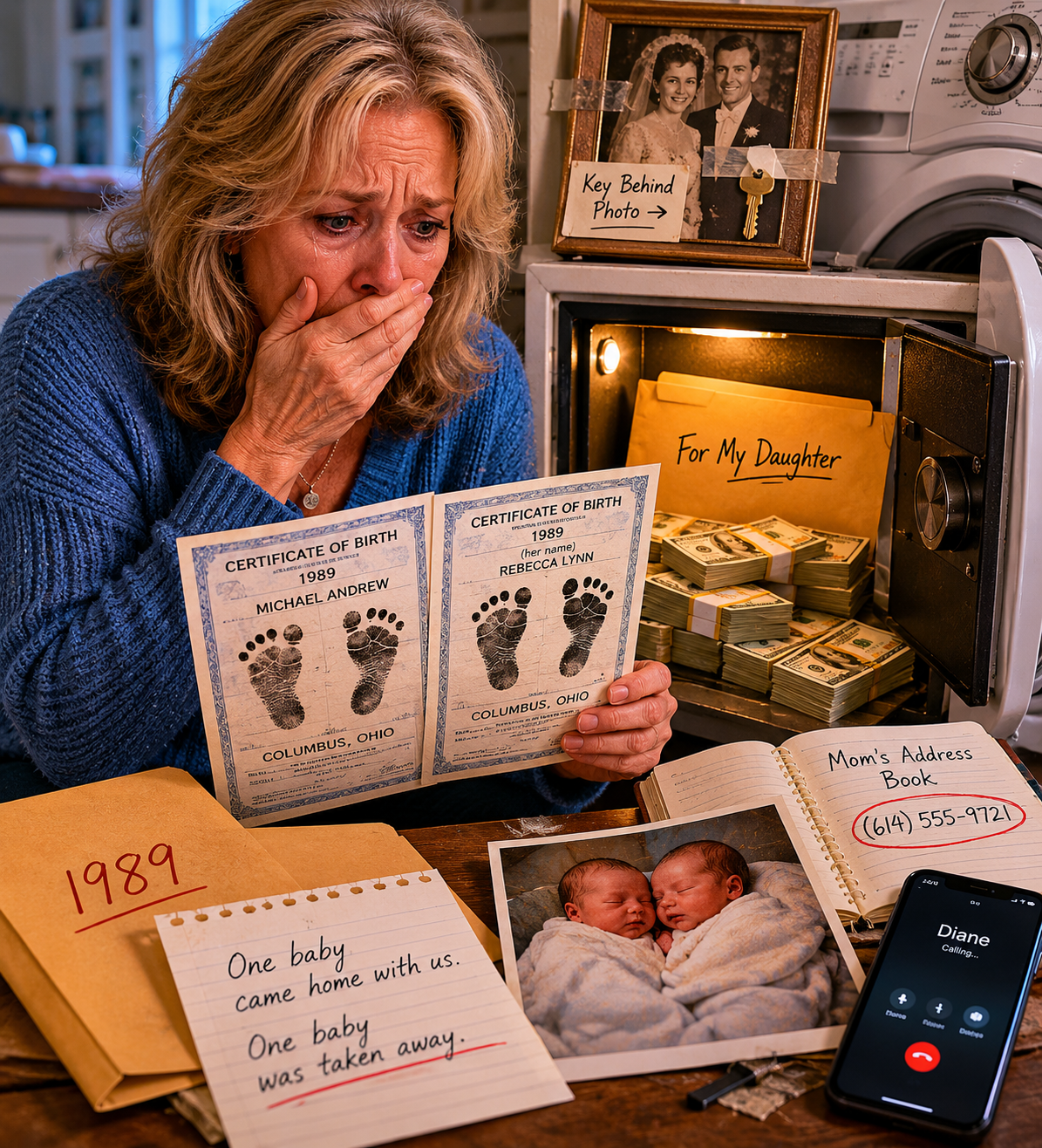
Wedged tightly into a recessed niche in the drywall behind the machine was a heavy grey metal lockbox. It was covered in a thick layer of lint and grease. It didn’t have a digital keypad, just a heavy, old-fashioned keyhole.
I stood there staring because my brain genuinely stopped working for a second. My parents didn’t have valuables. They didn’t even keep jewelry.
I remembered the silver wedding photo frame that had sat on our living room mantle for as long as I could remember. It was a heavy, ornate piece of silver, holding a black-and-white picture of my parents on their wedding day in 1964. My mother had always been fiercely protective of that frame.
I walked into the quiet living room, picked up the frame, and turned it over. Taped securely to the faded cardboard backing with yellowed Scotch tape was a small, flat brass key.
My knees felt weak as I peeled the tape free. I walked back to the utility room, knelt on the floor, and slid the key into the grey safe. It turned with a heavy, metallic click.
Inside the safe was a thick stack of cash. I counted it later. It was $22,000 in neat, banded $100 bills, straight from a local bank in Columbus. But it was the other item in the safe that made my breath catch.
It was a plain yellow manila folder. It looked completely ordinary, but when I opened it, my chest turned cold.
Inside were 2 birth certificates. Both were dated October 12, 1989. Both were from Grant Medical Center in Columbus, Ohio.
One certificate had my name on it, Ellen Marie Vance, with my parents listed as mother and father. The second certificate had a different name, Clara Diane Vance. The father’s line was left blank. The mother’s name was listed as Diane Vance.
Diane was my mother’s younger sister. She was the family’s secret, the girl who had supposedly vanished in 1990 after a wild teenage rebellion. Her name was never spoken in our house.
I looked down at the tiny, blue-ink newborn footprints stamped at the bottom of both certificates.
I am not a forensic expert, but I didn’t need to be. The ridges, the shape of the heel, the tiny curve of the big toe. They were absolutely identical.
My stomach dropped. I felt sick. I was looking at two different records for the exact same baby.
I ran my hand over the dusty paper. I needed to understand what this meant, but my mind was spinning in circles. I went to the kitchen and pulled out my mother’s old address book from the junk drawer. It was an old leather book with faded blue ink.
Under the letter D, there was a single entry that had been crossed out, then written over again in pencil. Diane. A number with a Columbus area code.
I sat on the kitchen counter, dialed the ten digits on my cell phone, and waited. It rang once. Twice. Then a woman answered.
“Hello?” she said. Her voice was lighter than my mother’s, but it had the exact same nasal, Midwestern lilt.
“Diane?” I asked. My voice sounded small, like a child’s.
There was a sharp intake of breath on the other end. “Yes. Who is this?”
“It’s Ellen,” I said. “I found the safe behind the washing machine.”
Neither of us said a word for what felt like a whole minute. The only sound was the hum of my parents’ old refrigerator in the quiet kitchen.
“So they finally told you,” Diane whispered. She sounded tired. So very tired.
“They didn’t tell me anything,” I said. “They’re dead, Diane. Dad died in April. Mom passed away six months later. I’m cleaning out the house alone.”
A soft gasp came through the line. Then, a long silence. I could hear her breathing, shaky and uneven.
“Oh, Ellen,” she finally said. “Then look at the back of the second certificate. The note explains everything about who your real mother is.”
I held the phone against my ear with one shoulder as I reached into the folder and flipped the second birth certificate over. On the back, written in my mother’s tight, neat cursive, was a message that destroyed my entire childhood in three short paragraphs.
“Diane was only 19,” the note began. “She was unmarried, living in a cheap rooming house in Columbus, and she had no money. We told our neighbors we were going away on a long trip to care for a sick relative. We paid her doctor bills. We made her sign the papers. We had to protect our family name. We took the baby. We told Diane she could never come back. It was the only way.”
My hands were shaking so badly I dropped the paper onto the linoleum.
My parents had not adopted me out of love. They had systematically pressured a frightened, broke 19-year-old girl into giving up her baby to protect their middle-class pride. Then, they had banished her from the family, leaving her to be remembered as a wild girl who ran away.
“Ellen?” Diane’s voice called out from the phone on the floor. “Are you there?”
I picked up the phone. “The cash,” I whispered. “The twenty-two thousand dollars. What is that?”
“That was the money they tried to give me,” Diane said, her voice crackling with old grief. “After they made me sign the custody papers, your father left an envelope on my kitchen table. It was supposed to help me start over in another state.
I told them I didn’t want their blood money. I never touched a cent of it. I guess they just kept it in that safe, waiting for me to change my mind.”
My jaw locked. I could hear my own pulse drumming in my ears. The people I had grieved, the parents I had thought were quiet and self-sacrificing, had bought me from my own aunt and then thrown her out like garbage.
“I want to see you,” I said. My voice was suddenly very steady. The sadness was gone, replaced by a cold, hard clarity.
“I would like that very much, Ellen,” she said.
Three days later, I drove to a quiet Bob Evans diner in Springfield, Ohio. It was a grey, overcast Tuesday. I sat in a corner booth, staring out the window at the highway traffic. The silver wedding photo frame was sitting on the laminate table next to my coffee cup.
When the bell above the door chimed, I looked up.
A woman in her early 50s walked in. She was wearing a simple denim jacket and dark slacks.
Her hair was light brown, fading to silver at the temples, pulled back in a loose clip. But it was her face that made me stop breathing.
She had my exact eyes. The same slight tilt at the corners. The same dimple in her left cheek when she looked around the restaurant.
She saw the silver frame on the table and walked over, her steps hesitant. She stopped at the edge of the booth.
“Ellen?” she asked.
“Yes,” I said, sliding the silver frame aside. “Sit down, please.”
She slid into the booth opposite me. Her hands were small, her fingernails clean but unpolished. She reached across the table, her fingers stopping just inches from mine, waiting to see if I would pull away. I didn’t.
We sat in that booth for four hours. She didn’t try to sugarcoat anything. She told me about the cold winter of 1989. She told me how my mother, her older sister, had showed up at her tiny apartment with a lawyer and a stack of papers.
“They told me if I didn’t sign, they would tell the landlord about my situation and have me evicted,” Diane said, her eyes wet but her voice remarkably calm. “They told me a single mother in Zanesville would be ruined.
They said you would grow up in poverty, and it would be my fault. I was nineteen, Ellen. I was so scared. I thought they were right.”
“Did you ever try to come back?” I asked.
“I drove past your house every year on your birthday,” she said, a small, sad smile touching her lips. “I would park down the street by the park and just watch the front door. One year, I saw you riding a red bicycle in the driveway.
You had ribbons on the handlebars. I wanted to get out of the car so badly. But your father had made me sign an agreement. If I contacted you, they would take legal action and move you to another state where I could never find you.”
I looked at the silver wedding frame on the table. The perfect, smiling couple in the photograph looked like strangers to me now. Their neat, quiet life was built on a foundation of absolute cruelty.
“I’m not going back to that house,” I said.
“What about the money?” Diane asked.
“It’s yours,” I said, pushing the manila folder across the table toward her. “It was always yours. We’re going to use it to sell that house, and we’re going to find a place of our own. If you’ll let me.”
Diane looked at me, and for the first time, a real, bright smile broke across her face. It was the exact same smile I saw in the mirror every morning.
“I’d like that, Ellen,” she said.
We walked out of the diner together into the cool Ohio afternoon. The house on Maple Street was still sitting there, full of dusty furniture and old lies, but I was done cleaning it.
I reached out and took my mother’s hand. My real mother’s hand. And for the first time in thirty-four years, I felt like I was finally on my way home.