I need you to understand how cold that room was. It smelled like industrial bleach and old cabbage, the kind of heavy, wet smell that sticks to the back of your throat.
My bed at St. Jude’s Hospital was pushed right against the window, and the wind from the Indiana plains kept rattling the loose glass. I had a thin hospital sheet that did nothing to stop the draft.
My body felt like it had been run over by a semi-truck. The emergency C-section had gone completely wrong, and I had lost almost three pints of blood. My baby boy, Leo, was down a long maze of corridors in the NICU, hooked up to tubes that I wasn’t allowed to see.
The daytime nurses were so short-staffed they barely had time to throw a plastic tray of cold broth on my bedside table before rushing out.
And I was entirely, completely alone.
I keep going back to that first night because it was the hardest. My husband, Tyler, had left for his annual hunting trip in Michigan two days before my water broke. I remember calling him from the bathroom floor when the contractions started.
He just sighed into the phone. He told me his mother had worked a full shift at the grocery store the day she had him, and that I was just being dramatic.
“Call an ambulance if it’s that bad,” he had muttered. I could hear his friends laughing in the background. Then he hung up.
So there I was, 24 years old, sitting in a dark room with a fever of 103, listening to the steady, mechanical beep of my heart monitor. I didn’t even have the strength to push the call button anymore. Every time I did, a voice over the intercom would just tell me someone would be there soon. Nobody ever came.
But then, around midnight, the heavy wooden door creaked open.
A woman slipped into the room. She was wearing faded green scrubs that didn’t have the official hospital logo on the pocket. I didn’t think anything of it at the time. I was just so grateful to see a human face. She had silver-gray hair pulled back in a messy bun, and she smelled like vanilla and lavender. It was the cleanest, sweetest smell in that whole miserable building.
She didn’t say much at first. She just walked over to my bed, took off her watch with the cracked glass face, and set it on the nightstand. Then she went to the bathroom and came back with a basin of warm water and a clean washcloth.
She didn’t ask me for my insurance card. She didn’t check my chart. She just began to gently wipe the dried sweat and blood from my forehead.
“You’re going to be okay, mama,” she whispered. Her voice was low and steady, like a warm blanket. “I’ve got you. You’re not alone.”
I started crying, and she didn’t try to make me stop. She just let me hold onto her sleeve while she brushed my hair out of my sticky eyes. Later that night, when I asked about Leo, her face softened. She told me she would go check on him herself.
An hour later, she came back. She had a little hand-written note on a piece of yellow scrap paper.
It read: “Leo is breathing on his own now. He has a patch of dark hair and the tiniest fingernails. He is sleeping like a little angel.”
She reached into her deep pocket and pulled out a small, knitted blue cap with a yellow star. The yellow star was a little crooked, and there was a loose thread hanging from the crown.
“I made this for him,” she said softly. “He’s wearing a green one now, but you keep this one. It’s for when you finally get to hold him.”
For 10 days, that woman was my only lifeline. I called her Sarah because that was the name on her faded badge. Every single night, she would show up around midnight. She brought me warm broth from a thermos she kept in her bag. She rubbed my back when the post-surgery cramps made me scream in my throat. She never seemed to be in a hurry.
Not on night three when my fever spiked again.
Not on night five when Tyler called to say he was staying an extra day in Michigan because the weather was nice.
Sarah just sat there with me, holding my hand through the plastic guardrails.
She never complained about the hospital or the staff. She just kept her eyes on me, humming some old lullaby I couldn’t quite place.
When I was finally discharged, I tried to find her to say goodbye. The daytime receptionist just stared at me like I was speaking a foreign language.
“We don’t have a night nurse named Sarah on this floor,” she said, not even looking up from her computer screen. “You must have had one of the floaters from the third floor.”
I was too tired to argue. I took Leo home in his car seat, clutching the little blue knit cap with the crooked star, and I tried to start my life.
Two years went by. Tyler and I got divorced six months after Leo was born. It turned out he didn’t like the sound of a baby crying any more than he liked high-risk pregnancies. I ended up renting a small, drafty duplex near the railroad tracks in Terre Haute. I took a job as a night clerk at a local hardware store just to pay the heating bills.
Money was tight, and my back still ached from the surgery, but Leo was thriving. He was a wild, happy toddler who loved to wear that blue knit cap even in the middle of July.
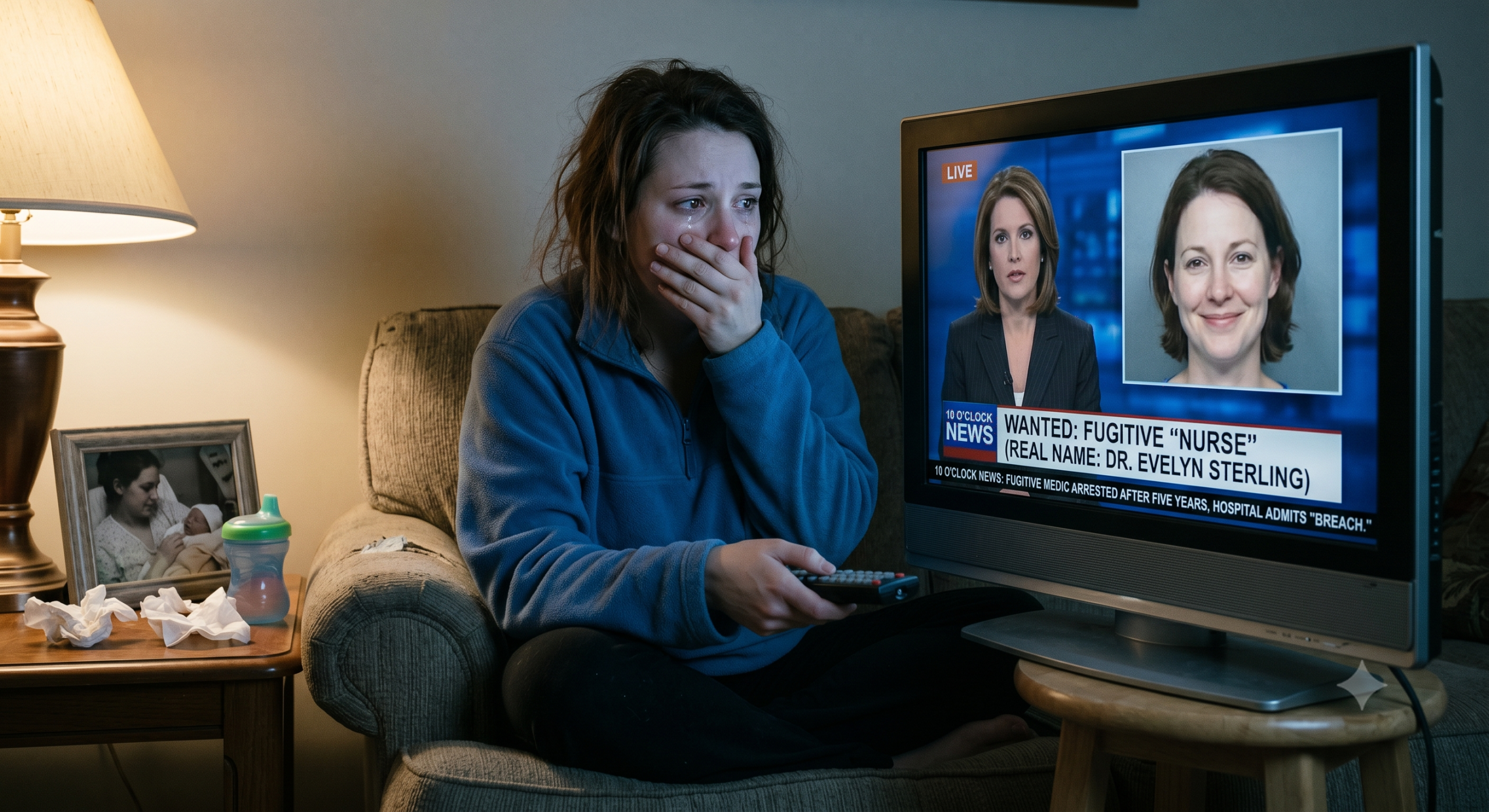
One Tuesday night, I was sitting on my worn green sofa, folding a pile of Leo’s tiny t-shirts. The TV was playing in the background, just a low murmur of the 10 o’clock news to keep me company. I was half-asleep, my mind drifting through bills and grocery lists.
Then the news anchor’s voice changed. It got serious, that dramatic tone they use when something bad has happened close to home.
“A major security breach has been uncovered at St. Jude’s Hospital,” the anchor announced. “A local woman has been arrested after spending five years posing as a registered nurse in the neonatal and maternity wards.”
I froze. My hand stopped halfway through folding a pair of socks.
An orange mugshot flashed on the screen.
It was her.
Her hair was looser, and there were deeper circles under her eyes, but it was Sarah.
The screen text didn’t say Sarah, though. It said: “Evelyn Vance, Age 58.”
“Vance is being charged with multiple counts of criminal trespass, grand theft of medical supplies, and practicing medicine without a license,” the reporter said. “Hospital officials state that she managed to evade security by wearing scrubs and stealing identification badges from retired employees. Authorities are calling her a highly sophisticated predator who targeted vulnerable mothers and infants.”
My phone slipped out of my hand and hit the hardwood floor. The sound was like a gunshot in my quiet room.
Predator?
They showed a clip of her being led into the county courthouse in handcuffs. She looked so small. She was wearing a baggy orange jumpsuit, and she was keeping her head down, trying to shield her face from the flashing cameras. Her wrists looked thin and fragile in the metal cuffs.
I sat there on the floor, looking at Leo’s blue cap resting on the sofa cushion. My brain genuinely stopped working for a second.
I knew what the news was saying. I knew she had broken the law. But I also knew that when I was d*ing in that bed, nobody else had cared. The hospital hadn’t cared. My own husband hadn’t cared.
Evelyn Vance had.
I didn’t sleep that night. I spent the hours searching online, trying to find out where they were holding her. It turned out her preliminary hearing was scheduled for Thursday morning at the county courthouse.
I called my boss at the hardware store and told him I couldn’t make my shift. He threatened to fire me, but I didn’t care. I put Leo in his stroller, packed his blue knit cap in my purse, and drove my old Chevy down to the courthouse.
The courtroom was packed. There were reporters with cameras, hospital administrators in expensive suits, and a row of angry-looking security guards. Evelyn was sitting at the defense table next to a public defender who looked like he wanted to be anywhere else in the world.
When the prosecutor stood up, he painted a terrifying picture. He called Evelyn a “threat to public safety” and demanded she be held on a high bond. He talked about “violating the sanctity of the medical system.”
Evelyn just sat there, staring at her own hands. She looked completely defeated.
I couldn’t take it anymore.
I stood up from the wooden bench in the back. My knees were shaking, and my heart was pounding against my ribs like a trapped bird.
“She saved my son!” I yelled. My voice sounded cracked and strange in the silent courtroom.
The bailiff immediately moved toward me, his hand resting on his belt. “Ma’am, sit down or you will be removed.”
But then, another woman stood up three rows in front of me.
“She saved mine, too,” she said. She was holding a little girl in a pink dress. The little girl was wearing a knitted yellow blanket with a green border.
Then an older man stood up. Then another young mother.
Within seconds, half the gallery was standing. We weren’t a mob. We were just a group of tired, ordinary people. And almost every single one of us was holding something. A knitted blanket. A small pair of booties. A crooked blue cap with a yellow star.
It turned out Evelyn hadn’t just visited me. For five years, she had been sneaking into that hospital to sit with the babies whose mothers couldn’t be there, or the mothers who had been abandoned by their families.
She had lost her own daughter and grandson to a preventable birth complication in an understaffed clinic ten years prior. She had tried to complain, but the hospital lawyers had buried her in paperwork. So, she had decided to become the nurse she wished her daughter had.
The judge, a stern-looking man named Miller, stared at the sea of knitted hats and blankets. He looked at the expensive hospital administrators, then down at Evelyn Vance.
He didn’t dismiss the charges. He couldn’t do that. But he did something else.
He set her bail at a single dollar. He looked at the prosecutor and said, “It seems to me that the real crime here is how many mothers in this county are left to suffer alone in the dark.”
The hospital administrators walked out of that courtroom with their faces completely pale. They had expected a quick, public victory. Instead, they got a lobby full of reporters asking why their night shifts were so empty that a grandmother in stolen scrubs had to do their jobs for them.
Evelyn Vance ended up pleading guilty to a reduced charge of trespass. She didn’t go to prison. She got two years of unsupervised probation and community service.
That was last year.
Yesterday, I drove Leo over to the local community center. They started a free daycare program for working mothers, and guess who they hired to run the nursery?
I watched through the glass door as Leo ran straight into Evelyn’s arms. She was wearing a bright yellow apron over a plain shirt, and she still smelled like vanilla.
She looked up and smiled at me. I still don’t really know how to feel about all the legal stuff, but as I watched my son laugh and pull at her silver hair, I knew one thing for sure.
Some people don’t need a license to be exactly what you need.