“Clara, please,” Brenda Vance sobbed into the receiver. “The bank is calling about our mortgage. We could lose our home. Greg was wrong, but please…”
I stood in my kitchen, looking out the window at the raw, pale stump sitting in the dirt.
“He should have thought about that before he started the chainsaw, Brenda,” I said.
My hand was shaking so hard the copper watering can rattled against the Formica counter.
I hung up the phone and looked out at the empty yard.
Let me back up.
Arthur and I bought our small home on Lakeshore Drive back in 1985.
The week we brought our first child, Leo, home from the hospital in 1986, Arthur walked into the house with a tiny oak sapling.
He had found it growing near the edge of the local shipyard where he worked.
“It’s going to grow with him, Clara,” Arthur said.
He bought a copper watering can from the hardware store, and that watering can became a fixture of our Saturdays.
It was a beautiful can, heavy and bright, though over the decades it developed a rich green patina from the well water.
Watering the tree became a weekly ritual for my husband.
Every Saturday morning, after we finished our breakfast, Arthur would fill the copper can at the side spigot.
He would walk out to the property line where the little sapling stood.
He would pour the water slowly around the base, checking the leaves and talking to the tiny tree.
I watched him from the kitchen window, smiling at how serious he was about this small piece of nature.
For 35 years, Arthur watered that tree every single weekend.
We watched it grow from a fragile twig into a massive, shading canopy.
It became a giant white oak, its trunk growing thick and strong, its branches reaching wide.
The oak tree sheltered our home from the hot summer sun, keeping our porch cool during the humid July afternoons.
When Leo was 5, Arthur hung a simple wooden swing from the lowest thick branch.
We spent our summer evenings sitting on the porch, listening to the lake wind rustle the leaves.
The swing was where Leo spent his afternoons, giggling as Arthur pushed him higher and higher.
That tree was the backdrop of our entire family life.
We took pictures of Leo standing against the trunk on his first day of school every year.
We marked his height in the bark, watching him grow taller alongside the oak.
It was a living diary of our years together, marking our anniversaries and our son’s growth.
When Arthur d*ed of lung c*ncer 5 years ago, that tree became my living memorial for him.
The loss of my husband was a quiet, heavy ache that never really went away.
But looking out at the oak tree brought me a strange sense of comfort.
It stood strong against the winter snow and blossomed beautifully in the spring.
It represented Arthur’s strength, his permanence, and the love he had for our family.
Every morning, I would sit by the window with my coffee, looking at its branches rustling in the wind, feeling Arthur’s presence.
It was the last physical connection I had to the life we had built.
And then Greg Vance bought the lot next door.
Greg was a local pool contractor in his early 40s.
He was a loud, wealthy man who drove a giant black truck and had no appreciation for the history of our street.
The first thing he did was clear all the beautiful, mature pine trees on his lot.
He replaced the soft grass with concrete, pouring it right up to our property line.
He built a massive in-ground swimming pool that took up his entire backyard.
But the branches of my oak tree hung slightly over the fence, casting a cool shade on his concrete deck.
Greg did not like that.
He began complaining about the leaves falling into his pool, claiming they were making his filtration system work double time.
He acted as if the natural falling of leaves was a personal attack on his property.
One morning, Greg stood by the fence holding a leaf skimmer, calling out to me.
He demanded that the tree be cut down, speaking as if my tree was a nuisance he had the right to remove.
He spoke about his expensive pool filters and how much time he spent cleaning the water.
I offered to have a professional tree service trim the branches that hung over his side of the fence.
But Greg shrugged, stating that trimming would not do and the entire tree had to go.
“You can’t cut down that tree, Greg,” I told him. “My late husband planted it. It’s a memorial.”
He did not argue. He just nodded once and walked away.
I thought the matter was settled, believing that even an arrogant neighbor would respect the memory of a deceased man.
But I was wrong.
A few weeks later, I went to Chicago.
My daughter was having her baby shower, and I was gone for exactly 5 days.
I spent those days folding tiny baby clothes and celebrating the upcoming birth, pushed by a happy anticipation.
But when I drove my old Buick back into the driveway on Sunday afternoon, my heart stopped.
The backyard was too bright, flooded with a harsh, blinding glare.
I walked to the back, and my stomach dropped.
There was no oak tree.
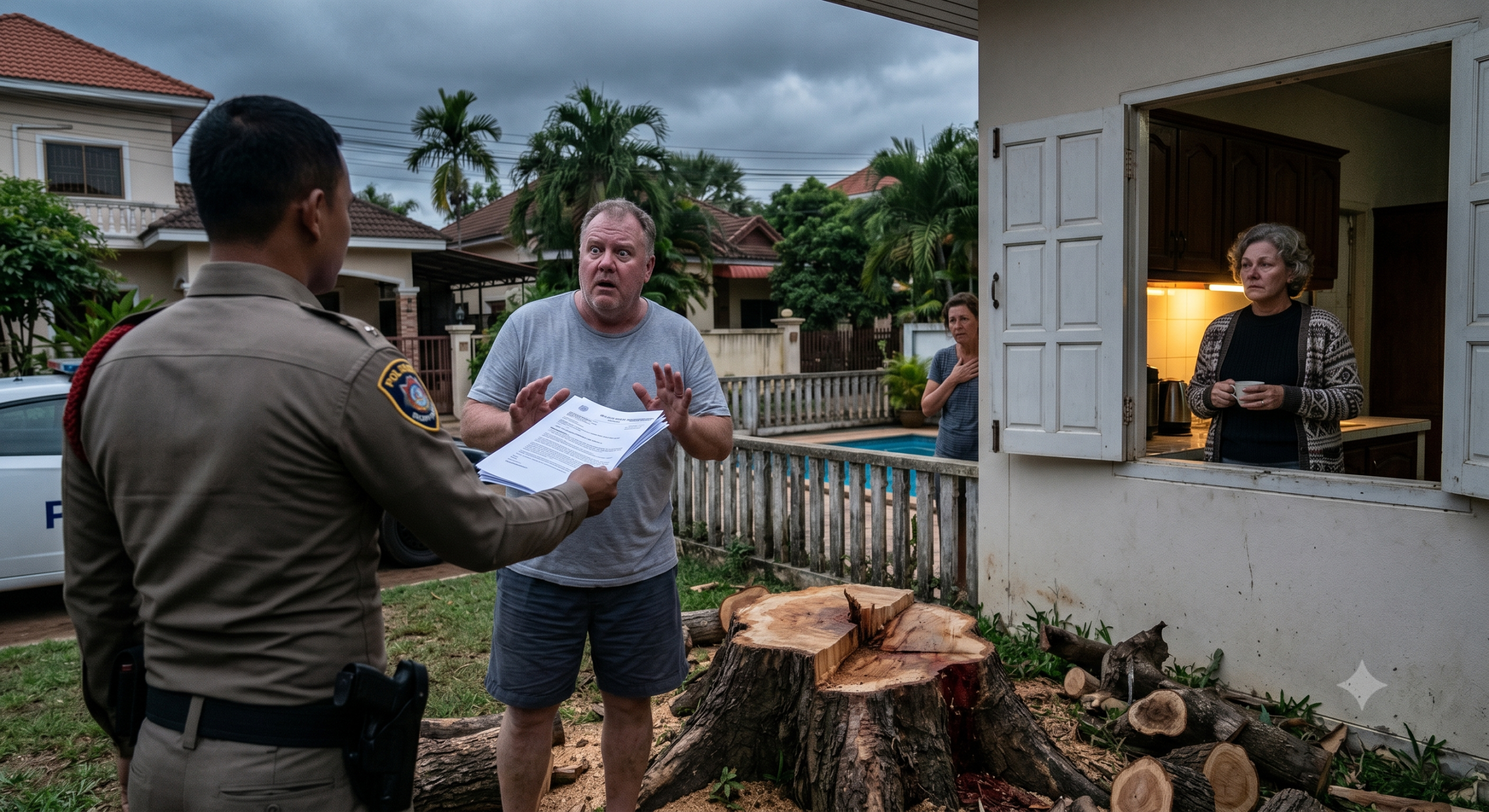
There was only a massive pile of sawdust and a raw, yellow stump sitting in the dirt.
The branches were gone, and Leo’s childhood swing was crushed under a pile of logs.
My husband’s living memorial had been reduced to a flat piece of wood.
I stood there for 10 minutes, unable to draw a breath, feeling a deep, hollow ache in my chest.
Greg walked out onto his back deck, holding a can of beer, looking completely unbothered.
He walked over to the fence, stating that he had done me a favor because the tree was supposedly rotting.
He claimed his pool was clean now and that the yard looked much better without the shade.
“You cut it down,” I whispered.
He shrugged it off as just a piece of wood, reached into his pocket, and pulled out a wad of cash.
He offered me 500 dollars, telling me it was more than enough for some firewood and that we should call it even.
He actually smiled, expecting me to take the bills and forget the 40 years of history he had destroyed.
I did not take the money.
I walked back inside my house, locked the door, and sat on the kitchen floor, staring at the copper watering can.
I wept for Arthur, and I wept for the tree that had guarded my home for decades.
The next morning, I called my son Leo, who was furious.
Leo insisted that the tree was perfectly healthy and that Greg had no legal right to touch it.
We called David, a certified master arborist, to examine the stump.
David spent an hour measuring the rings, examining the wood, and checking the root system.
He shook his head, confirming the tree was in perfect health and could have lived another 100 years.
He explained that mature white oaks are irreplaceable, providing ecological, structural, and cooling benefits to the land.
He wrote a formal valuation of 27,000 dollars, using standard industry formulas for mature trees.
I took the arborist’s report to my lawyer, Mr. Fletcher.
Mr. Fletcher explained that under Michigan law, cutting down trees without permission is called timber trespass.
Because Greg did it intentionally while I was away, we were entitled to treble damages, which meant triple the value.
That brought the damages to 81,000 dollars, plus the costs of stump removal and replanting.
We filed a lawsuit for 100,000 dollars on Monday afternoon.
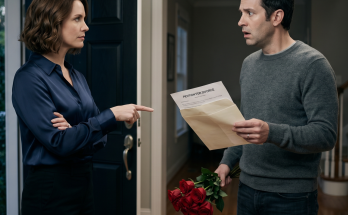
I watched from my kitchen window as Greg was served the papers.
He took the envelope, laughed, and later that evening shouted toward my porch that I was crazy and he would not pay a dime.
He believed the lawsuit was a bluff, a minor neighborhood dispute that a judge would throw out of court.
But Greg did not understand how tree law worked, and he did not know what his insurance company would do.
On Tuesday afternoon, a representative from Greg’s homeowner’s insurance company visited his home.
The investigator looked at the stump, the property line, and requested the contract Greg had signed with the tree removal crew.
The tree removal company had saved the paperwork, which included a specific waiver.
In that contract, Greg had signed a clause verifying that the tree was on his property and authorizing its immediate removal.
By signing that waiver, Greg had taken sole liability for the trespass and property damage.
Since he lied and signed it, it was proof of an intentional, premeditated act of trespass.
Insurance policies only cover accidental damage, not intentional acts of destruction.
On Tuesday evening, Greg was pacing his driveway, screaming into his phone in a panic.
On Wednesday morning, Mr. Fletcher called me with the news.
Greg’s insurance company had denied coverage and dropped his policy immediately.
Without homeowner’s insurance, Greg’s bank threatened to accelerate his mortgage, demanding immediate payment.
He was now personally liable for the full 100,000 dollars.
His personal assets, his truck, his business accounts, and his home were all on the line.
That was when Brenda called me, sobbing into the receiver, begging for mercy.
She cried for 15 minutes, saying Greg was losing his mind and they could lose everything they had built.
She pleaded that they had invested all their savings into the house and the pool.
She asked me to think of their future and drop the lawsuit.
But I remembered the sawdust, the empty sky, and the crushed swing.
I remembered the Saturday mornings Arthur had spent caring for that tree.
“Brenda,” I said gently, “Greg was calm when he cut down my husband’s tree. Tell him to be calm now.”
I hung up the phone, refusing to let them escape the consequences of their arrogance.
Greg settled the case for 85,000 dollars.
He had to sell his truck and his boat to pay the debt.
His pool business lost local contracts when the story of what he did spread through Grand Haven.
People did not want to hire a contractor who destroyed a widow’s memorial tree for his own convenience.
Last Saturday, Leo came over with a small oak sapling in the back of his truck.
We dug a new hole in the backyard together, near where the old stump remained.
Leo pressed the soil around the roots and assured me it would grow.
I watered the new sapling this morning, watching the water flow from the spout of the copper watering can.
The backyard is quiet again.
My kitchen faucet still has that small leak Arthur never got to fix, but I do not mind it.
I stand by the window, watching the little green leaves of the new sapling catch the wind.