“We are only paying for your sister’s royal wedding. Not yours,” my mother said—then dropped my invitation into the fireplace and demanded I sign an NDA about the institution where they locked me away at sixteen. I walked out without arguing. The next morning, an anonymous package appeared on my desk. Inside was my old Hawthorne Ridge wristband and six words: “Your mother came every single month.” That was when I realized my parents hadn’t abandoned me by accident.
### Part 1
My mother held my wedding invitation over the fireplace long enough for me to understand that what she was about to do was deliberate.
The envelope was thick ivory paper with a narrow embossed border, the kind Nathan and I had spent an embarrassing amount of time choosing because I wanted the invitation to feel simple and warm rather than expensive. My mother’s manicured thumb rested over my name as the fire cracked behind her, filling the dining room with the smell of cedar and smoke.
Then she let go.
The envelope struck one of the burning logs, curled at the corners, and vanished beneath orange flame.
My father never looked away from his wineglass.
My younger sister, Camille, sat three chairs down from me in a pale cashmere sweater, frozen with one hand around the stem of her glass. Nathan’s knee touched mine beneath the table, but he did not interfere. He knew why I had asked him to let me handle this myself.
My mother, Celeste Bellamy, turned back toward me with the calm expression she usually reserved for charity luncheons and photographs.
“We are only paying for your sister’s royal wedding,” she said. “Not yours.”
She glanced at the fire.
“And frankly, Avery, after everything you’ve put this family through, you should be grateful we even let you come here tonight.”
For thirty-eight years, I had been trained to respond to sentences like that in one of three ways.
Defend myself.
Cry.
Or apologize for something I had not done.
That night, I did none of them.
I watched my name turn black in the flames and felt something inside me go strangely quiet.
“Understood,” I said.
My father’s head finally lifted.
Richard Bellamy had built a career advising corporations through mergers, scandals, and hostile restructurings. He was a man who could enter a conference room full of frightened executives and leave with everyone believing the disaster had been somebody else’s fault.
He hated one thing more than losing control.
He hated realizing he no longer had it.
“What does that mean?” he asked.
“It means I understand.”
“You brought us a list of conditions,” he said, tapping the document I had placed beside the invitation. “You come into our house and give us rules?”
“They’re boundaries.”
“They’re insults.”
The document contained exactly four requests.
No speeches about my childhood.
No discussion of my supposed “mental instability.”
No attempt to interfere with the ceremony.
No insulting Nathan or his family.
I had not demanded an apology.
I had not demanded money.
I had not even demanded affection.
I had asked my parents to behave normally for one afternoon.
Richard opened the leather folder beside him and slid another document across the mahogany table.
“Then sign this.”
I looked down.
NONDISCLOSURE AND NON-DISPARAGEMENT AGREEMENT.
I almost laughed.
“What exactly am I agreeing not to disclose?”
His expression did not change.
“Family matters.”
“Which family matters?”
Celeste folded her hands.
“Oh, don’t start.”
I looked at my father again.
“You mean Hawthorne Ridge.”
Camille’s fork stopped halfway to her mouth.
Nobody in our family said the name.
Hawthorne Ridge Youth Center had been the locked residential facility where my parents sent me when I was sixteen.
I had remained there for twenty-one months.
According to them, I had become uncontrollable. Aggressive. Unstable. Dangerous to my little sister.
According to the story they told relatives, neighbors, teachers, and eventually anyone who asked where I had disappeared to, my parents had been heroic people forced into an impossible decision.
According to my memory, men I barely knew had arrived at our house before sunrise, put me into a vehicle while I cried, and driven me four hours away.
I remembered fluorescent hallways.
Plastic mattresses.
Industrial disinfectant.
Overcooked vegetables.
Doors that locked from the outside.
And waiting.
Mostly, I remembered waiting.
Waiting for my mother to visit.
Waiting for my father to call.
Waiting for somebody to tell me when I could go home.
The staff repeatedly told me that my parents had refused contact because seeing me would “reinforce manipulative behavior.”
At seventeen, I had believed them.
At thirty-eight, I had stopped believing almost everyone involved.
Richard tapped the agreement.
“If you want us at your wedding, this is the price.”
Nathan shifted beside me.
I reached for his hand beneath the table.
Then I pushed the document back.
“No.”
That was when my mother picked up the invitation.
That was when she burned it.
And that was when I finally understood that I had been treating cruelty like a negotiation.
I stood.
Nathan rose with me.
Camille whispered, “Avery—”
I looked at her.
She was thirty-three now, beautiful in the effortless way that comes from spending an adult life buffered from consequences. Our parents had paid for everything: private university, graduate school, a townhouse, travel, a car, and now a wedding so elaborate that Celeste had spent six months calling it “the social event of the year.”
I didn’t hate Camille.
But I didn’t trust her either.
Not then.
“Enjoy your wedding,” I told her.
Her face tightened.
“Avery, I didn’t ask Mom to—”
“I know.”
That was the truth.
Whatever my parents had done to me, Camille had been eleven when it began.
I picked up my coat.
My father spoke before we reached the doorway.
“If you walk out over this, don’t expect us to come crawling after you.”
I turned around.
The fireplace reflected in the windows behind him, making the room look as though it were burning from both sides.
“I don’t.”
Outside, the January air cut against my face.
Nathan waited until we were inside the car before saying anything.
“How are you?”
I stared through the windshield at the enormous stone house where I had grown up.
“Finished.”
He reached across the console and took my hand.
Nathan Mercer had never tried to rescue me from my family.
That was one of the reasons I loved him.
He listened.
He believed me.
And when I told him I needed to handle something myself, he respected that even when every instinct in him wanted to intervene.
“Then we’re finished,” he said.
The next morning, I arrived at my law office before seven.
I was halfway through my first coffee when my assistant knocked and carried in a battered brown package.
“No courier information,” she said. “It was sitting with the overnight deliveries.”
The box had been wrapped in paper and reinforced with so much tape that somebody had clearly wanted to make sure it survived the trip.
There was no return address.
No company name.
Nothing.
I cut through the tape with the silver letter opener I kept beside my keyboard.
Inside were layers of old newspaper.
Then something small fell onto my desk.
Plastic.
Yellowed with age.
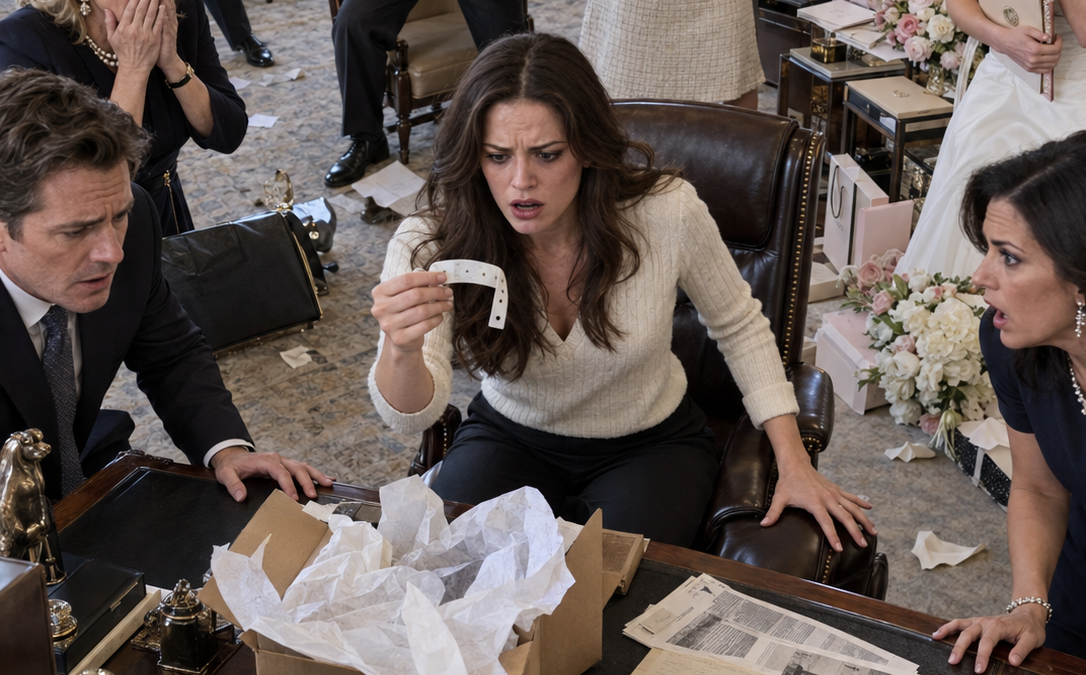
A hospital identification bracelet.
My hands stopped moving.
Printed across the front was my full maiden name.
AVERY BELLAMY.
My date of birth.
And beneath it, a faded institutional code.
HRC-ADMIN-06.
Hawthorne Ridge Center.
For several seconds I could hear nothing except the ventilation system above my desk.
Then I noticed the folded piece of paper taped beneath the bracelet.
Six handwritten words.
Your mother came every single month.
I read the sentence three times.
During my twenty-one months at Hawthorne Ridge, I had been told my mother never came.
I had been told she could not bear to see me because I had hurt Camille.
I had been told my father refused contact because my behavior proved I was not ready to return home.
But somebody had just mailed me evidence that Celeste had been inside the building.
Not once.
Every month.
My first instinct was to call my mother.
My second was to drive to Hawthorne Ridge, even though the facility had closed years earlier.
My professional instinct was the one that saved me.
I touched nothing else.
I photographed the box where it sat.
Then I called Mara Ellison.
Mara was an attorney whose practice focused on institutional misconduct and complex civil litigation. We had worked opposite each other years before and remained friends afterward.
When I told her what was on my desk, she was silent for several seconds.
“Don’t investigate this yourself,” she finally said.
“I know.”
“I’m serious, Avery.”
“So am I.”
“If your family is involved, anything you uncover personally will be attacked as contaminated or retaliatory.”
“I know.”
“Good. Put the bracelet in an evidence sleeve. Save the packaging. I’m coming over.”
By noon, Mara had obtained access to archived licensing records.
By evening, she called me from her office.
“I found the code.”
I stood beside my living room window while Nathan cooked dinner behind me.
“What does it mean?”
“The bracelet isn’t from the residential wing.”
I tightened my grip on the phone.
“What?”
“HRC-ADMIN was issued to people processed through the administrative reception area.”
“Patients?”
“No.”
The word landed harder than I expected.
Mara continued carefully.
“Your mother wasn’t entering the building as a visitor.”
I stared at my reflection in the dark window.
“Then what was she doing?”
“I don’t know yet.”
Two days later, we found the woman who did.
Her name was Ruth Calder.
She was seventy-one years old, retired, widowed, and so frightened of my father that she refused to speak to us on the phone.
Mara arranged a meeting at her office.
Ruth arrived carrying an old canvas tote bag against her chest.
She looked at me for a long time before sitting down.
“I knew someday you’d come looking,” she said.
Then she reached inside the bag.
What she placed on the conference table was not one document.
It was an entire ledger.
And the first page contained my mother’s signature.
### Part 2
Ruth Calder’s hands shook as she opened the ledger.
The pages smelled faintly of dust and old paper, and several corners had been softened by years of being handled. Each sheet contained rows for dates, names, reasons for entry, and staff initials.
“Your mother came on Tuesdays,” Ruth said.
I looked down.
January.
Celeste Bellamy.
Administrative meeting.
February.
Celeste Bellamy.
Administrative meeting.
March.
April.
May.
The signatures continued month after month.
Twenty-one months.
My throat tightened.
“Did she ever ask to see me?”
Ruth lowered her eyes.
“No.”
The answer hurt more than I expected.
Some childish part of me had still been hoping for an explanation.
Maybe Celeste had tried.
Maybe the staff had stopped her.
Maybe somebody had lied to both of us.
“No?” I repeated.
“Never.”
Ruth reached into her bag again.
“She asked for these.”
She placed a stack of documents beside the ledger.
They were copies, but the originals had been preserved elsewhere.
Authorization for continued residential placement.
Parental restriction of unsupervised communication.
Extension of restricted correspondence.
My mother’s signature appeared at the bottom of every form.
I stared at the page.
“When I wrote home…”
Ruth’s mouth tightened.
“I remember the letters.”
My skin prickled.
“You saw them?”
“I handled outgoing correspondence.”
I leaned forward.
“Did my parents receive them?”
Ruth looked directly at me.
“Your mother did.”
For a moment, nobody in the room moved.
Ruth opened another envelope.
Inside were copies of letters written in my own sixteen-year-old handwriting.
Mom, please come.
I don’t understand why I’m still here.
Please tell Dad I’m sorry for whatever he thinks I did.
Please let me talk to Camille.
One letter had a water stain across the bottom.
I remembered that one.
I had cried so hard while writing it that the ink blurred.
“I handed several of these to your mother personally,” Ruth said.
My fingernails pressed into my palms.
“What did she say?”
“The first time, she read one in the lobby.”
“And?”
“Nothing.”
“Nothing?”
“She folded it and put it into her purse.”
Ruth’s voice broke.
“The next month, she signed the restriction form.”
I looked away.
The conference room suddenly felt too small.
For twenty years, I had carried one question more faithfully than I had carried almost anything else.
Why wasn’t I worth visiting?
Now I had the answer.
My mother had been there.
She had been close enough to walk down one hallway and look me in the face.
Instead, she had signed paperwork designed to keep me quiet.
Mara slid a glass of water toward me.
I didn’t drink it.
“Why?” I asked.
Ruth hesitated.
“That’s the part I didn’t understand then.”
She reached into her tote for a third time.
This time she produced an old photocopy of an internal payment memo.
The letterhead belonged to Harrowgate Youth Services, the company that had owned Hawthorne Ridge.
The recipient was Valecrest Advisory Group.
My father’s company.
I read the first line.
Consulting performance disbursement.
Then the amount.
Then the date.
The payment had been issued two days after one of my confinement extensions.
My breathing changed.
Mara noticed.
“There are more,” Ruth said.
There were seventeen.
Not all identical.
Some were consulting payments.
Some were “retention performance incentives.”
Others referenced a pilot program called Family Continuity Metrics.
It sounded clinical enough to mean nothing.
Mara did not speculate.
Neither did I.
We hired a forensic accountant named Dominic Hale.
For two weeks, he worked through corporate filings, archived bank records, bankruptcy documents, old civil complaints, and tax disclosures.
I went to work every morning.
I met clients.
I argued motions.
I answered emails.
Then I returned home and sat at my kitchen island with Nathan, trying not to imagine what Dominic might find.
My parents did not contact me.
They were busy preparing for Camille’s wedding.
I knew this because Celeste continued posting photographs publicly.
Flowers.
Dress fittings.
Menu tastings.
A ballroom mock-up with enough candles to illuminate a stadium.
The message was obvious.
The family was celebrating without me.
I surprised myself by not caring.
Then Dominic called.
“We need to meet.”
That sentence is rarely followed by good news.
The four of us gathered in Mara’s office that evening.
Dominic connected his laptop to a large monitor.
“I found the structure,” he said.
A diagram appeared.
Harrowgate Youth Services.
Valecrest Advisory Group.
Several corporate subsidiaries.
A consulting agreement.
Then a series of payment triggers.
My father had been hired to improve Harrowgate’s profitability during an expansion period.
One component of his contract rewarded him for increasing what the company called “continuity rates.”
In ordinary language, that meant keeping beds occupied longer.
But Richard had gone further.
He had helped design a program teaching administrators how to persuade wealthy parents to extend residential placements.
My file was one of the program’s early test cases.
Every extension Celeste signed allowed Hawthorne Ridge to record another successful retention milestone.
Those milestones triggered escalating payments under Valecrest’s contract.
My father had not received millions because I alone stayed there.
He had used my confinement as evidence that his retention model worked.
Once the model was proven, Harrowgate expanded it across several facilities.
I had been the demonstration.
The first profitable example.
Dominic enlarged another section of the chart.
“Here’s where your father’s bonuses went.”
The money moved through Valecrest.
Then into several family investment accounts.
Then into an irrevocable trust.
Beneficiary: Camille Bellamy.
I stared at the screen.
“No.”
Dominic said nothing.
“Check again.”
“I did.”
“Check the trust documentation.”
“I did.”
“Maybe there were multiple beneficiaries.”
“There weren’t.”
Nathan leaned closer.
“Avery.”
I stood so quickly my chair rolled backward.
All those years, I had told myself that Camille’s advantages were simply the ordinary result of being the favorite child.
Private schools.
A beautiful car at sixteen.
Travel.
An elite university.
A graduate degree with no debt.
Her townhouse.
Her wedding.
I had never imagined that some of the money funding her life could be traced directly to the machinery that had destroyed mine.
The next morning I asked Camille to meet me.
Not at our parents’ house.
Not at my office.
A coffee shop halfway between her townhouse and downtown.
She arrived fifteen minutes late wearing sunglasses despite the gray weather.
“You sounded weird on the phone,” she said.
“I need you to look at something.”
I slid the documents across the table.
She read the first page.
Then the second.
Her eyebrows pulled together.
“I don’t understand.”
“That’s your trust.”
“I know what my trust is.”
“Look at the deposits.”
She did.
Then she looked at me.
“Where did you get this?”
“Independent forensic review.”
Her expression hardened instantly.
“Avery, if this is some kind of revenge because Mom burned your invitation—”
“It isn’t.”
“You’ve hated that they paid for things for me.”
“No, Camille. I’ve hated what they did to me.”
“Same difference.”
I almost left.
Then I remembered she had been eleven.
“Look at the dates.”
She did.
I watched the color slowly disappear from her face.
Each large deposit followed one of Celeste’s signatures at Hawthorne Ridge.
Camille shook her head.
“No.”
“I didn’t believe it either.”
“Dad told me the trust came from his executive bonuses.”
“It did.”
Her eyes lifted.
I said quietly, “Those were the bonuses.”
For several minutes she said nothing.
Then she shoved the papers away.
“I didn’t know.”
“I know.”
“Do you?”
“Yes.”
“You think I wanted this?”
“I don’t know what you knew.”
“I was eleven!”
“I know.”
Her voice rose enough that people at the next table looked over.
“I barely remember that night.”
“What night?”
Camille froze.
The coffee machine hissed behind the counter.
“What night?” I repeated.
“The night you left.”
I stared at her.
“You told everyone I attacked you.”
“That’s what Mom said happened.”
“What do you remember?”
She rubbed both hands over her face.
“Dad yelling.”
“At me?”
“No.”
That surprised me.
“At Mom, I think.”
“About what?”
“I don’t know.”
“Camille.”
“I don’t know, Avery.”
She closed her eyes.
“I remember something breaking.”
My pulse quickened.
“What?”
“Glass. Maybe.”
“What else?”
She opened her eyes again.
“You grabbed me.”
That was the story I had heard for twenty-two years.
I had grabbed Camille.
I had thrown her down.
I had attacked her.
“But…” she said.
“But what?”
Her breathing became shallow.
“I don’t remember being afraid of you.”
I leaned forward.
“Who were you afraid of?”
Her mouth opened.
No answer came.
That night Camille went to our parents’ house while they were attending a private dinner.
She still had a key.
She searched my father’s study.
Then the basement.
Then the storage room.
Finally, she climbed into the attic.
Just after midnight, my phone rang.
Camille was crying so hard I could barely understand her.
“I found something.”
“What?”
“A receipt.”
“For what?”
“A storage transfer.”
My entire body went still.
“What was transferred?”
“A videotape.”
I sat up in bed.
Nathan switched on the lamp beside me.
Camille inhaled shakily.
“Dad moved it three days before they sent you away.”
“What tape?”
“I don’t know.”
Then she read the handwritten label.
Family Room — Original — Box 14.
My father had preserved the night he claimed I attacked my sister.
And for reasons none of us yet understood, he had hidden the original recording for twenty-two years.
### Part 3
Mara filed for an emergency preservation order before sunrise.
The request was narrow enough to survive scrutiny and urgent enough that the judge reviewed it the same day. By afternoon, the commercial storage company holding Valecrest’s archived materials had been instructed not to release, alter, move, or destroy anything connected to Box 14.
That timing mattered.
Less than six hours later, someone from my father’s legal department contacted the same facility requesting that several outdated records be destroyed under a routine retention policy.
Box 14 was included on the list.
When Mara told me, I stopped walking in the middle of my office hallway.
“He knows.”
“Probably.”
“How?”
“We don’t know.”
Maybe Camille had been seen entering the house.
Maybe Richard monitored access to his storage accounts.
Maybe somebody at the archive had called him.
It didn’t matter.
The order held.
Three days later, a neutral evidence technician retrieved the box.
Inside was a home video cassette.
Not a copy.
Not an edited compilation.
The original.
We sent it to an independent audiovisual laboratory and waited while specialists stabilized and digitized it.
I barely slept.
My memories of the night before Hawthorne Ridge had always existed in disconnected pieces.
My father’s voice.
Camille crying.
My mother telling me to calm down.
A crash.
Hands on my arms.
Then nothing reliable.
Trauma does strange things to memory.
So does spending two decades being told that your version of an event was proof of your illness.
When the lab called, I almost told Mara to watch the footage without me.
Instead, Nathan drove me to the screening room.
Camille was already there.
She looked smaller than usual, sitting with both hands locked around a paper cup she had not touched.
The technician dimmed the lights.
The screen flickered.
Our childhood living room appeared.
The furniture was exactly as I remembered it.
The green sofa Celeste hated but refused to replace because it had cost too much.
The brass lamp beside the staircase.
My father’s collection of business awards on the mantel.
Then sixteen-year-old me walked into frame.
For one strange second, seeing myself felt like watching a stranger.
I was thin.
My hair was tied back.
I wore a faded college sweatshirt that had belonged to a cousin.
Richard stood near the fireplace.
Celeste stood across from him holding a folder.
They were arguing.
The camera had apparently been left running after some family event earlier that evening.
The audio was rough but clear enough.
“You lost it?” my father demanded.
“I moved it.”
“Where?”
“Somewhere safer.”
“Without telling me?”
“You were screaming.”
“Because you almost exposed everything.”
Teenage me stopped on the staircase.
“What are you talking about?”
My father’s head snapped toward me.
The expression on his face changed instantly.
I remembered that expression.
I had spent years trying to forget it.
“Go upstairs.”
“No.”
“Avery.”
“What did Mom expose?”
Celeste turned toward the camera side of the room.
“Richard, stop.”
I came down another step.
“Is this about the company?”
My father moved toward me.
Then eleven-year-old Camille entered.
She was crying.
“Dad?”
Richard spun around.
“What are you doing down here?”
“You were yelling.”
“Go back to bed.”
She did not move.
My father reached toward the mantel.
My stomach clenched before my mind understood why.
He picked up a heavy bronze award.
Camille whispered, “Dad?”
Then Richard threw it.
Not at the wall.
Not accidentally.
At her.
Everything happened in less than two seconds.
Teenage me lunged.
I hit Camille hard enough to knock both of us onto the rug.
The bronze award passed over us and smashed into a framed glass photograph behind the sofa.
The sound filled the screening room.
On the video, Camille screamed.
I covered her with my body.
My father stared at us.
No apology.
No shock.
Only fury.
Then he looked at Celeste.
“Call Hawthorne.”
My mother stared at him.
“What?”
“You heard me.”
“Richard—”
“Tell them Avery attacked her sister.”
The air left my lungs.
On screen, my mother looked down at us.
I watched the moment she made her choice.
Not twenty-two years later.
Not through somebody else’s testimony.
I watched it happen.
Celeste asked, “What time do we say it happened?”
The technician stopped the video.
Camille made a sound I had never heard from another person.
She slid from the chair and covered her face.
“Oh my God.”
I couldn’t move.
Nathan’s hand found mine.
Camille looked at me through tears.
“You saved me.”
I stared at the blank screen.
“I didn’t remember.”
“You saved me.”
“I didn’t remember.”
She crossed the room and dropped to her knees in front of me.
“I spent twenty-two years thinking you hurt me.”
I finally looked at her.
“That’s what they needed you to think.”
She began crying again.
I didn’t immediately hug her.
That mattered.
I loved my sister, but pain does not disappear simply because a new fact arrives.
She had repeated our parents’ version of me for years.
She had laughed when relatives made jokes about my “wild phase.”
She had accepted every privilege they offered while I rebuilt my life alone.
She had been manipulated.
She had also grown into an adult who rarely questioned why everything came so easily to her.
Both things could be true.
After a moment, I placed my hand on her shoulder.
“We deal with the truth first,” I said.
“Then we figure out us.”
She nodded.
The legal consequences widened rapidly.
The video did more than prove my parents lied about the incident that triggered my placement.
Combined with the financial records, it gave investigators a reason to examine whether my institutionalization had been part of a broader fraudulent business arrangement.
Mara contacted the appropriate authorities.
Not the media.
Not my employer.
Not anyone who could turn it into gossip.
Within weeks, investigators were reviewing Valecrest’s relationship with Harrowgate.
Former employees began cooperating.
Old records surfaced.
My case was not the only one.
That revelation sickened me more than anything else.
My father had helped build a system that rewarded prolonged placements, and families had been encouraged to keep children inside facilities longer through fear, selective reporting, and financial incentives hidden behind consulting language.
My experience had been a prototype.
Other children had followed.
Then Richard struck back.
The first package arrived at the executive committee of my law firm.
It contained supposed medical records claiming I suffered from persistent delusions, violent ideation, and obsessive accusations against family members.
The second went to several journalists.
The third went to Nathan’s employer.
They were sophisticated.
Dates.
Letterheads.
Signatures.
Clinical language.
Enough truth around the edges to make the lies dangerous.
My managing partner called me into his office.
“I don’t believe this,” he said.
“But?”
“But whoever sent it wants us afraid.”
“I know.”
“Are you?”
I thought about my father.
“No.”
That answer was not completely true.
I was terrified.
But fear and surrender are not the same thing.
Mara had the records examined.
Several signatures belonged to clinicians who had never treated me.
One doctor had died years before the date shown on a supposedly recent assessment.
Another document referenced a department that did not exist until after Hawthorne Ridge closed.
Forgery often looks intimidating from across the room.
Up close, arrogance leaves fingerprints.
Then my parents went after Camille.
They intercepted her outside her townhouse.
Richard told her that if she supported me, her trust would be frozen.
Celeste threatened to cancel every remaining wedding payment.
They told her fiancé, Grant, that Camille was about to lose everything.
Grant lasted less than a day.
He packed two suitcases and left.
Not because Camille had lied.
Not because she had betrayed him.
Because the money might disappear.
She called me from the floor of her bedroom.
“I thought he loved me.”
“I’m sorry.”
“He asked whether Dad could still pay for the reception before he asked if I was okay.”
I closed my eyes.
“I’m sorry.”
“I don’t have anything.”
“That’s not true.”
“My wedding is gone. My trust is probably gone. Mom says they’ll disinherit me.”
“Camille.”
“What?”
“You still have a choice.”
She went quiet.
The next morning she walked into Mara’s office without makeup, without her engagement ring, and carrying every document she had taken from our parents’ attic.
She signed a sworn statement.
Not against me.
With me.
When Richard learned about the affidavit, he left me a voicemail.
His voice was almost gentle.
“Avery, you’re making a mistake that cannot be undone.”
I listened to the message twice.
Then deleted it.
He was right about one thing.
Something could no longer be undone.
For once, it wasn’t my life.
It was his.
### Part 4
Nathan and I had planned a small wedding.
That fact became funny later, considering what happened.
Originally, we wanted forty guests, a garden, dinner under string lights, and enough privacy that I could forget my last name for a day.
Then the legal investigation into Hawthorne Ridge expanded.
Survivors began contacting my office.
Former residents.
Parents.
Former staff.
Some had spent years believing nobody would ever care what happened inside those facilities.
I could not represent them personally because of my own involvement, but I helped connect them with independent counsel and advocacy organizations.
One group asked whether Nathan and I would consider turning part of our wedding weekend into a fundraising event supporting survivors of abusive youth institutions.
Nathan looked at me and said, “Only if you want to.”
I did.
A private foundation offered the use of Château Montfleur, a restored French estate valued at roughly sixty million dollars. The property sat among vineyards and old stone roads several hours outside Paris, with pale limestone towers, formal gardens, an iron gate taller than my first apartment building, and a ballroom that looked as if it had been built for another century.
A national broadcaster learned about the survivor fundraiser and requested permission to cover selected public portions of the event.
I almost refused.
Then Mara said, “Visibility changes what powerful people can bury.”
So we agreed.
Not to broadcast my vows.
Not to turn my wedding into a trial.
But to cover the arrival, the charity event, and several survivor interviews.
The ceremony itself would remain ours.
My parents were not invited.
That should have ended the matter.
Instead, Celeste released a statement claiming I was exploiting “family trauma” for publicity.
Richard released another saying he was deeply concerned about my emotional health.
Then they announced they were traveling to France.
Their statement said they intended to “retrieve Camille from a coercive environment.”
Camille was thirty-three years old.
She read the statement over breakfast and laughed for the first time in weeks.
“Retrieve me?”
Nathan looked up from his coffee.
“Maybe they think you’re luggage.”
She laughed harder.
I did too.
It felt strange.
Good strange.
The day before the wedding, federal prosecutors informed Mara that an indictment connected to Valecrest would likely be unsealed the following morning.
I sat on the edge of the bed in our suite at Montfleur, staring at her message.
Nathan came out of the bathroom fixing his cuff links.
“What happened?”
“They’re unsealing it tomorrow.”
He stopped.
“Your father?”
“Valecrest. Him. Several others.”
“How do you feel?”
I considered the question.
“I thought I’d feel victorious.”
“And?”
“I feel tired.”
Nathan sat beside me.
“Then tomorrow doesn’t have to be about them.”
That became my rule.
My wedding would not be about Richard and Celeste.
Whatever happened outside the gates belonged outside the gates.
The next afternoon, I stood inside one of Montfleur’s upper rooms while a stylist fastened the last pearl button on my dress.
The windows overlooked a long gravel drive bordered by clipped hedges.
Beyond them, cameras gathered near the public entrance.
Camille entered wearing a blue dress.
For a second, neither of us spoke.
She had been supposed to wear white at her own wedding that month.
Instead, she had canceled the ballroom, returned several deposits, sold a piece of jewelry bought with trust money, and moved into a smaller apartment.
She had also started working for the first time in years.
Not because she suddenly needed a redemption story.
Because she wanted to learn who she was without our parents financing every decision.
“You look beautiful,” she said.
“So do you.”
Her eyes filled.
“I wish I had known.”
I understood what she meant.
“Me too.”
“If I had remembered—”
“You were eleven.”
“I repeated their story when I was older.”
“Yes.”
She flinched slightly.
I continued.
“And that hurt me.”
“I know.”
“But you’re here because when you learned the truth, you chose what to do with it.”
She nodded.
“I don’t expect you to forget.”
“I won’t.”
That was probably the first truly healthy thing we had ever said to each other.
A horse-drawn carriage waited in the courtyard.
It had been Nathan’s idea.
I had laughed when he suggested it.
Then I saw it beneath the pale afternoon sky and changed my mind.
When the doors opened, sunlight spilled across the stone.
I stepped outside.
The television cameras were positioned beyond the ceremonial lane, far enough away that they did not intrude.
I could hear the horses’ harnesses jingling.
The wheels rolled over gravel.
Guests turned.
Somebody applauded.
Then, from beyond the estate walls, came shouting.
I knew the voice immediately.
My father.
“We are her parents!”
The carriage continued moving.
I did not turn around.
Outside the iron gates, Richard and Celeste had arrived in a black hired SUV.
They were dressed as though attending a diplomatic reception.
Richard wore a dark tailored suit.
Celeste wore a cream coat and large sunglasses.
They marched directly toward security while cameras shifted toward them.
“Open the gate,” Richard demanded.
The security director checked his credential list.
“This is a private event, sir.”
“I said we are her parents.”
“Yes, sir.”
“Then open it.”
The guard looked at the tablet in his hand.
“Your names are not on the VIP list.”
Richard apparently thought this was a misunderstanding caused by an employee too unimportant to recognize him.
He produced identification.
The security director did not even take it.
“You’re not on the general guest list either.”
Celeste stepped forward.
“Our daughter is being manipulated.”
“Ma’am, please remain outside the security line.”
“We have every right to be here.”
“No, ma’am. You don’t.”
That exchange alone might have become a mildly embarrassing television clip.
Then an investigative journalist approached.
“Mr. Bellamy?”
Richard turned, probably expecting a sympathetic question.
The reporter held a printed court filing.
“Federal prosecutors unsealed an indictment this morning charging you and two former Harrowgate executives with conspiracy, wire fraud, and falsification of corporate records. Do you have a response?”
My father stopped moving.
The cameras closed in.
Another reporter called out.
“Mr. Bellamy, investigators say Valecrest received performance payments tied to prolonged residential placements. Did you personally approve that compensation structure?”
Richard’s face changed.
Not anger yet.
Calculation.
He searched for the version of reality he could still control.
Celeste whispered something to him.
Then another reporter addressed her.
“Mrs. Bellamy, records show your signature on repeated restrictions preventing your daughter from contacting people outside Hawthorne Ridge. Why did you sign them?”
Celeste stepped backward.
“I was advised by professionals.”
“Did your husband ask you to sign them?”
Richard turned sharply.
“Celeste.”
That one word did it.
Something in her cracked.
“I didn’t design any program,” she said loudly.
My father stared at her.
“What are you doing?”
“I signed what you told me to sign.”
The reporters surged closer.
Richard’s face reddened.
“Stop talking.”
“You said it was temporary!”
“Celeste.”
“You handled the money!”
There it was.
The marriage that had survived on image, money, and shared cruelty collapsed the second self-preservation became more valuable than loyalty.
Richard pointed at her.
“You knew exactly what you were doing.”
Celeste ripped off her sunglasses.
“You told me Avery would ruin us if she talked!”
My father took a step toward the reporters, raising his voice.
“This is an orchestrated smear campaign by a disturbed woman who has spent her entire adult life trying to punish her family.”
One of the journalists answered calmly.
“Is the video from your living room fabricated too?”
Richard froze.
The video had not yet been publicly released.
Only investigators and the legal teams knew its contents.
His reaction told every camera there was something worth asking about.
“Which video?” another reporter shouted.
Richard realized his mistake.
Too late.
His hand struck the metal barricade.
“Get those cameras out of my face!”
Security moved between him and the press.
No one touched him until he tried to push past the barrier.
The cameras captured everything.
The rage.
The threats.
Celeste yelling that she had only followed instructions.
Richard accusing her of lying.
Two people who had spent decades presenting themselves as the model American family suddenly fighting on a public road outside a wedding they had not been invited to attend.
Inside the estate, the carriage reached the end of the drive.
Nathan waited beneath an arch of white flowers.
I finally looked back once.
From where I stood, the iron gates were far away.
My parents looked small.
Not powerless.
Not yet.
But small.
For most of my life, they had seemed enormous.
Then Nathan held out his hand.
I stepped down from the carriage.
And for the first time, I chose not to watch my parents destroy something.
I chose to watch my own life begin.
### Part 5
The indictment did not send my father to prison the next morning.
Real justice rarely moves that fast.
What happened instead was slower and, in some ways, more complete.
Valecrest’s board placed Richard on immediate leave.
Major clients terminated their contracts.
Banks froze several accounts connected to the investigation.
Civil lawsuits followed.
Former Hawthorne Ridge residents came forward with records of their own.
Investigators uncovered internal correspondence showing that my father had repeatedly pushed administrators to improve “retention outcomes” while privately discussing the revenue generated by longer stays.
He had spent years hiding cruelty behind business vocabulary.
Once prosecutors translated that vocabulary into ordinary English, it looked very different.
Families had been frightened.
Children had been isolated.
Records had been manipulated.
Money had changed hands.
The case took more than a year to resolve.
Richard eventually entered a plea on several federal fraud charges rather than face the full indictment at trial. He lost his position, surrendered significant assets, and was ordered to pay restitution connected to the broader scheme.
The company he had spent decades building his identity around effectively disappeared.
Celeste avoided the most serious criminal charges by cooperating with investigators, but cooperation did not make her innocent.
Her signatures were real.
Her visits to Hawthorne Ridge were real.
The letters she received from me were real.
Her decision to walk into that building every month and leave without seeing me was real.
She sold the family house.
Not because she suddenly discovered humility.
Because legal fees, settlements, and asset seizures made the house impossible to keep.
For months afterward, she sent messages.
At first they were defensive.
“I did what I believed was best.”
Then sentimental.
“A mother makes mistakes.”
Then accusatory.
“Your father manipulated all of us.”
Eventually they became desperate.
“Can we please meet?”
I never answered.
People sometimes confuse forgiveness with access.
I don’t.
Maybe one day I will reach a point where I feel nothing when I think of my mother reading a letter written by her terrified sixteen-year-old daughter and then signing a form that prevented another letter from leaving the building.
Maybe I already have forgiven parts of it in the only way that matters to me.
I stopped carrying the fantasy that Celeste would someday become the mother I needed.
But she will never again have access to my private life.
Richard will not either.
Months after our wedding, Mara forwarded a letter from him because legal correspondence still passed through counsel.
He wrote six pages.
He described his childhood.
His ambitions.
The pressure he felt to succeed.
The fear that my accusations would destroy the family.
He apologized exactly once.
Then he spent three paragraphs explaining why his decisions had been complicated.
I returned the letter unread after that.
Not every explanation deserves an audience.
Camille’s life changed more than I expected.
When the trust became tangled in restitution claims, she lost access to most of the money.
She sold the townhouse.
Moved into a one-bedroom apartment.
Found a position with a nonprofit events organization where nobody cared who Richard Bellamy was.
Her first months were rough.
She called me once because she had received a utility bill and genuinely could not understand why it was so high.
I laughed.
She got offended.
Then she laughed too.
Our relationship did not heal through one dramatic embrace.
It healed in ordinary pieces.
Coffee on Saturday mornings.
Texts about work.
Her helping me paint a guest room.
Me sitting beside her when she finally deleted the wedding folder from her laptop.
We also fought.
Once, almost a year after Montfleur, she referred to our childhood as “what happened to us.”
I corrected her.
“What happened to me.”
She went quiet.
I expected an argument.
Instead she nodded.
“You’re right.”
That mattered more than an apology.
She was harmed by our parents’ lies.
But she was not locked away.
She did not lose twenty-one months of adolescence.
She was not made into a corporate test case.
Healing required us to stop pretending our wounds were identical.
Nathan understood that before either of us did.
Our marriage was quiet after the spectacle surrounding the wedding.
Deliberately quiet.
We bought a modest house with a crooked backyard fence and a kitchen that needed renovating.
The first morning there, I woke to rain tapping against the bedroom window and the sound of Nathan arguing with a coffee grinder downstairs.
I lay in bed listening.
No cameras.
No reporters.
No locked doors.
No one deciding whether I deserved contact with the outside world.
For a woman who once believed safety had to feel dramatic, ordinary happiness was almost disorienting.
My work changed too.
I remained a civil rights attorney, but I helped establish an independent legal project connecting former youth-facility residents with counsel, records specialists, and advocates.
We were careful about what we promised.
Some records had been destroyed.
Some statutes of limitation had expired.
Some families would never admit what they had done.
Justice was not always a courtroom.
Sometimes justice was simply obtaining a file and seeing, in black and white, that the story you had been told about yourself was false.
Ruth Calder testified during the investigation.
I saw her once afterward.
We met at a small restaurant near Mara’s office.
She apologized before we had even ordered.
“I should have done something then.”
I looked at the woman who had carried my letters in her conscience for more than twenty years.
“You were an administrative clerk working for people with money and lawyers.”
“I still knew it was wrong.”
“Yes.”
She looked down.
I had learned not to offer false absolution just because someone felt guilty.
So I told her the truth.
“I wish you’d helped me then.”
Her eyes filled.
“But you helped me now.”
She nodded.
That was enough.
On our first wedding anniversary, Nathan surprised me with a box.
For one terrible second, the shape reminded me of the anonymous package containing the Hawthorne Ridge bracelet.
Then I opened it.
Inside was one of our original wedding invitations.
The same ivory paper.
The same embossed border.
The same design my mother had thrown into the fireplace.
I looked at him.
“Where did you get this?”
“I saved one.”
I ran my thumb across my name.
AVERY MERCER.
“You knew she’d burn it?”
“No.”
He smiled.
“I just know you. You keep evidence. I keep memories.”
I laughed.
Then I cried.
Not because I was thinking about my parents.
Because I wasn’t.
That surprised me most.
For years, almost every important moment in my life had been measured against Richard and Celeste.
Would they approve?
Would they criticize it?
Would they ruin it?
Would they tell people a different version?
Even my victories were shaped like arguments with them.
Now, standing in my own kitchen with an anniversary cake leaning slightly to one side because Nathan had tried to bake it himself, I realized something had changed.
They were no longer the audience.
They weren’t even the opposition.
They were simply people I used to know.
Camille came over later carrying flowers and a bottle of sparkling cider.
She noticed the invitation framed on our mantel.
For several seconds she stared at it.
Then she smiled.
“You kept one.”
“Nathan did.”
She walked closer.
“Mom’s probably still telling people she was excluded because you were vindictive.”
“Probably.”
“Does that bother you?”
I thought about it.
Once, the possibility that strangers believed my mother’s version of me would have kept me awake all night.
Now?
“No.”
Camille looked at me.
“Really?”
“People who want the truth can find it. People who don’t were never mine to convince.”
She nodded slowly.
Then she told me Celeste had contacted her again.
I waited.
“What did she want?”
“Christmas.”
I almost smiled.
“Of course.”
“She says the family shouldn’t stay divided forever.”
“And what did you say?”
Camille looked toward the framed invitation.
“I told her there isn’t a family waiting for her to put back together.”
I said nothing.
She continued.
“I don’t hate her.”
“You don’t have to.”
“But I don’t want her in my life.”
“Then don’t let her in.”
She looked relieved.
For years, both of us had been taught that family loyalty meant remaining available for mistreatment.
It took us far too long to understand that a locked door can also be an act of peace.
A few weeks later, I received one final message from Celeste.
There was no apology.
Just one question.
“How can you do this to your own mother?”
I read it while sitting on the back steps of my house.
Nathan was in the yard arguing with the crooked fence.
Camille was inside cutting vegetables for dinner.
The evening smelled like rain and fresh grass.
For a moment, I considered answering.
I could have reminded Celeste of Hawthorne Ridge.
Of the letters.
Of the administrative desk she sat behind while I waited a few hundred feet away.
Of the fireplace.
Of the NDA.
Of the cameras outside Montfleur.
I could have explained everything one final time.
Then I understood that explanations are only useful when the other person is capable of hearing them.
I deleted the message.
That was my answer.
My parents once believed money gave them the right to decide which daughter mattered.
They paid for Camille’s education.
Her home.
Her almost-wedding.
They used wealth to reward obedience and silence anything that threatened their image.
When I refused to remain silent, they tried to erase me.
First as a teenager.
Then as an adult.
They failed both times.
The invitation my mother burned was never the important thing.
Paper burns easily.
Evidence doesn’t.
Memory doesn’t.
Truth, once somebody finally has the courage to uncover it, can survive far more than fire.
I used to think the most satisfying moment of my life would be watching my parents realize they had lost.
It wasn’t.
It wasn’t Richard standing outside the iron gates demanding to be recognized.
It wasn’t Celeste turning on him beneath television cameras.
It wasn’t the indictment.
It wasn’t the money disappearing.
The most satisfying moment came much later.
It was a rainy Tuesday morning.
Nathan left early for work.
I made coffee.
I opened the back door and listened to water dripping from the trees.
My phone sat on the counter behind me, silent.
There was no crisis waiting.
No parent to impress.
No family story to correct.
No one deciding whether I was worthy of being loved.
I had spent twenty-two years believing freedom would arrive like revenge.
Instead, it arrived quietly.
And when it finally did, I understood something my parents never had.
A beautiful life is not the one everyone envies from outside the gate.
It’s the one where the people who tried to destroy you no longer have a key.
THE END!