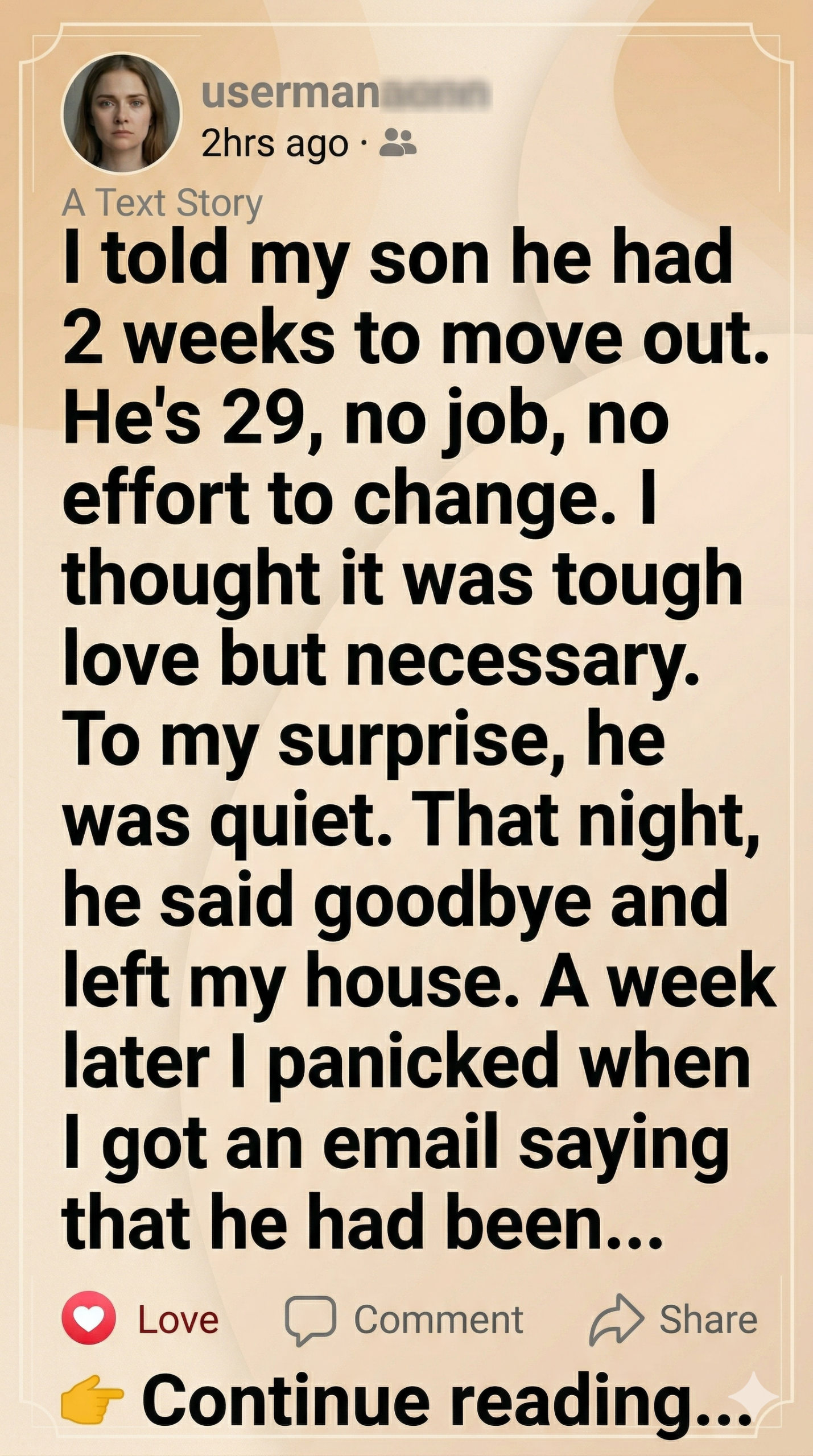
I told my son he had two weeks to move out.
He was 29 years old, sleeping until noon, drifting from one short-lived plan to another, and somehow always having a reason why nothing was ever his fault.
At least, that’s how I described him to everyone else.
To my sister on the phone.
To my coworkers over reheated lunches.
To myself, every time I stepped over the sneakers he left in the hallway or opened the fridge to find the groceries I’d paid for half gone again.
“No job. No ambition. No effort to change,” I would say, my voice full of equal parts anger and embarrassment. “He’s almost thirty. I can’t do this anymore.”
And in some ways, I meant it.
My son, Daniel, had moved back in with me a year earlier after what he called “a rough stretch.” That rough stretch had started with him losing a warehouse job, then quietly deepened into something neither of us wanted to name. He stopped answering calls from friends. Stopped going out. Stopped shaving. Stopped making eye contact for more than a second or two.
At first I told myself he just needed time.
Then I told myself he needed discipline.
Then I told myself he was taking advantage of me.
Maybe all three were true in pieces. Maybe none were. But by the end of that year, I felt like I was living with a ghost who left dirty dishes in the sink.
That Tuesday evening, I came home from work already angry.
The electric bill had gone up.
My manager had criticized me in front of the team.
My lower back ached.
And when I opened the front door, Daniel was on the couch in the same gray hoodie, the TV on mute, an untouched bowl of cereal on the coffee table beside him.
Something in me snapped.
“Get up,” I said.
He looked over slowly, blinking as if I’d pulled him up from underwater. “What?”
I dropped my purse on the chair. “We need to talk.”
He sat up straighter then, but he didn’t argue. That almost made me angrier.
I stood in the middle of the living room with my coat still on and said words I had clearly been rehearsing in my head for months.
“You have two weeks to move out.”
He stared at me.
I kept going, because once the sentence was out, I was afraid if I stopped, I’d soften.
“You’re 29, Daniel. You have no job, no plan, and no effort to change. I thought letting you stay here would help you get back on your feet, but nothing is changing. I can’t keep supporting this. I won’t.”
He looked down at his hands.
For a moment, I thought he might yell. Or cry. Or beg. Some part of me was ready for that, maybe even wanted it, because anger would have made me feel justified.
Instead, he just nodded once.
“Okay,” he said quietly.
That threw me off.
I folded my arms. “Okay?”
“Yeah.”
He stood up, took the bowl to the kitchen, rinsed it out, and placed it in the drying rack.
Then he came back, looked at me with an expression I couldn’t read, and said, “I’m sorry.”
Before I could answer, he went to his room and shut the door.
That night, he didn’t come out for dinner.
Around ten, I heard him moving around, opening drawers, zipping a bag. I sat in bed with a book open in my lap, pretending not to listen. Part of me wanted to go knock on his door. Part of me wanted to say, I’m doing this because I love you. Part of me wanted him to come out and tell me I was wrong about him.
Instead, around midnight, there was a soft knock on my bedroom door.
When I opened it, he was standing there with a duffel bag slung over one shoulder.
“Where are you going?” I asked.
“You said two weeks,” he said. “No point dragging it out.”
My stomach tightened. “Daniel, I didn’t mean tonight.”
He gave a tired little shrug. “It’s fine.”
He had said that phrase since he was a boy. After scraped knees. After bad report cards. After his father missed another birthday. It’s fine.
I looked at the bag. “Do you have somewhere to go?”
He hesitated just a little too long.
“Yeah,” he said.
I knew he was lying.
Or maybe I just knew he didn’t want to tell me the truth.
I should have stopped him.
I should have said, Forget what I said. Stay. We’ll figure it out.
But pride is a cruel thing. It can dress itself up as principle and make you feel righteous while you are breaking your own heart.
So I stepped back and let him pass.
At the front door, he turned around.
“Goodbye, Mom.”
Not good night.
Not see you later.
Goodbye.
Something cold moved through me then.
But I still didn’t stop him.
The door closed softly behind him, and that was it.
The house went so quiet it felt unnatural.
The next morning, I woke up expecting to hear the floor creak in the hallway or the shower running late, and when I didn’t, I felt both relief and something much worse.
The first two days, I stayed angry on purpose.
I told myself this was necessary. That maybe hitting bottom would force him to grow up. That maybe I had done what his father never could and finally drawn a line.
By day three, I was checking my phone every hour.
By day four, I texted him: Are you okay?
No response.
I texted again that evening: Let me know where you are.
Nothing.
I called. Straight to voicemail.
I told myself he was punishing me. Ignoring me to prove a point. Sleeping on a friend’s couch and enjoying the satisfaction of making me worry.
By day six, I wasn’t sleeping much.
I started replaying little things I’d ignored all year. The way he’d stopped laughing. The circles under his eyes. The untouched food. The way he often looked not lazy, but exhausted in some deep, unnameable way.
On day seven, the email came.
The subject line read:
Regarding Daniel Mercer
My hands went numb before I even opened it.
It was from a woman named Elise Warren, director of outreach at a mental health crisis center two counties over. The message was polite, professional, and short.
She wrote that my son had listed me as his emergency contact.
She wrote that he had been admitted after being found disoriented and hypothermic near a bus terminal.
She wrote that he was physically stable.
Then came the sentence that made my vision blur:
He had been experiencing severe depression and suicidal thoughts.
I sat down so suddenly the chair nearly tipped.
For a long time, I couldn’t breathe.
The words on the screen kept shifting in and out of focus.
Severe depression.
Suicidal thoughts.
My son.
My son, whom I had called lazy.
My son, whom I had told to leave.
My son, who had stood in front of me with a duffel bag and said goodbye.
I don’t remember grabbing my keys. I don’t remember driving. I only remember the two-hour highway blur of prayer and panic and self-hatred.
Please let him be alive.
Please let him still want to be alive.
Please let me not be too late.
When I got to the crisis center, a woman in navy scrubs met me in the lobby. She had kind eyes and the tired face of someone who had witnessed too many private disasters.
“Mrs. Mercer?”
I nodded, unable to speak.
“He’s okay,” she said gently. “He’s resting.”
Okay.
That word barely meant anything anymore, but I clung to it anyway.
She led me down a quiet hallway to a small room with a narrow bed, a plastic chair, and a window that looked out over a patch of wet grass.
Daniel was asleep on top of the blanket, turned slightly toward the wall.
He looked so young.
That was my first thought.
Not 29. Not stubborn. Not difficult.
Just young.
Young in the way children always become again when you are terrified of losing them.
His face was thinner than I had realized. His beard had grown in unevenly. His hand rested open beside him, and I suddenly remembered that same hand gripping my thumb when he was three years old crossing parking lots.
I sat down in the chair and started crying soundlessly.
Not dramatic sobs. Just tears that would not stop.
A few minutes later, his eyes opened.
He looked confused at first. Then embarrassed.
“Mom?”
I stood up too quickly. “I’m here.”
He swallowed. His voice came out rough. “How did you—”
“They emailed me.” I wiped at my face. “You put me as your contact.”
He looked away.
For a moment, neither of us spoke.
Then I said the only true thing I had.
“I am so sorry.”
He shut his eyes.
“I thought you were right,” he whispered.
Every cell in my body seemed to go still.
“What?”
He kept staring at the wall. “About me. Being useless. Not trying. Taking up space.” His mouth trembled once, then flattened. “I thought if my own mother believed that… maybe everybody would be better off if I just disappeared.”
I made a sound I had never heard come out of myself before.
Not a word. Not a cry. Something broken.
I sat on the edge of the bed and reached for him, slowly, like approaching a frightened animal. When he didn’t pull away, I held his hand in both of mine.
“Daniel,” I said, my voice shaking so badly I barely recognized it, “listen to me. I was wrong. I was so wrong.”
He didn’t answer.
So I told him everything I should have said before.
That I had seen his pain and mislabeled it.
That I had mistaken depression for laziness because anger was easier than fear.
That I had been overwhelmed and proud and blind.
That none of it meant he was a burden.
That his life was not a problem to solve or a bill to resent.
That he was my son.
“My son,” I said again, because I needed him to hear it. “Not my disappointment. Not my failure. My son.”
He covered his face with his free hand and finally started to cry.
I held on.
We stayed like that a long time.
Later, a psychiatrist met with me and explained what, deep down, I should have recognized long before: Daniel had likely been struggling with major depression for months, maybe longer. The job loss had worsened it. The isolation had fed it. Shame had done the rest.
“He didn’t need punishment,” she said gently. “He needed treatment, structure, support, and hope.”
I nodded while each word landed like a stone.
That evening, when Daniel was sleeping again, I sat in the center’s cafeteria with a paper cup of coffee gone cold in my hands and stared at the table.
The worst part of guilt is that it doesn’t let you rewrite anything. It only lets you understand.
I understood everything then.
The cereal left untouched.
The silence.
The lack of eye contact.
The sleeping all day.
The numbness.
The absence of anger when I threw him out.
He hadn’t been refusing to fight for his life.
He had been losing the ability to imagine one.
Daniel stayed at the crisis center for nine days, then transitioned into an outpatient program. This time, when forms asked for family support, I didn’t just sign them. I showed up.
I attended meetings.
I learned the language of depression instead of judging its symptoms.
I listened more than I spoke.
I apologized without asking him to make me feel better.
I brought him clean clothes, books, and once, embarrassingly, the wrong kind of socks, which made him laugh for the first time in months.
That laugh nearly undid me.
When he was ready, he came home.
Not to the same silence. Not to the same arrangement.
We made changes.
Real ones.
He saw a therapist twice a week. A doctor adjusted his medication carefully. I stopped treating recovery like a moral test. We set small goals instead of giant ultimatums. Showering. Walking outside. Applying for one volunteer position. Cooking dinner together twice a week.
Some days were awful.
Some days he shut down again.
Some days I lost patience and had to catch myself before old habits turned my fear into criticism.
Healing did not arrive dramatically. It came in inches.
In the first full meal he finished.
In the afternoon he opened the curtains on his own.
In the text he sent me from the backyard that simply said: I think the sun helped today.
Months later, he started helping at an animal shelter.
Then part-time office work for a nonprofit.
Then, slowly, a life.
One night, almost a year after the email, we were washing dishes together when he said, without looking at me, “I really did think you wanted me gone.”
I put the plate in the rack and took a breath.
“I know,” I said. “And I will regret that for the rest of my life.”
He nodded.
After a moment, he added, “I’m glad the center found me before…”
He didn’t finish.
He didn’t need to.
I dried my hands and turned to him.
“So am I.”
Then he did something he had not done in years.
He hugged me first.
These days, Daniel is 31.
He has his own small apartment now, a job he actually likes, and a dog named Pickles who destroys tennis balls in under ten minutes. He still has hard weeks. Recovery is not a straight road, and we both know that now. But he also has plans. Friends. A therapist he trusts. A life that belongs to him.
And I have a sentence I say whenever another parent tells me their adult child is lazy, dramatic, or just needs a push.
I say: maybe.
But maybe not.
Maybe what looks like defiance is despair.
Maybe what looks like apathy is illness.
Maybe the person you are most frustrated with is already fighting not to disappear.
I told my son he had two weeks to move out.
A week later, I got an email saying he had been found cold, alone, and dangerously close to giving up on life.
People like stories where the lesson is simple and the ending is clean. This isn’t one of those stories.
Because love did not save him by itself.
Regret did not heal him.
And my apology did not erase what I had said.
But truth opened the door that pride had slammed shut.
And by grace I do not deserve, my son lived long enough for me to walk back through it.
So now, whenever he leaves my house, I never let the last words be casual.
I say, “I love you.”
And I wait until he says it back.