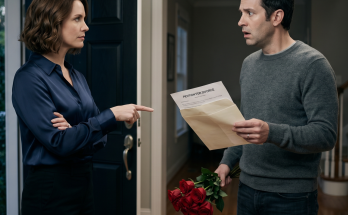
My Father Stood Up At The Lake House Dinner To Give His Toast. Forty People Watching. Candles Lit. My Glass Already Raised. “To My Three Daughters—Claire, Becca, And Sasha.” My Name Is Not Sasha. It Never Was. I Set My Glass Down. I Picked Up My Keys. He Didn’t Notice Until My Chair Was Empty. I Never Went Back.
Part 1
The room was too beautiful for what happened in it.
That was the part I kept thinking about later. The lake house dining room had been arranged like a magazine spread my mother would pretend not to care about while secretly checking every angle. White candles in glass hurricanes. Linen napkins folded upright, three folds and a tuck. Tiny sprigs of rosemary tucked beside each plate, releasing a sharp green smell every time someone moved an elbow too close.
Outside, Lake Edinboro was turning black under a violet August sky. Inside, forty people were warm from wine and old jokes and the heavy comfort of believing the night already had a shape.
I was sitting two seats to my father’s left.
My daughter, Maren, was in the sunroom playing cards with my cousin’s little girl. My overnight bag was still zipped upstairs because I had arrived at 3:52, set it beside the twin bed, and gone straight down to help my mother with the centerpieces. I had driven six hours for this dinner. I had stopped once for gas, once for coffee, and once to buy the particular lemon shortbread cookies my mother liked from a bakery near Erie because she had mentioned, three weeks earlier, that she missed them.
At 8:41, my father stood.
Gerald Voss was sixty-seven then, broad-shouldered in the way retired men become when they still think of themselves as useful with tools. He wore a navy jacket and a white shirt open at the throat. The candlelight liked him. It made him look softer than he was.
He raised his glass.
“To my three daughters,” he said, smiling.
I remember turning my head a little because I thought he had misspoken already. Three daughters was right. Claire, Becca, and me. Our brother Tom was the fourth child, not part of that count.
My father continued.
“Claire, Becca, and Sasha.”
No one laughed.
No one said, “Gerald.”
No one leaned across the table and whispered, “You mean Nadia.”
He smiled as if the sentence had landed where it belonged.
My aunt Renata, seated directly across from me, looked at my face for one full second. Then she looked down at her plate. That was the first crack in the room. Not the name. Her looking away.
I waited for my father to catch himself.
He didn’t.
He said something about family being the work of a lifetime. He said something about how lucky he was to have daughters who made him proud. People nodded. Claire wiped at the corner of her eye. Becca leaned into her husband’s shoulder. My mother’s smile stayed fixed and bright.
Sasha.
There had never been a Sasha in our family.
The name hung above the table like smoke from a candle no one would admit had gone out.
My hand was around my wineglass. Riesling, pale gold, too sweet. I stared at it for a long moment and watched the candle flames bend inside the curve of the glass.
Then I set it down.
Not hard. Carefully.
The way you set down something breakable when you have decided you will not be the one to break.
My father sat. People clapped. The conversation resumed with the nervous force of a room agreeing not to notice a stain spreading across white cloth.
I stood up.
My mother caught my movement from the far end of the table. Her eyes sharpened, not with concern, but with calculation. She knew the schedule of every oven timer, every guest’s dietary restriction, every linen rental fee. She knew when something threatened the surface.
“Nadia?” she called softly.
I smiled at her.
It must have looked normal enough because she looked away first.
I went upstairs to the small bedroom at the end of the hall. Two twin beds. White quilts. Window facing the water. I had slept there as a child so many summers that I knew which floorboard complained and which window latch needed two hands.
My bag was still zipped.
That felt like information.
I picked it up and went downstairs. In the sunroom, Maren was sitting cross-legged on the rug, fanning cards in her small hands. She looked up, saw my bag, then my face.
“We’re going to head home, bug,” I said quietly.
She didn’t ask why. Maren was seven, but she had already learned the difference between a change in plans and a storm.
“Okay,” she said, and began gathering the cards.
We passed through the kitchen. Copper pots gleamed above the island, untouched since 1998. The green tile backsplash reflected the yellow light. My brother-in-law Dex was standing by the counter eating cake from a paper napkin.
“Leaving already?” he asked.
“Yes.”
“Drive safe.”
That was everything.
Outside, the air smelled like lake water and pine needles and damp wood. I buckled Maren into her booster seat. She was quiet until I turned onto the narrow road that led away from the house.
Then she asked, “Mom?”
“Yes, bug?”
“Who’s Sasha?”
My hands tightened around the wheel.
In the rearview mirror, the lake house windows glowed behind us, every one of them bright, as if nothing had gone dark at all.
“I don’t know,” I said.
And that was the first honest sentence anyone had spoken all night.
### Part 2
I drove for two hours before I stopped.
The rest area near Irwin was almost empty. Two trucks idled at the far end of the lot. A minivan sat under a flickering light by the restroom entrance. Maren was asleep, her head tipped sideways, her mouth slightly open, one sneaker pressed against the back of the passenger seat.
I should have cried there.
That would have made sense. A woman alone in a car after midnight, humiliated by her father in front of forty people, with her child sleeping in the back seat and four hours of dark highway behind her.
But I didn’t cry.
I opened the notes app on my phone and made a list.
One: He said three daughters.
Two: He said Claire, Becca, and Sasha.
Three: He did not correct himself.
Four: Mom heard it.
Five: Renata heard it.
Six: No one said my name.
Seven: I left.
Eight: I am not going back.
I looked at the last line until the letters blurred.
Not from tears. From recognition.
My name is Nadia Voss. I was thirty-four years old that night, divorced, mother of one, tax analyst at Aldridge Pennington Group in Pittsburgh. I had a mortgage, a retirement account, a color-coded budget spreadsheet, and a daughter who liked pancakes shaped like animals but refused to eat them if the ears were uneven.
I had also been the family’s quiet solution since childhood.
When I was eight, I made my own lunch because mornings were easier if I did. Peanut butter on wheat bread, apple slices in a plastic container, crackers in a sandwich bag I washed and reused until the seams split. When I was ten, I reminded my mother to sign Becca’s field trip forms. When I was twelve, I started keeping a handwritten calendar taped inside my closet door because someone needed to know when picture day was, when library books were due, when Claire had soccer, when Tom needed cupcakes for class.
Nobody asked me to do it.
That was the trick.
If nobody asked, nobody owed gratitude.
My father coached Claire’s soccer team for three seasons. He bought a silver Sony Handycam to record her games and learned how to transfer the tapes to DVDs because, he said, memories deserved preserving. He attended Becca’s piano recitals with flowers wrapped in grocery store plastic. When Tom’s appendix ruptured at four, my father slept in a hospital chair for four nights and became a legend in our family for it.
I was on the honor roll for fourteen straight semesters.
My father missed my college graduation for a drainage project meeting.
My mother came. She took three photos on a disposable camera, bought me soup at a diner, and left before two because Becca had a volleyball tournament.
For years, I told myself these were separate facts.
A missed graduation. A forgotten award. A birthday card signed “Love, Dad” instead of the two full sentences he wrote for Claire. A Christmas where he gave Becca a charm bracelet, Claire a new camera, Tom a signed Steelers jersey, and me a bookstore gift card still in the pharmacy sleeve.
Separate facts are easy to survive.
Patterns are harder.
At 1:17 in the morning, I carried Maren into our house. She stirred against my shoulder and murmured something about cards. Her hair smelled like the strawberry shampoo she liked and the lake house, faintly smoky from the grill outside.
I tucked her in and stood in her doorway longer than usual.
I thought about my father raising his glass.
I thought about Maren hearing another woman’s name where mine belonged.
By Tuesday morning, I had eleven missed calls.
Four from my mother.
Three from Claire.
Two from Aunt Renata.
One from my father.
One from a number I didn’t recognize.
I made coffee before listening to any of them. Toasted bread. Sat at my kitchen table with the gray morning light slipping through the blinds.
My mother’s first voicemail was calm.
“Nadia, call me when you get this. We didn’t realize you’d gone. I hope the drive was okay.”
Logistics.
Her second came at 11:47 that night.
“Nadia, I don’t understand why you left without saying goodbye. Your father is confused, and I think you need to explain what happened.”
Your father is confused.
I wrote that phrase on a napkin.
Her third message was sharper.
“This is becoming a thing, and it doesn’t need to be a thing. We have a lot coming up, and I need to know you’re going to be present for this family.”
Present.
That word made me laugh once, quietly, without humor.
My father’s voicemail was last.
“Nadia, it’s Dad. I’m not sure what happened the other night, but your mother says you left upset. I…” He paused so long I thought the message had ended. “I want to make sure you’re all right. Call when you can.”
Not I’m sorry.
Not I said the wrong name.
Not Sasha.
Never Sasha.
I listened to Aunt Renata’s message twice.
“Nadia, sweetheart. I saw your face. I want you to know I saw it. Call me if you want to talk. If you don’t, I understand that, too.”
I called her.
She answered on the second ring.
Before I could speak, she said, “You’re not imagining it.”
My hand shook so hard coffee spilled onto the table.
I grabbed a dish towel and pressed it into the puddle.
Renata said, very softly, “And Nadia?”
“Yes?”
“That name did not come from nowhere.”
### Part 3
Aunt Renata had always known how to let silence work.
She had taught high school English for thirty-three years, which meant she had spent most of her adult life waiting for teenagers to tell the truth by accident. She did the same thing on the phone that morning. She didn’t rush. She didn’t soften what she had already said.
That name did not come from nowhere.
I stood in my kitchen, barefoot on the cold tile, the dish towel still in my hand.
“What does that mean?” I asked.
“I don’t know exactly.”
“Renata.”
“I’m telling you the truth. I don’t know exactly. But I know your father heard that name before. More than once.”
The refrigerator hummed. A garbage truck groaned somewhere down the street. Ordinary sounds, which felt offensive.
“When?”
She sighed, and in that sigh I heard age, guilt, and something like fear.
“Years ago. Before Tom was born. Maybe before Becca. Your parents went through a bad stretch. Your mother stayed with me for nine days. She told everyone it was because the furnace went out, but it was August.”
My stomach tightened.
“What bad stretch?”
“I shouldn’t be the one to tell you the parts I don’t know.”
“That’s a very careful sentence.”
“Yes,” she said. “It is.”
My family had a talent for careful sentences. They were heirlooms, passed down like china nobody used. Your father meant no harm. You’ve always been sensitive. We didn’t want to upset you. This isn’t the time.
Careful sentences were how people built locked rooms inside a house and called it architecture.
Renata said, “What I can tell you is this. Your mother heard the name at that table. Your father heard himself say it. Don’t let them tell you it was nothing.”
I sat down.
The kitchen chair scraped against the floor too loudly.
“Why didn’t anyone correct him?”
Renata was quiet.
Then she said, “Because in this family, Nadia, everyone waits for you to absorb the impact.”
I closed my eyes.
There are sentences that don’t reveal something new. They reveal what you have spent your life working not to know.
Three days later, a letter arrived from my mother.
Her stationery was pale yellow, thick, expensive, and old-fashioned. Patricia Voss had used the same brand since before I was born. The envelope smelled faintly of her desk drawer: paper, lavender sachet, and the dry dust of things saved too long.
I read it standing at my kitchen counter.
Dear Nadia,
Your father and I love you very much.
That sentence appeared four times in two pages.
Your father meant no harm.
That appeared twice.
The word Sasha did not appear at all.
Neither did sorry.
The letter said my father had no memory of saying anything wrong. It said I had always been the sensitive one, even as a little girl. It said Claire’s thirtieth birthday dinner was coming in October and my mother hoped I would not let “one unfortunate misunderstanding” damage the family further.
Near the end, she wrote:
I hope you will think about what your absence is doing to the people who love you.
I read that line three times.
Not what his words did to you.
What your absence is doing to us.
I folded the letter along its original creases and put it in a manila folder. On the tab, I wrote Lake House.
Then, because I am the kind of woman who has survived by turning pain into documentation, I opened my laptop and created a spreadsheet.
The first tab was called Facts.
The second was called Money.
I didn’t fill in Money yet.
I wasn’t ready for what I already knew would be there.
That Thursday, I brought the letter to Dr. Lorraine Hecht, my therapist. Her office was on the second floor of a brick building in Squirrel Hill, above a dental practice that always smelled faintly of mint and latex. Dr. Hecht’s room had warm lamps, two chairs, a low table, and a bookshelf arranged by subject rather than color, which I appreciated.
I read her the sentence about being sensitive.
She asked, “How old were you the first time someone in your family called you that?”
“Seven,” I said.
“Do you remember what happened?”
I did.
Claire had spilled grape juice on my science project the night before the fair. I cried. My mother told me not to be dramatic. My father said, “Your sister didn’t mean it, Nadia. Don’t be so sensitive.”
I rebuilt the project after everyone went to bed.
It won second place.
My parents kept the ribbon in a drawer with batteries and takeout menus.
Dr. Hecht said, “What did sensitive mean in your house?”
“It meant the pain was my fault.”
She nodded once.
I looked at the letter in my lap.
“And now?” she asked.
“Now it means I have evidence.”
For the first time since the toast, I felt something other than humiliation.
It was small. Hard. Bright.
Not anger yet.
Something cleaner.
I went home that night and finally opened the Money tab.
I entered the first number.
$1,800 for my parents’ anniversary dinner.
Then the second.
$2,200 for the family cabin rental.
Then the third.
$900 for Becca’s bridal shower deposit.
By midnight, I had sixteen lines.
The total was $9,840.
At the bottom of the spreadsheet, I added one more column.
Received in return.
I left it blank.
The next morning, my mother texted:
Need to discuss Claire’s birthday headcount and payment plan. Call tonight.
I stared at the words payment plan.
Then another message appeared.
Also, please don’t bring up the lake house dinner. Your father is still upset.
I put the phone down.
For the first time in my life, when my family reached for me, I did not move closer.
### Part 4
Claire’s birthday was not just a birthday.
It was a financial emergency wearing a blue dress.
My mother had booked a private dining room at Garfield Social, a restaurant in Pittsburgh with exposed brick, brass light fixtures, and an event coordinator named Jessie who used phrases like “elevated family-style service” and “bar package minimum.” I knew these details because my mother had forwarded me the contract in March with a note that said, Isn’t this lovely?
Lovely meant expensive.
The deposit had been $1,400.
The estimated balance was between $5,400 and $6,800 depending on bar usage, cake, and guest count.
My parents did not have that money. Claire did not have that money. Becca had just bought a house with Dex and was “cash poor,” a phrase she enjoyed using because it made granite countertops sound like hardship. Tom lived in Colorado and sent funny texts but rarely money.
Which left me.
Always me.
The family had never asked formally. They did not say, Nadia, can you contribute $2,000 by this date? They said, The venue needs an answer. Your mother is stressed. Claire has had such a hard year. We all need to pull together.
Pull together meant I paid.
On October 2, my mother called at 6:48 p.m.
I watched my phone ring on the kitchen counter while I chopped garlic.
I did not answer.
Her voicemail was brisk.
“Nadia, I need to confirm the final count for Claire’s party by Friday. Also, we need to talk about the balance. Call me tonight.”
Need.
Not want. Not hope. Need.
On October 6, my father called while I was at work. His name lit up on my phone as I was reviewing tax estimates for a client who owned three apartment buildings and had better bookkeeping than my family.
I let it go to voicemail.
“Nadia, it’s Dad. Your mother’s been trying to reach you about the arrangements for Claire’s party. I know things have been strained between us.” A pause. “I think maybe we should talk at some point, but right now your mother just needs the head count.”
At some point.
Right now.
That was my father’s emotional range in two phrases.
On October 9, Claire texted.
Nadia, I don’t know what happened between you and Mom and Dad and honestly I don’t want to be in the middle of it, but this is my birthday. My 30th. Can you please not make it about whatever is going on?
I was sitting in my parked car outside Maren’s school when I read it. Children were pouring out through the front doors, backpacks bouncing, voices high and bright in the cold air.
I typed five replies.
Deleted all five.
Then I wrote:
Happy early birthday, Claire. I hope the party is wonderful. I’m not going to be able to come, and I’m not able to help with the arrangements. I’m sorry this lands on your birthday. That part isn’t fair to you.
I sent it before I could turn it into an apology for existing.
Claire replied five hours later.
Wow.
That was all.
I made pasta with garlic, olive oil, and white beans that night. Maren was at Daniel’s, so the house was too quiet. I ate at the kitchen table with my phone face down beside my plate and resisted the old urge to fix what I had broken by refusing to be used.
At my next session, Dr. Hecht asked, “How did it feel to say no?”
“Terrifying.”
“And?”
I looked out the window. Rain moved down the glass in crooked lines.
“Correct.”
She smiled, but only a little. Dr. Hecht never celebrated too early.
The party was October 19.
I sent Claire flowers that morning. Pale pink peonies and white ranunculus in a glass vase. The card said: Happy birthday. I mean every word.
I did mean every word.
Love and refusal can sit at the same table. My family had taught me they could not. Life was beginning to teach me they could.
The next morning, Becca sent eight photographs without a message.
Claire in a blue wrap dress, smiling beneath gold balloons.
My mother holding a champagne flute.
My father with his arm around Claire, face open and proud.
The cake with gold lettering.
Dex making a ridiculous face behind Becca.
A group shot near the bar.
I swiped through them once, then again.
On the third pass, I noticed the woman.
She stood at the edge of the group shot, half turned away, holding a glass of water. She was about my age, maybe younger. Dark blond hair cut at her shoulders. Green dress. Pearl earrings. Not family. Not one of Claire’s friends, at least not one I knew.
My father was looking at her.
Not directly. Not obviously.
But his body angled toward her in the way people turn toward what they are aware of.
I zoomed in until the image blurred.
There was something familiar in the line of her jaw.
I texted Becca.
Who’s the woman in green near the bar?
Three dots appeared.
Disappeared.
Appeared again.
Becca replied:
Not sure. Maybe someone from Garrett’s side? Why?
Garrett was Claire’s boyfriend. He had not been mentioned as serious enough to have “a side.”
I wrote:
Just wondered.
Becca didn’t answer.
Two minutes later, the photo vanished from the thread.
She had deleted it.
I sat very still, holding my phone in both hands.
Then I opened my laptop, downloaded the image from my automatic backup, and saved it in the Lake House folder.
I named it Woman in Green.
For the first time, Sasha was not just a name.
She had a shape.
### Part 5
My mother’s first message after Claire’s party came nineteen days later.
The restaurant bill was $5,840. We had to use Gerald’s savings account to cover it. He had been saving that for the water heater replacement. I hope you’re satisfied with how this turned out.
I read it while standing at my desk at home, still wearing my coat.
The house smelled like rain because my umbrella had leaked onto the entry rug. Maren was in the living room building a cardboard castle for a stuffed rabbit she had named Attorney Rabbit, because she had overheard me use the word attorney and decided it sounded powerful.
I did not respond to my mother.
Instead, I opened the Money tab and added a note beneath the total.
Refusal is not harm.
I stared at that sentence for a long time.
Then I called Dana Pressman, the attorney who had handled my divorce.
Dana did not waste words. She had once described my ex-husband Daniel’s proposed custody calendar as “creative but not legal,” which was the closest I had seen her come to sarcasm.
When I explained the situation, she listened without interrupting.
At the end, she said, “You’re not asking me about family law.”
“No.”
“You’re asking me about property.”
“Yes.”
“The lake house?”
“Yes.”
She gave me a name: Sylvia Marks, Marks and Holloway, Shadyside.
I called Sylvia’s office the next morning at 9:14. Her assistant, Grant, had the calm voice of a man who controlled several calendars and feared none of them. He offered me an appointment the following Tuesday.
The lake house had belonged to my grandmother Vera.
Vera Kowalczyk had bought it in 1979 for $38,000 after saving for thirty years. She had worked as an office manager at a small engineering firm, packed her lunches in wax paper, and kept receipts in shoeboxes labeled by year. The lake house was the one extravagance she allowed herself, though she would have hated that word. To Vera, a place where children could swim and adults could drink coffee on a screened porch was not extravagance. It was proof of labor.
When she died in 2014, she left the property in equal thirds to her three children: my mother Patricia, my uncle Dennis, and my aunt Carol.
In 2019, Dennis needed money and wanted to sell his share. My mother called me on a Thursday night.
“We don’t want a stranger owning part of the lake house,” she said.
I remembered standing in my apartment kitchen, Daniel still my husband then, Maren only two, the dishwasher thumping behind me.
“You’d be an owner,” my mother said. “You could use it anytime.”
Anytime became every third April weekend if no one else objected.
The buyout cost me $94,040 including fees.
I paid it because the family needed me.
Because my grandmother’s house mattered.
Because I believed ownership would mean belonging.
Five years later, my father stood inside that house and did not count me.
Sylvia Marks’s office had a window facing a small courtyard with a dogwood tree. The tree was bare when I arrived, all gray sticks against gray sky. Sylvia was forty-nine, precise, silver-threaded hair pulled back at the nape of her neck. She listened the way some people read contracts: slowly, for liability.
I told her about the toast, the calls, the letter, the birthday, the spreadsheet, the deleted photo.
At the photo, she looked up.
“Do you know who she is?”
“No.”
“Do you want to?”
That question landed harder than I expected.
“I want to know why my name disappeared,” I said.
Sylvia nodded.
“Then we’ll start with what is yours. The lake house.”
I handed over the 2019 transfer documents, the cost-sharing records, insurance statements, property tax receipts, emails from my mother about maintenance.
Sylvia reviewed them in silence.
Then she said, “You own one-third. Cleanly.”
“Can I sell my share?”
“Yes. The co-owners likely have practical leverage, but not magical leverage. We can notify them formally, get an appraisal, offer right of first refusal, and proceed from there.”
“Good.”
“Are you prepared for this to upset them?”
I almost laughed.
“They were upset when I didn’t pay for dinner.”
“That’s not the same as property.”
“No,” I said. “It’s not.”
She made a note.
Then she turned one page over and frowned.
“This insurance renewal,” she said. “Who is S. Meredith?”
I leaned forward.
“What?”
She tapped the page.
“Authorized contact. Not an owner. Not insured. But listed for property access and emergency notification.”
The room seemed to narrow.
S. Meredith.
Sasha.
Meredith.
My pulse beat once in my throat.
“I’ve never seen that name,” I said.
Sylvia looked at me carefully.
“Someone added it last year.”
Outside, a gust of wind moved through the dogwood branches.
For a moment, every bare twig looked like a finger pointing at the same locked door.
### Part 6
I took a copy of the insurance renewal home in a folder so stiff the edges cut into my palm.
S. Meredith.
Authorized contact.
Added last year.
I put Maren to bed, read two chapters of a book about a girl who solved mysteries with a pet ferret, and waited until her breathing settled into sleep. Then I went to my desk.
The house was quiet except for the low tick of the radiator and the occasional hiss of tires on wet pavement outside.
I searched my email first.
Meredith.
Nothing relevant.
Sasha.
Nothing.
S. Meredith.
One result.
A five-year-old email from my mother with the subject line Lake House Cleaning Schedule. It was a forwarded chain from a local handyman, a woman named Carol, my mother, and someone whose email address began with s.meredith.
The actual name was hidden.
The message was short.
Patricia, I can open the house Friday morning before the girls arrive. Same code as last summer?
The girls.
I stared at that phrase until my eyes burned.
Same code as last summer.
The email was from 2020. One year after I bought Dennis’s share. The summer when my mother told me the lake house was too crowded for me to come over Labor Day weekend because Claire had invited friends and Becca needed “space after a stressful semester.”
Someone named Meredith had opened the house.
For the girls.
I printed the email and put it in the Lake House folder.
The next morning, I called Aunt Renata.
She did not sound surprised.
That was how I knew.
“Renata,” I said, “who is S. Meredith?”
There was a pause.
Then the small clink of a mug being set down.
“I wondered when that would surface.”
My mouth went dry.
“You knew?”
“I knew there was someone. I didn’t know she had access to the lake house.”
“Who is she?”
Renata exhaled.
“Her full name is Sasha Meredith Cane. At least, it was Cane when I heard it.”
The room tilted.
I pressed one hand flat against my desk.
“How do you know her?”
“I don’t. Your father did.”
“Did?”
“Nadia.”
“Say it.”
“She is your father’s daughter.”
The sentence did not explode.
That would have been easier.
It sank.
Heavy and cold.
“My father has another daughter.”
“Yes.”
“How old?”
“I don’t know for sure. Early thirties.”
“My age?”
Renata was quiet.
“Close.”
I stood and walked to the kitchen, though I had no reason to. The floor felt too solid. The cabinets looked too ordinary. A blue cereal bowl sat in the sink with a spoon inside it, and I wanted to scream at it for existing in a world where my father had another daughter.
“Did my mother know?”
“Yes.”
That word hurt more than the first answer.
My father having a secret was one kind of betrayal.
My mother helping him organize the furniture around it was another.
Renata said, “I found out by accident years ago. Your mother came to my house after a fight with Gerald. She was furious. She said he had been sending money to someone in Erie. I heard the name Sasha. She told me to forget it.”
“And you did?”
“No,” Renata said softly. “I obeyed.”
I closed my eyes.
Obedience had built our family as much as blood had.
“Why didn’t you tell me?”
“Because I told myself it wasn’t my place.”
“And now?”
“Now I understand silence has a place too. Usually beside the person doing harm.”
I gripped the counter.
“Was she at Claire’s party?”
“I don’t know.”
I sent her the photo.
She called back three minutes later.
Her voice had changed.
“That’s her.”
I sat on the kitchen floor.
The tile was cold through my pants. Somewhere down the hall, Maren laughed in her sleep, a small bright sound from another life.
Renata said my name twice before I answered.
“I’m here.”
“Nadia, listen to me. Sasha did not take your place at that table. Your father gave it to her.”
I looked toward the hallway, toward my daughter’s closed door.
A child can survive a missing chair.
But I was not a child anymore.
And I was done standing in rooms where other people decided whether I existed.
That afternoon, my mother called six times.
I did not answer.
At 8:12 p.m., she texted:
Whatever Renata thinks she knows, she should be ashamed of herself.
I read the message once.
Then another came in.
You have no idea what your father and I carried to keep this family together.
I opened the Lake House folder and slid the new printouts inside.
For the first time, the folder felt less like evidence.
It felt like a map.
And all the roads led back to the same house.
### Part 7
Sylvia Marks sent the intent letter in early December.
Four paragraphs. Clean language. No accusation. No drama.
It stated that I intended to seek fair market valuation of my one-third ownership interest in the Lake Edinboro property and explore transfer or co-owner buyout. It requested written response within thirty days.
My mother called forty-four minutes after USPS confirmed delivery.
I was at work, reviewing year-end reconciliations. My phone lit up with her name. I watched it ring.
Then again at 4:30.
Again at 6:15.
Again at 8:49.
At 9:07, she texted:
Nadia, what is this? Why would you send a lawyer letter to our house? Call me right now.
I was on the couch, a blanket over my lap, a novel open facedown beside me. Maren was asleep. Outside, December had sealed the street in cold darkness.
I typed one reply.
Please direct all questions to Sylvia Marks. Her contact information is on the letter.
I added, I hope you have a good night.
Then I deleted that sentence.
It was a reflex, not a truth.
I sent the message without it.
The next morning, Aunt Carol emailed Sylvia. Practical, brief, no emotional punctuation. She lived in Arizona and had always treated the lake house like a beloved memory she didn’t want to manage. She was interested in buying my share if the valuation was fair.
My mother did not respond through counsel.
She sent me a photograph.
It was a picture of my grandmother Vera on the lake house porch in 1984, sitting in a webbed lawn chair with sunglasses on and a cigarette in one hand. Vera looked glamorous by accident, hair pinned up badly, mouth caught mid-sentence.
Under the photo, my mother wrote:
Your grandmother saved thirty years for that house. She would be heartbroken.
I looked at Vera’s face.
I remembered her teaching me how to snap green beans on that porch, how she would put a bowl in my lap and say, “Work goes faster when nobody wastes breath complaining.” I remembered her hands, square and strong, nails short, wedding ring loose in summer heat.
Vera had loved the lake house.
But she had also loved clean ledgers.
I doubted she would admire people using inheritance as a leash.
I forwarded the text to Sylvia.
She replied ten minutes later.
Do not engage.
So I didn’t.
In January, the appraiser visited the property. Robert Feeney from Feeney Valuations, Erie County. He wore practical boots, took photographs, measured rooms, reviewed comparable lakefront sales, and submitted a report seventeen days later.
Full property value: $334,000.
My one-third interest: $111,333.
I read the number in Sylvia’s office while snow tapped against the window.
I felt nothing at first.
Then I felt my grandmother.
Not as a ghost. I don’t believe in that.
As arithmetic.
In 2019, I had paid $94,040. I had paid annual costs after that. I had maintained my share while being treated like a guest who might inconvenience the real family by showing up.
Now the numbers said something no one in my family could soften.
I owned what I owned.
My mother had expected a much lower number. I learned that from Sylvia, who said Patricia had called her office and “expressed surprise.”
That was attorney language.
My mother had probably screamed.
Two days after receiving the appraisal, my father called.
I was at the grocery store, standing in front of apples. Honeycrisp were on sale. Gala were cheaper. I held my phone and watched his name.
For months, he had not called except to ask me to help my mother with Claire’s party. Now property had given him courage.
I let it go to voicemail.
“Nadia.” His voice was rough. “This has gone far enough. Your mother is beside herself. That house is family. You know that. Whatever you think happened, whatever Renata has been saying, you don’t punish everyone over one dinner.”
One dinner.
I put three Honeycrisp apples in a bag.
He continued.
“And about Sasha—”
My hand stopped.
There was a sound like paper shifting.
Then my mother’s voice in the background, sharp and panicked.
“Gerald.”
The voicemail ended.
I stood in the produce aisle with cold air blowing over my hands.
A woman beside me reached for pears. Somewhere near the bakery, a child asked for cookies. The world did not pause for revelations. It almost never does.
I saved the voicemail.
Then I bought apples, milk, bread, and the cinnamon cereal Maren liked.
At home, I played the message for Dr. Hecht during our next session.
She listened without changing expression.
When it ended, she said, “What do you hear?”
“My father almost said her name.”
“And?”
“My mother stopped him.”
“And?”
I looked down at my hands.
“They are still managing the story.”
Dr. Hecht nodded.
“What do you want?”
The answer came before fear could edit it.
“I want to stop being a character in theirs.”
That night, I received an email from an address I didn’t know.
Subject: I think we should talk.
The sender’s name was Sasha Meredith.
### Part 8
I did not open the email for twenty-seven minutes.
I timed it, not intentionally at first, then intentionally after minute ten.
Maren was doing homework at the kitchen table, her pencil making small irritated taps against the paper. The dishwasher hummed. A pot of soup simmered on the stove, tomato and basil and too much garlic because I had forgotten I’d already added some.
The email sat unread on my laptop screen.
Sasha Meredith.
My father had said her name in the room where mine belonged.
Now she had entered my house through a subject line.
When Maren finished her math sheet, I checked it, kissed the top of her head, and sent her to choose pajamas. Only then did I open the email.
Nadia,
I know this is probably not welcome. I’m sorry for reaching out directly. I didn’t know your family didn’t know about me. I was told different versions at different times, and I’m beginning to understand that most of them were not true.
I don’t want anything from you.
I was at Claire’s birthday because your father asked me to come. He said it was time I met everyone slowly. I thought you knew. When I realized you weren’t there, he said you were busy.
I am sorry he said my name at the lake house. Your aunt Renata gave me your email after I asked her whether you were okay. I hope that was not a violation. If it was, blame me.
Sasha
I read it once.
Then again.
Then I called Renata.
“You gave her my email?”
“I did.”
“Why?”
“Because she called me crying.”
I closed my laptop halfway.
“That’s not my problem.”
“No,” Renata said. “It isn’t.”
“Then why?”
“Because she asked whether you knew she existed, and I decided one person in this mess should receive a truthful answer.”
I hated that I understood.
I hated that understanding did not reduce my anger.
“What is she like?” I asked.
Renata breathed in.
“Careful. Sad. Not your enemy.”
“That doesn’t make her safe.”
“No.”
“Did she know he was my father?”
“Yes. But not the way you think.”
“There is no good version of that sentence.”
“I know.”
I did not reply to Sasha that night.
The next morning, I woke before my alarm and lay in the dark listening to the house settle. My mind kept sorting and resorting the same facts.
My father had another daughter.
My mother knew.
My sisters might have known something.
Sasha thought I knew.
Everyone had been living with some version of the truth except me.
At work, I opened Sasha’s email three times between client calls. By lunch, I wrote back.
I’m not ready to talk in person. You can answer one question by email if you want to.
What did my father tell you about me?
Her reply came at 2:11.
He said you were distant. Successful. Private. He said you didn’t come around much and didn’t like family obligations. He said you had “chosen your own life.”
I stared at that phrase.
Chosen your own life.
I had driven six hours to fold napkins.
I had paid venue deposits, cabin balances, emergency household bills.
I had bought one-third of a lake house to keep it in the family.
And my father had described me as distant.
I went to the restroom, locked myself in the last stall, and stood there under fluorescent light until my breathing slowed.
When I returned to my desk, there was another email.
I didn’t understand why he looked so sad when he talked about you. I thought maybe you had hurt him. I’m sorry.
That one made me sit down.
Not because it softened him.
Because I could see the shape now.
My father had not erased me only in our family.
He had rewritten me somewhere else.
That evening, Claire called.
I almost didn’t answer.
Then I did.
For several seconds, neither of us spoke.
Finally Claire said, “Did you know?”
Her voice sounded small.
“No.”
A shaky breath.
“I didn’t either. Not really.”
“Not really means something.”
“I saw her at the party. Mom said she was Dad’s friend’s daughter. Then Becca said not to ask questions.”
“Becca knew?”
“I don’t know. Maybe. Nadia, I swear I didn’t know at the lake house.”
I looked toward the living room, where Maren was lining up crayons by shade.
“Did you hear him say Sasha?”
“Yes,” Claire whispered.
“And you didn’t say anything.”
“I froze.”
“You clapped.”
She started crying.
I did not comfort her.
That was new.
“I’m sorry,” she said.
It was the first actual apology anyone in my immediate family had given me.
I let it sit between us.
“Thank you for saying that,” I said.
“Can we fix this?”
I closed my eyes.
“I don’t know what this is yet.”
After we hung up, I found a new voicemail from my mother.
Her voice was low and furious.
“You had no right contacting Sasha.”
I laughed once.
A sharp sound in an empty kitchen.
I had not contacted Sasha.
But in my mother’s mind, the truth itself was always something I had done wrong.
### Part 9
The confrontation happened at a diner in Monroeville because my mother refused to meet at Sylvia’s office and I refused to meet at their house.
The diner was called Blue Ridge Café, though there were no mountains visible, only a strip mall, a tire shop, and a gray February sky pressing down on the parking lot. Inside, the air smelled like coffee, frying oil, and maple syrup. A waitress with red glasses led me to a booth in the back.
My parents were already there.
My father sat on the outside of the booth, hands folded around a mug he had not drunk from. My mother sat beside the window, scarf still wrapped around her neck, purse in her lap like she was prepared to evacuate.
I had one goal.
Say as little as possible.
Let them speak.
People reveal themselves when you stop filling the silence for them.
My mother started.
“This has become cruel, Nadia.”
I took off my coat and folded it beside me.
“Good morning.”
My father looked older than he had at the lake house. Not frail. Just unarranged. His hair needed cutting. His jaw had silver stubble. For one dangerous second, I felt the old pull to take care of him.
Then he said, “You’re hurting your mother.”
The pull snapped.
A waitress came. I ordered coffee. My parents ordered nothing.
When she left, I said, “I know about Sasha.”
My mother closed her eyes.
My father looked at his mug.
No one asked what I meant.
That told me plenty.
“How long?” I asked.
My mother said, “This is not something to discuss in public.”
“We’re in the back booth of a half-empty diner. How long?”
My father rubbed one hand over his mouth.
“She was born in 1991.”
One year after me.
The diner noise thinned into a dull roar.
“Who was her mother?”
“Meredith Cane,” he said.
The name made something click.
S. Meredith.
Sasha Meredith.
A daughter carrying her mother’s name like a shield.
My mother spoke quickly. “It happened during a difficult time in our marriage.”
“A difficult time,” I repeated.
Her eyes flashed. “You were a baby. You have no idea what things were like.”
“No,” I said. “I was a baby.”
That landed. My father flinched.
For a moment, I saw him not as the father from photographs, not as the man other people praised for coaching soccer and sleeping in hospital chairs, but as a man who had made a choice and then let everyone else live inside its consequences.
“Did you support her?” I asked.
“Sasha?”
I hated hearing him say the name gently.
“Yes. Sasha.”
“I sent money when I could.”
My mother’s mouth tightened.
“When he could,” she said. “While I was raising three children.”
“Four,” I said.
She looked at me.
“What?”
“You were raising four children.”
The waitress set down my coffee. Her hand moved slowly, sensing weather.
My father said, “Nadia, nobody forgot you.”
I stared at him.
“You raised a glass in front of forty people and named another daughter instead of me.”
“That was a mistake.”
“Was it?”
His face colored.
“Yes.”
“Then why didn’t you correct it?”
He looked at my mother.
There it was.
The old family reflex.
Check with Patricia. Follow the approved version.
My mother leaned forward.
“We had planned to introduce Sasha carefully. Your father was nervous. He mixed up the names. That’s all.”
“You planned to introduce her at a family dinner where no one had told me she existed?”
“It was complicated.”
“Not for me. I had no information.”
My father finally looked at me.
“I didn’t know how to tell you.”
“Why me specifically?”
He blinked.
“What?”
“You told Claire enough to bring Sasha to her birthday. Becca knew not to ask questions. Renata knew pieces. Mom knew everything. Why was I the last one?”
My mother’s face hardened.
“Because you make things difficult.”
I sat back.
There it was. Plain at last.
“How?”
“You analyze everything. You document everything. You turn every hurt into a case.”
I almost smiled.
“No,” I said. “I turn every pattern into evidence.”
My father whispered, “Patricia.”
But my mother was past caution now.
“You have no idea what I had to swallow to keep this family intact.”
“And you made sure I swallowed the rest.”
Her hand tightened around her purse strap.
“You were fine. You were always fine. Claire needed more. Becca needed more. Tom was little. Your father was ashamed. I was humiliated. You were the one who could handle things.”
I looked at my father.
“Is that what you thought?”
His eyes were wet.
I wanted to feel moved.
I felt tired.
“You didn’t need us the same way,” he said.
The sentence opened something old and airless inside me.
I saw myself at eight making lunch. At twelve taping calendars inside my closet. At twenty-two sitting alone after graduation with cold coffee. At thirty-four folding my mother’s napkins before being erased from a toast.
“I did need you,” I said.
Neither of them answered.
That was the moment I stopped waiting for the correction.
I took a folder from my bag and placed it on the table.
Inside was my spreadsheet. The payments. The lake house ownership. The appraisal. The email chain with S. Meredith. The deleted party photo. My mother’s texts.
My father stared at it like I had set down a weapon.
“This is not for debate,” I said. “It’s for clarity. I am selling my share to Aunt Carol. Sylvia will handle communication. I will not discuss money with either of you again.”
My mother’s voice went cold.
“If you do this, you will not be welcome at the lake house.”
I looked at her.
“I already wasn’t.”
For the first time that morning, she had no careful sentence ready.
### Part 10
Sasha and I met once.
Not because I owed her. Not because blood demanded ceremony. Because I wanted to see the woman whose name had cracked my family’s polished surface and find out whether she was holding a hammer or bleeding from the same broken glass.
We met at a coffee shop in Shadyside on a Saturday morning. The place had black tables, hanging plants, and espresso machines loud enough to cover awkward pauses. Sasha arrived five minutes early. So did I.
She recognized me first.
That was strange.
She stood when I approached, then seemed unsure whether standing was too formal, so she sat again halfway, then stood fully.
“Nadia.”
Her voice trembled.
“Sasha.”
Up close, she looked less like a threat and more like a person who had not slept well in several weeks. Dark blond hair tucked behind one ear. No makeup except mascara. A green wool coat folded over her chair. Her eyes were my father’s color.
That hurt.
We ordered coffee. Mine black. Hers with oat milk. We carried them to a corner table under a fern with browning tips.
“I don’t want money,” she said immediately.
“I didn’t ask.”
“I know. I just—your mother said you thought I was after the lake house.”
“My mother says many things.”
Sasha gave a small, bitter smile.
“I’m learning that.”
Her hands were wrapped around her cup. No rings. Short nails. A small scar near her thumb.
She told me her mother, Meredith, had died when Sasha was twenty-six. Before that, Gerald had been “a family friend” who sent birthday cards, visited sometimes, helped with school expenses, and appeared most reliably when something needed fixing but never stayed long enough to be depended on.
When Sasha was twenty-eight, after Meredith’s death, he told her the truth.
“He said he had wanted to tell me sooner,” she said. “Then he said that about everything.”
I looked out the window. A man in a Steelers cap walked past with a dog in a red sweater. Pittsburgh in winter was never glamorous. It was gray, salted, practical. I liked it for that.
“What did he tell you about us?”
“That your mother knew. That it had been painful but settled. That Claire and Becca were open to meeting eventually. That you were…” She stopped.
“Distant.”
Her eyes filled.
“Yes.”
I nodded.
“I have been called worse by people who needed my money.”
Sasha flinched.
“I’m sorry.”
“You didn’t say it.”
“No. But I believed it.”
That honesty made me look at her.
She continued. “He made it sound like you had rejected the family. I thought maybe you were cruel. Or ashamed of me. Then he said your name at the lake house afterward, and your aunt told me what happened, and I realized he had not introduced me to a family. He had inserted me into a wound.”
I did not comfort her.
Again, new.
But I believed her.
“What did he want from you?” I asked.
She frowned.
“What do you mean?”
“My father rarely moves without a purpose.”
She looked down.
“He wanted me at holidays. Birthdays. He said he was tired of hiding. He said he had already lost enough time.”
“Did he say what my mother wanted?”
Sasha’s mouth tightened.
“Your mother wanted me introduced after the lake house ownership was settled.”
The coffee shop noise seemed to drop away.
“What ownership?”
Sasha looked up, alarmed.
“You didn’t know?”
“No.”
She reached into her bag and pulled out a folded paper.
“I shouldn’t have this. He gave it to me, then asked for it back, and I kept a copy because something felt wrong.”
She slid it across the table.
It was a draft agreement. Informal, unsigned, but clear enough.
My mother and father had planned for me to transfer my one-third share of the lake house into a family trust at a reduced valuation, supposedly to “simplify future inheritance.” The beneficiaries listed were Claire, Becca, Tom, and Sasha Meredith.
Not me.
My share.
Their trust.
Her name in my place again.
I read the page without breathing.
Sasha whispered, “I thought you had agreed.”
I laughed then. Quietly. Not because it was funny.
Because some betrayals are so complete they become architecture.
“They were going to ask me to give up the lake house,” I said.
Sasha’s face crumpled.
“I’m sorry.”
I folded the paper once, carefully.
“May I keep this?”
“Yes.”
Outside, snow began to fall in thin, uncertain flakes.
Sasha wiped under one eye with her thumb.
“I don’t know what to do now.”
I believed her.
That did not make her mine.
“You build your own relationship with the truth,” I said. “I’m busy building mine.”
When we left, she did not ask to hug me.
I respected that.
In the car, I put the draft agreement in the Lake House folder.
For the first time, the title felt too small.
This was not about a toast anymore.
The toast had simply been the first time my father said the quiet part loud enough for me to hear.
### Part 11
The buyout paperwork moved through February with the slow, dry rhythm of legal work.
Draft.
Review.
Correction.
Initial here.
Sign there.
Attach exhibit.
Confirm wire instructions.
It was almost peaceful.
No candles. No speeches. No one calling cruelty family.
Aunt Carol bought my share for the appraised value. She did not ask me to discount it. She did not invoke my grandmother. She did not tell me what Vera would have wanted.
She sent one email through Sylvia.
I’m sorry this became so painful. I will take care of the house as best I can.
That was all.
I appreciated it more than anything my parents had said in months.
The final signing happened on a Friday afternoon. Sylvia laid twelve pages across her desk in order. Outside, the dogwood tree in the courtyard was still bare, but the light had changed. February pretending it might one day become spring.
I read every page.
Sylvia waited.
When I signed Nadia Louise Voss on the last line, I felt something unclench between my ribs.
Not joy.
Release.
The wire cleared the following Tuesday at 9:47 a.m.
$111,333.
I was at my desk at work. Patrick Yuen, my colleague, was on a client call beside me, saying, “No, depreciation doesn’t work that way,” with the patience of a saint approaching martyrdom.
My phone buzzed with the deposit notification.
I opened my financial spreadsheet and entered the line.
Credit: $111,333.
Description: Lake House Sale.
Status: Closed.
Then I created two transfers.
One to Maren’s education fund.
One to my emergency savings.
I did not buy champagne.
I did not post anything.
I finished reviewing a quarterly estimate.
At lunch, I walked outside. The air smelled like wet concrete and exhaust. Pittsburgh traffic moved badly, as usual. A bus sighed at the curb. A man dropped a glove and a stranger picked it up for him.
The world continued.
That evening, my mother called.
I did not answer.
Then she texted:
Your grandmother would not recognize you.
I read it while Maren sat across from me at dinner, carefully removing peas from her rice as if they were legal violations.
I turned the phone face down.
Maren looked up.
“Bad message?”
“Unkind message.”
“From who?”
“My mother.”
She considered this.
“Are you going to answer?”
“No.”
“Good,” she said. “You tell me not to answer kids when they’re being mean on purpose.”
I nearly cried then.
Not from sadness.
From the strange, bright pain of hearing your own lesson returned correctly.
My father’s message came two days later.
Not a call.
A letter.
It arrived in a plain white envelope, his handwriting on the front. My name and address. No return label.
I opened it at my desk after Maren went to bed.
Nadia,
I don’t know how to write this. Your mother thinks I should not. Maybe she is right. I have made mistakes. Sasha was one. Not Sasha herself. The way I handled things. I was ashamed for a long time. Then I was tired of being ashamed.
At the lake house, I had been thinking about how to bring her into the family. I looked around that table and thought about daughters. I said her name. I should have corrected myself.
I know you believe we did not see you. That is not true. We saw that you were capable. We saw that you were strong. Maybe we leaned on that too much.
I am sorry you were hurt.
Dad
I read it twice.
Then I took out a pen and underlined one sentence.
I am sorry you were hurt.
Not I hurt you.
Not I erased you.
Not I lied.
Sorry you were hurt is an apology with no fingerprints.
I put the letter in the folder.
Then, for the first time in my life, I wrote my father a letter I did not try to make gentle.
Dad,
You did not lean on my strength. You used my silence.
You did not “bring Sasha into the family.” You used her existence to reveal how little truth the rest of us had been allowed.
You did not forget my name. You practiced forgetting me for thirty-four years and finally did it out loud.
I am not available for repair work on a house I did not break.
Do not contact me directly again. If there is a legal matter, use Sylvia Marks. If there is a medical emergency, contact Claire, Becca, or Tom.
Nadia
I printed it.
Signed it.
Mailed it the next morning.
At the post office, the clerk asked if I needed tracking.
“Yes,” I said.
My voice was steady.
I wanted proof it had arrived.
Not because I expected him to understand.
Because I had finally understood myself.
### Part 12
Spring arrived without asking my family’s permission.
The dogwood outside Sylvia’s office bloomed for nine days. Maren turned eight and requested a chocolate cake with vanilla frosting, rainbow sprinkles, and no “fancy adult jam.” Daniel came to the party with his new girlfriend, who brought a wooden puzzle Maren liked more than most of the expensive gifts.
Claire came too.
Alone.
She stood in my doorway holding a gift bag and wearing the nervous expression of someone approaching a dog that might remember being kicked.
“Maren invited me,” she said.
“I know.”
“Is it okay?”
I stepped aside.
“Yes.”
That was how repair began with Claire. Not with a speech. Not with full forgiveness. With her kneeling on my living room rug helping Maren assemble a puzzle while I watched from the kitchen and decided not to confuse caution with cruelty.
After cake, Claire helped me carry paper plates to the trash.
At the counter, she said, “Mom told everyone you sold the lake house because you wanted to punish Dad.”
“I’m sure she did.”
“I didn’t believe her.”
I looked at her.
“That’s new.”
She nodded. Her eyes were shiny but she didn’t cry. I appreciated the effort.
“I should have asked questions sooner.”
“Yes.”
“I liked not knowing.”
That was the first brave thing she said.
I rinsed frosting from a knife.
“Why?”
“Because if I knew, I’d have to choose what kind of person I was.”
I turned off the water.
“And?”
“I don’t want to be the person who claps when someone disappears.”
I thought of the lake house table. Candlelight. Her hands coming together. My name missing in the air.
“Thank you for saying that.”
“I’m sorry, Nadia.”
This apology had fingerprints.
I accepted it carefully.
Accepting an apology does not mean handing someone the keys to every locked room. It means acknowledging they knocked.
Claire and I did not become instantly close. That only happens in bad movies and family stories told by people who need the ending to erase the middle. We texted sometimes. She sent photos of her dog. I sent Maren’s school art. We avoided our parents until we didn’t have to.
Becca did not reach out.
Tom sent one message from Colorado:
Heard things are weird. You okay?
I replied:
I’m okay. Things have been weird longer than you know.
He sent back:
That sounds ominous but fair.
Tom had always survived by floating above the family weather. I did not hate him for it. I simply stopped mistaking distance for innocence.
Aunt Renata and I began having dinner once a month at Toll House Grill in Greensburg. She ordered roasted chicken. I ordered salmon. We sat in the same corner booth and talked for two hours about books, Maren, her sons, my work, her garden, and occasionally the family.
In April, she told me my father had said my name at Sunday dinner.
“Just in passing,” she said carefully. “Something about Pittsburgh traffic. He said, ‘Nadia always hated that tunnel.’”
I buttered a roll.
“He remembered correctly.”
“He did.”
Renata watched me.
“Does that hurt?”
I considered lying, then didn’t.
“Yes. But not the way it used to.”
“How does it hurt now?”
“Like touching a bruise after you already know what caused it.”
She nodded.
“That’s progress, I suppose.”
“It’s something.”
Sasha emailed me once in May.
She said she had stopped speaking to Gerald for now. She said she had spent years wanting a father and had mistaken secrecy for intimacy. She thanked me for telling her the truth plainly.
I replied two days later.
I’m glad you’re choosing truth. I hope you build something honest.
I did not say sister.
I did not say family.
Those words require more than biology and shared damage.
My mother sent cards on holidays. Easter. Mother’s Day. Memorial Day, which was strange, but Patricia Voss believed in paper trails when emotion failed.
I did not answer them.
In June, a certified letter arrived from my parents’ attorney.
For one sharp second, fear returned. My hands went cold. My mind ran through possibilities: lawsuit, property dispute, accusation, demand.
I called Sylvia.
She reviewed the letter and laughed once, very softly.
“They are requesting mediation for family reconciliation.”
“Is that a legal thing?”
“No.”
“What is it?”
“A performance with letterhead.”
I sat back in my chair.
“What do I have to do?”
“Nothing.”
Nothing had become my favorite legal option.
Still, that night I dreamed of the lake house.
In the dream, I was setting the table. Forty plates. Forty napkins. Forty glasses. Every time I placed one setting, another disappeared. I worked faster and faster until my hands cramped, but the table kept shrinking.
Then Maren appeared at the doorway and said, “Mom, why are you setting a table you’re not eating at?”
I woke before dawn.
The room was blue and quiet.
For the first time, I did not wake ashamed.
I woke free enough to be angry.
And anger, I was learning, could be a door.
### Part 13
In August, one year after the toast, Claire got engaged.
She sent me a photo from a restaurant patio. Her hand rested on a wooden table, a ring catching late sunlight. Garrett, the physical therapist she had been dating quietly for months, smiled beside her with the dazed expression of a man who had planned a proposal and still somehow been surprised by it.
Her text said:
I wanted you to hear from me first.
I looked at those words for a while.
First.
Not after Mom. Not through Becca. Not from a party photo with missing context.
From me first.
I replied:
Congratulations. I’m happy for you. I mean every word.
Then I ordered flowers. White and yellow. Bright but not bridal. The card said the same thing.
Claire called that evening.
“I don’t want Mom to plan the wedding,” she said without greeting.
I laughed before I could stop myself.
“Hello to you too.”
“Sorry. Hi. I’m serious.”
“I believe you.”
“She’s already talking about guest lists and lake house photos and family healing moments.”
The words family healing moments made my skin tighten.
“What do you want?”
“I want a small wedding. I want Garrett. I want people who can behave.”
“That’s a good list.”
“I want you there.”
I walked to the window. Outside, Maren and a neighbor girl were drawing chalk cities on the driveway. Purple roads. Yellow houses. A blue river that ran straight into the grass.
“I can come if Mom and Dad are there,” I said. “But I will not perform reconciliation. I won’t take family photos arranged to prove something. I won’t sit through speeches about unity. I won’t be cornered.”
“I know.”
“Do you?”
“Yes,” Claire said. “Because I don’t want that either.”
That was how trust returned: not as a flood, but as small cups of water carried carefully.
By September, my life had a shape my parents no longer organized.
Maren started third grade. She decided she wanted to learn violin, then changed her mind after one rental appointment because “it sounds like a door being murdered.” We tried art class instead.
At work, I was promoted to senior tax manager. Patrick brought cupcakes. My boss gave a speech that mentioned my accuracy, steadiness, and leadership. I accepted the praise without shrinking.
That night, I took Maren out for ramen.
She lifted noodles with intense concentration and said, “Are you proud?”
“Of what?”
“Your job thing.”
I smiled.
“Yes.”
“Good. You should say it out loud.”
So I did.
“I’m proud of myself.”
It felt awkward.
It also felt true.
In October, my father sent a birthday card.
My birthday, not Claire’s. Mine.
It arrived three days early. The envelope contained a card with watercolor flowers and a handwritten note.
Nadia,
Happy birthday. I hope you and Maren are well. I think of you often.
Love, Dad
No apology. No request. No Sasha. No lake house.
For another version of me, that might have been enough to reopen the door.
This version placed the card in the folder and went to work.
My mother’s message came later that day.
Your father is trying. You could try too.
I blocked her number.
I did it standing in the grocery store aisle between canned tomatoes and pasta sauce. No ceremony. No trembling. Just three taps on a screen.
A woman reaching for marinara asked if I could pass her the crushed tomatoes from the top shelf.
I handed them to her.
“Thank you,” she said.
“You’re welcome.”
Life gives you tiny exchanges of decency all day long. It becomes harder, after a while, to accept cruelty just because it comes from someone who shares your blood.
That winter, Sasha sent a holiday card.
No family photo. No emotional message.
Just a simple card with a note:
I hope you and Maren have a peaceful season. I’m doing okay. Thank you for being honest when no one else was.
I put it in a different folder.
Not Lake House.
A new one.
Unsorted.
Some things did not need decisions yet.
On Christmas morning, Maren and I made pancakes. Mine burned. Hers looked like a lopsided snowman. She declared both perfect because syrup “fixes structural problems.”
At noon, Claire called. She and Garrett were driving to his parents’ house. She sounded relaxed. Free.
“Mom asked if I’d invite Sasha to the wedding,” she said.
I closed my eyes.
“And?”
“I said I’d invite who I wanted. Not who made a better story.”
I leaned against the kitchen counter.
“Good.”
“She cried.”
“I’m sure.”
“I didn’t fix it.”
That made me smile.
“Even better.”
After we hung up, Maren and I walked to the park. The air was cold enough to sting. Snow from the week before had hardened along the path in dirty ridges. Maren ran ahead, red hat bobbing, and called back for me to hurry.
For once, I did not feel behind.
### Part 14
The final conversation with my father happened by accident.
Or maybe that is just what we call timing when we don’t want to admit a door was always going to open once more.
It was March, nearly two years after the lake house toast. Claire’s wedding was six weeks away. She had chosen a small venue outside Pittsburgh with stone walls, simple flowers, and a strict no-speeches-except-maid-of-honor-and-best-man rule that I admired deeply.
I was not maid of honor.
That was Becca.
I was relieved.
My role was guest, sister, aunt to no one yet, and emergency holder of safety pins because I always had safety pins.
My father called from a number I didn’t recognize while I was in the parking lot of Maren’s art class.
Normally, I would not have answered.
But I was expecting a call from the dentist about an appointment change, so I picked up.
“Nadia?”
I knew his voice immediately.
My body knew it before my mind did. Shoulders tight. Jaw locked. Heart hard and fast.
“Yes.”
“Please don’t hang up.”
I looked through the windshield. The art studio window glowed warm against the rainy evening. Inside, children moved around tables with paintbrushes in their hands.
“You have two minutes.”
He inhaled shakily.
“I wanted to hear your voice before Claire’s wedding.”
“That is not a reason.”
“No. I suppose not.”
Silence.
Old me would have rescued him from it.
New me watched rain move down the glass.
He said, “I did not understand what I had done until you stopped answering.”
“That’s unfortunate.”
“I know you think that’s too late.”
“It is too late for some things.”
His breath caught.
“I loved you, Nadia.”
I closed my eyes.
There it was. The sentence every neglected daughter both wants and distrusts.
“I believe you loved the idea that I required little maintenance.”
He made a small sound.
“I don’t know how to answer that.”
“You don’t have to.”
“I was ashamed of Sasha. Then I was ashamed of being ashamed. Your mother wanted control. I wanted peace. You were easy to leave alone because you never made us chase you.”
I looked at my hands.
“That is the closest you’ve come to telling the truth.”
“I’m sorry.”
This time, the words were naked.
No hurt attached.
No passive construction.
Just sorry.
I let them enter the car.
I let them sit on the passenger seat like an object I did not have to pick up.
“Thank you for saying that,” I said.
He started crying then.
Quietly.
I felt sorrow. I did. I am not made of stone. I had once been a little girl watching the driveway for his car, hoping he would remember the school concert, the award night, the parent breakfast, the small ceremonies children use to ask, Do I matter?
That little girl heard him crying.
But I was the adult in the car now.
And I did not hand him my life to make him stop.
“Nadia,” he said, “can we try again?”
The rain tapped the roof.
Inside the art studio, Maren held up a painted canvas toward the teacher, her face bright with concentration.
“No,” I said.
The word was quiet.
Final does not always sound dramatic.
Sometimes it sounds like a door closing properly.
My father whispered, “Never?”
“I’m not making promises about never. I’m telling you no now. I won’t rebuild a father-daughter relationship at the exact moment you became lonely enough to notice it was missing.”
He cried harder.
“I understand.”
I did not know if he did.
It no longer mattered.
“At Claire’s wedding,” I said, “I will be polite. I will not make a scene. Do not approach Maren without asking me first. Do not mention the lake house. Do not mention Sasha to me. Do not ask for photographs that suggest we are repaired.”
“All right.”
“And Dad?”
“Yes?”
“My name is Nadia.”
He was silent for a long moment.
Then he said, “I know.”
I ended the call.
When Maren came out ten minutes later, she carried a painting of a crooked yellow house under a purple sky.
“Do you like it?” she asked.
“I love it.”
“It’s our house,” she said. “But I made it brighter.”
I looked at the painting, at the impossible yellow walls, the crooked windows, the purple sky pressing down like evening and magic at once.
“Yes,” I said. “You did.”
Claire’s wedding was beautiful.
My father walked her down the aisle. My mother wore silver and did not look at me unless necessary. Becca gave a speech that was funny and mostly kind. Garrett cried before Claire reached him.
I sat beside Aunt Renata and held Maren’s hand.
During dinner, my father remained at his table.
Once, across the room, his eyes met mine.
He nodded.
I nodded back.
That was all.
No forgiveness scene. No family circle. No late-life miracle where every wound became wisdom because people were tired of consequences.
After the wedding, I drove home with Maren asleep in the back seat. Her shoes were off. Her hair was full of tiny flower petals from the ceremony. The road was dark, but not like the road from the lake house. That night had felt like escape.
This felt like return.
At home, I carried her inside. She woke enough to mumble, “Did everybody behave?”
“Yes,” I said. “Everybody behaved.”
“Good.”
I tucked her into bed and went to the kitchen.
On the counter sat the folder labeled Lake House. It had grown thick over two years: letters, screenshots, legal documents, copies of checks, the deleted photograph, the trust draft, my father’s apology, my own final letter.
I opened it one last time.
Then I removed three things.
The deed transfer.
The appraisal.
My letter to my father.
I put those in my permanent records.
Everything else went into a banker’s box in the closet.
Not destroyed.
Not displayed.
Stored.
There is a difference.
People like to say forgetting is freedom. I don’t agree. Forgetting is just another locked room. Freedom is remembering without moving back in.
My father gave a toast and said her name instead of mine.
For a while, I thought that was the moment I lost my place.
I was wrong.
That was the moment I finally saw the seating chart.
So I stood up.
I set down my glass.
I took my daughter home.
And from that night forward, when I counted the people I was responsible for saving, I began with myself.
THE END!
Disclaimer: Our stories are inspired by real-life events but are carefully rewritten for entertainment. Any resemblance to actual people or situations is purely coincidental.